








Billy Ray Cyrus – Achy Breaky Heart
The Oak Ridge Boys passed on it because their singer hated the words “achy breaky.”
Don Von Tress was in his sister’s basement in 1990, messing about with a new amplifier his wife had given him for his birthday and a drum machine, when he wrote the song. He was not a professional songwriter. He had flown 140 combat missions as an Army helicopter pilot in Vietnam, settled in Cypress Inn, Tennessee with his wife and two children, and wrote music on the side. What came out of that basement session sold in numbers almost nobody in Nashville had seen, and it was very nearly never recorded at all.
Keep watching: Billy Ray Cyrus – It’s Alright · more Billy Ray Cyrus →
The first act offered it turned it down over two words. The Oak Ridge Boys had the song in hand in the early 1990s and passed, reportedly because lead singer Duane Allen disliked the phrase “achy breaky.” Those are the two words the entire record is built on. The Marcy Brothers, a trio of actual brothers from Oroville in northern California, cut it instead in 1991, released it on their self-titled second album under the title Don’t Tell My Heart, altered some of the lyrics, and got nowhere with it. They broke up the same year.
Billy Ray Cyrus was around thirty and living out of a Chevrolet Beretta. He had been trying Nashville for years and getting nothing. When a producer played him Von Tress’s own version of the song, Cyrus has said he stood up before the chorus had finished and recognized it as everything he had been raised on. He cut it in November 1991 with producers Joe Scaife and Jim Cotton, in the key of A major, using two chords for the entire song. Mercury released it on March 23, 1992 as his debut single.
Two versions of the same video
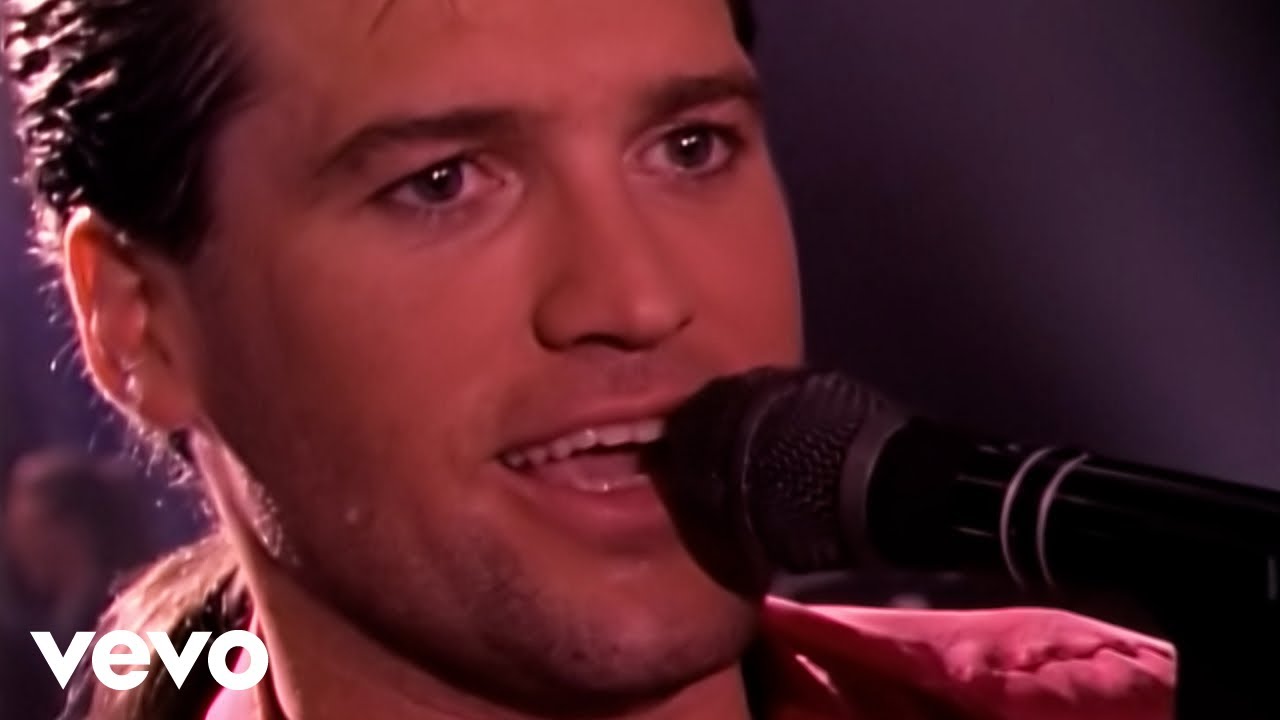
Marc Ball directed the video as a live performance at the Paramount Arts Center in Ashland, Kentucky, twenty minutes from the Flatwoods house where Cyrus grew up. What almost nobody knows is that it exists in two forms. The version serviced to country stations opens on an establishing shot of the theater and closes on extended applause. The version cut for MTV — the one on Cyrus’s own channel, and the one playing on this page — opens instead with Cyrus stepping out of a limousine, and trims the closing crowd noise. Same performance, two different films, built for two audiences that in 1992 still had almost nothing to do with each other.
The MTV version is the one that mattered, because the crowd in the footage is dancing in rows. Line dancing existed long before this record, in country bars and dance halls, and Nashville had been quietly building it for years. What the video did was put it on national television in front of people who had never set foot in a honky-tonk. Within months it was in wedding receptions, school gyms and shopping malls across the country, and the steps had a name most people learned from the screen rather than a dance floor.
The record went to No.1 on Hot Country Songs and stayed five weeks — the longest run at the top by a debut single since Henson Cargill’s Skip a Rope in 1967, and the last until Blake Shelton’s Austin in 2001. It crossed to No.4 on the Billboard Hot 100 and No.4 on Cash Box. Australia made it No.1 and the best-selling single of 1992, and it became the first single ever certified triple platinum there. New Zealand and Canada’s country chart both went to No.1. Britain, in the middle of a summer running on grunge and rave, sent it to No.3 after a Top of the Pops appearance and made it No.1 on airplay. The RIAA certified it platinum — the first country single to manage that since Kenny Rogers and Dolly Parton’s “Islands in the Stream” nine years earlier.
The most hated hit in America
Nashville’s traditionalists took it badly and made Cyrus the face of everything they disliked about the new commercial country. Reviewers piled on at the time and kept going for years afterward: VH1 and Blender later put it at No.2 on a list of the fifty most awesomely bad songs ever recorded, and Blender separately named it among the fifty worst songs of all time. The Orlando Sentinel complained that it stuck in the head like a commercial jingle. Rolling Stone, more usefully, described a record matching genuine breakup misery with total absurdity in a country tradition that has always sat a hair away from novelty.
The commercial answer arrived regardless. Some Gave All spent seventeen consecutive weeks at No.1 on the Billboard 200 — still the longest run by a debut artist and by a country artist — sold nine times platinum in America and more than twenty million worldwide, and stands as the best-selling debut album by a solo male artist. The single won Single of the Year at the CMA Awards and Favorite Country Single at the American Music Awards, and drew Grammy nominations for Record of the Year and Best Country Vocal Performance, Male, with a Best New Artist nomination for Cyrus alongside them.
Von Tress never wrote another hit on that scale, which is the ordinary fate of hobbyist songwriters who get one. Cyrus spent the next quarter-century being defined by three and a half minutes recorded in a month, until 2019, when he turned up on a remix of Lil Nas X’s “Old Town Road” and finally had a bigger record — nineteen weeks at No.1, twenty-seven years later. The song critics called the worst thing in country music was a cover, of a version that flopped, of a song two better-known acts had already refused. That is not a defense of it. It is just what happened.
SONG INFORMATION
Related videos
 Watch LaterAdded
04:53
Watch LaterAdded
04:53  Watch LaterAdded
04:22
Watch LaterAdded
04:22  Watch LaterAdded
04:29
Watch LaterAdded
04:29