






![The Score – Revolution: Lyrics [Assassins Creed: Unity]](https://musicvideosclub.com/wp-content/uploads/2025/10/the-score-revolution-lyrics-assa-360x203.jpg)


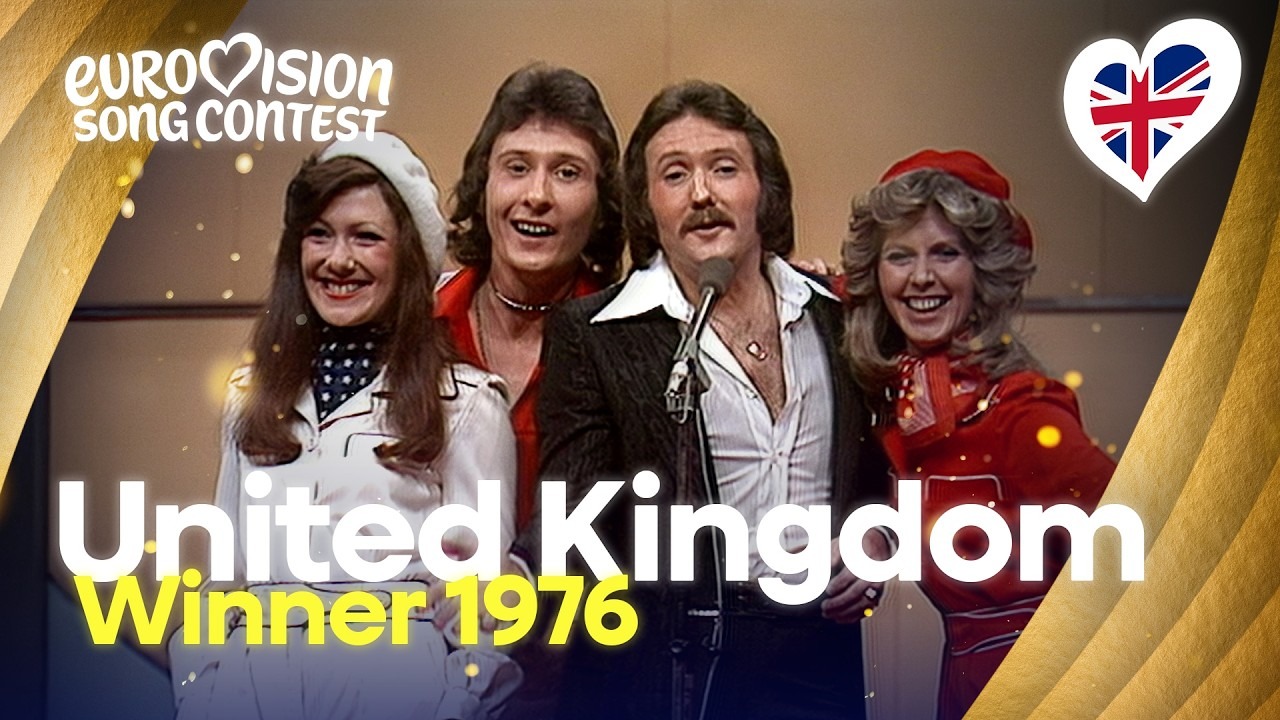
Brotherhood of Man – Save Your Kisses For Me
The Whole Song Sounds Like a Love Ballad — Until the Final Line Reveals He’s Singing to His Three-Year-Old
The footage on the Eurovision Song Contest YouTube channel captures the moment Brotherhood of Man went from a group with European promise to one of the biggest-selling acts of the 1970s. The date is 3 April 1976. The venue is the Nederlands Congresgebouw in The Hague, broadcast live to 33 countries. Brotherhood of Man have drawn the opening slot in the running order, performing first of eighteen entries — a position that had already produced the previous year’s winner and that, statistically, tends to work against the act that fills it. None of that will matter. By the time the voting closes, they will have received the maximum twelve points from seven countries and accumulated 164 of a possible 204 — 80.39% of the available total, the highest relative score achieved under the douze points voting system that had been introduced just the previous year and remains in use today.
The song they perform had existed, in one form or another, since August 1974. Lee Sheriden, one of the group’s two male members and a principal songwriter in the classic lineup alongside Martin Lee and manager-producer Tony Hiller, had brought an early version to a writing session where the others found the title clumsy. They reworked it into something called “Oceans of Love.” Sheriden disliked the changes and the song was shelved. A year later, with one more track needed for an album, he brought it back — and this time knew exactly what he wanted. The glockenspiel introduction was his idea. So were the 12-string acoustic guitar and the string arrangement. The song was recorded, and what had looked like a minor setback for a minor track became the most commercially successful Eurovision winner in the history of the contest.
A Song Already at Number One Before It Won Anything
By the time Brotherhood of Man walked onto the stage in The Hague, “Save Your Kisses for Me” had already been at number one in the United Kingdom for two weeks. Released as a single in March 1976 after winning the BBC’s A Song for Europe national final at the Royal Albert Hall, it had climbed to the top of the UK chart before Eurovision had even aired. The win in The Hague added an entirely new dimension to its commercial trajectory. Over the following weeks the song went to number one in France — where it stayed for five weeks — and across multiple other European markets, eventually selling over six million copies worldwide. In the UK it spent six weeks at number one, received BPI platinum certification in May 1976, and became the biggest-selling single of the year — and by some measures the sixth biggest-selling of the entire decade.
The performance seen in this footage is a precise document of exactly where the group stood. The choreography — simple, composed, built around small arm and leg movements rather than the elaborate stage productions that would become Eurovision convention in later decades — was devised by Guy Lutman. Martin Lee and Lee Sheriden perform in black and white suits; Nicky Stevens and Sandra Stevens wear white and red jumpsuits with matching berets. The orchestra, conducted by Alyn Ainsworth, plays live — this was still the era of required live orchestral accompaniment, with no backing tracks. The group had rehearsed the presentation carefully, believing from the outset that going first required something that would stick in the memory before any of the other seventeen acts had performed. Martin Lee later recalled the logic: “We were up first on stage, and thought we had to do something different, something people would remember.” The choreography was the answer.
The lyrical construction of “Save Your Kisses for Me” is a small but effective piece of misdirection. For most of its three minutes, it presents as a love song between two adults — a person who has to leave for work, reluctantly extracting themselves from someone they don’t want to say goodbye to. The final lines reveal that the “darling” being asked to save their kisses is the singer’s three-year-old child. Tony Hiller later described the emotional kernel of the song as “every three year old in the world who had a dad running off to work, and who kissed them goodbye.” The reveal lands gently rather than as a twist — the affection throughout the song is recognisably parental once you hear it — and it gives the record an emotional range that a straightforward love song would not have carried. It is, among other things, the reason the song has survived nearly five decades without sounding like it belongs to any particular era’s idea of romance.
SONG INFORMATION
Related videos
![Tina Charles – I Love To Love [Starparade]](https://musicvideosclub.com/wp-content/uploads/2026/03/tina-charles-i-love-to-love-star-360x203.jpg) Watch LaterAdded
Watch LaterAdded
 Watch LaterAdded
 Watch LaterAdded
03:31
Watch LaterAdded
03:31