







Conway Twitty – Hello Darlin’
Written In 1960, Stored In A Box For Nine Years
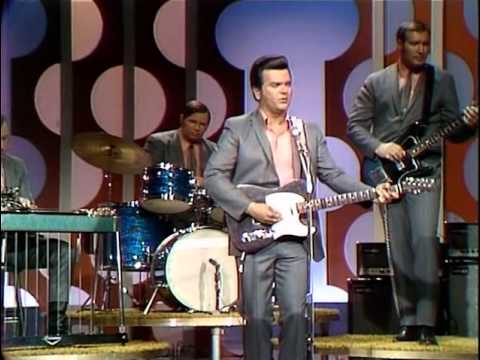
Released in March 1970, “Hello Darlin'” became Conway Twitty’s fourth number one on the Billboard Hot Country Singles chart, spending four weeks at the summit that summer and earning the distinction of being named Billboard’s number one country song of 1970. The track marked Twitty’s first country chart-topper of the seventies and established his signature sound for the remainder of his career, becoming his standard concert opener for the next two decades. What audiences hearing those instantly recognizable spoken words didn’t realize was that the song had been written a full decade earlier in 1960 when Twitty was still riding high on the rock and roll charts with “It’s Only Make Believe,” and had spent nine years gathering dust on a cassette tape in a storage box because there was no outlet for country songs from a rockabilly star during that era.
The single demonstrated remarkable staying power on the country charts through the summer of 1970, helping the Hello Darlin’ album reach number one on the Billboard Country Albums chart on October 3, where it stayed for multiple weeks. The song’s commercial performance cemented Twitty’s transformation from rock and roll singer to country superstar, proving he could compete with established Nashville artists despite initial skepticism from radio programmers who doubted a rockabilly veteran could authentically sing country. The track received nominations for CMA Single of the Year and Song of the Year for 1970, while Twitty earned nominations for Album of the Year and Male Vocalist of the Year, though he wouldn’t win his first CMA awards until 1972 when his duet partnership with Loretta Lynn began earning them consecutive Vocal Duo honors. The song earned a Grammy Hall of Fame Award in 1999, the same year Twitty was inducted into the Country Music Hall of Fame.
Conway Twitty wrote “Hello Darlin'” alone in 1960 during the height of his rock career, inspired by the country music he’d grown up listening to in Mississippi but had no professional outlet to record. Born Harold Lloyd Jenkins on September 1, 1933 in Friars Point, Mississippi, Twitty had transformed himself into a rock and roll star by adopting a stage name created by combining Conway, Arkansas and Twitty, Texas on a roadmap. After scoring his massive 1958 hit “It’s Only Make Believe,” which topped both the pop and R&B charts, Twitty continued writing country songs in private, recording rough demos on cassette tapes and dropping them into a large storage box because he had no way to get them heard. The songs sat there through the early sixties as Twitty pursued his rock career, waiting for the moment when he could fully embrace his country roots without commercial suicide.
In 1969, after shifting his focus entirely to country music with his first chart-topper “Next in Line” in 1968, Twitty retrieved the decade-old cassette from storage and played it for legendary producer Owen Bradley at his barn studio in Nashville. The song told the story of a man encountering an old flame years after their breakup, acknowledging she’s just as lovely as you used to be before admitting despite his bravado that he can’t sleep and cries all night until dawn, confessing his deep sorrow for mistakes that ended their relationship. Bradley immediately recognized the song’s potential but suggested a crucial change. Twitty had written the opening line to be sung, but Bradley convinced him to speak it instead: Hello darlin’, nice to see you. That spoken introduction became the hook that made the song instantly recognizable, transforming a good country ballad into an unforgettable classic. The result was pure seduction, Twitty’s deep baritone caressing those two words in a way that made predominantly female audiences swoon.
Recording took place in 1969 at Owen Bradley’s studio in Nashville, with Bradley producing and Twitty delivering one of the most emotionally resonant vocal performances of his career. The arrangement featured acoustic guitar, steel guitar pedal prominently in the mix, electric piano providing subtle texture, and Twitty’s distinctive vocals layered with backing harmonies. The production emphasized Twitty’s voice, allowing the lyrics and melody to carry the emotional weight without excessive instrumentation. The overall sound was warm and nostalgic, reflecting the song’s theme of lost love and lingering regret. The track clocked in at approximately two minutes fifty seconds, the perfect length for country radio in an era when three-minute songs were considered standard. Twitty sang with the smoke-and-sex-filled vocal delivery that became his trademark, making every word sound like a confession whispered in private.
The Hello Darlin’ album was released in 1970 on Decca Records, solidifying Twitty’s transition from his earlier rock persona to full-fledged country artist. The album’s tracklist also included his cover of “Blue Eyes Crying in the Rain,” years before Willie Nelson’s definitive version. By this point, Twitty had already achieved three number one country singles with “Next in Line” in 1968, “I Love You More Today” in 1969, and “To See My Angel Cry” also in 1969, proving his country credentials. The success of “Hello Darlin'” launched what would become an unprecedented run of commercial dominance. Over the next two decades, Twitty would rack up fifty-five number one country singles, a record that stood until George Strait surpassed it decades later. His partnership with Loretta Lynn beginning in 1971 produced a string of successful duets including “After the Fire Is Gone,” “Lead Me On,” and “Louisiana Woman, Mississippi Man.”
The song became deeply embedded in country music culture beyond its chart success. Twitty opened virtually every concert with “Hello Darlin’,” often singing it directly to Loretta Lynn during their joint performances, creating an intimate moment that audiences treasured. The song was covered extensively, with Loretta Lynn recording her own version on her 1971 Coal Miner’s Daughter album. George Jones covered it twice, first in 1972 and again in 1993 on his High Tech Redneck album as a tribute after Twitty’s death in June 1993. Other artists recording notable versions included Lynn Anderson, Bobby Bare, Wanda Jackson, Charley Pride, Charlie Rich, Lynn’s nineteen-year-old sister Crystal Gayle in 1971, and Scotty McCreery who performed it at the Grand Ole Opry in 2015. Brad Paisley delivered an emotional rendition in 2009 that reduced audiences to tears. Twitty’s son Michael continues performing the song while touring to keep his father’s legacy alive.
The song achieved unexpected international recognition on July 17, 1975 during the historic Apollo-Soyuz Test Project when American astronauts played a Russian-language version titled “Privet Radost” for Soviet cosmonauts as a gesture of goodwill. Twitty worked with a language professor from the University of Oklahoma to record the phonetic Russian version, which was released as a special edition single in 1975 though it didn’t chart. The track can be found on The Conway Twitty Collection box set. The song also appeared in popular culture through a clip from Twitty’s Hee Haw performance used at the end of the Family Guy episode Peter’s Daughter, and as the dance song for characters Tyra and Tim in the finale of Friday Night Lights. The track was featured in the 2021 film Paranormal Activity: Next of Kin, introducing it to yet another generation.
Conway Twitty succumbed to an abdominal aortic aneurysm on June 5, 1993 at age fifty-nine, collapsing on his tour bus en route to a performance in Branson, Missouri. His death shocked the country music community, with thousands attending memorial services. Four months later, George Jones released his tribute version of “Hello Darlin'” on High Tech Redneck, ensuring Twitty’s signature song continued resonating. In reflecting on the track’s enduring appeal, the simplicity stands out. No grand metaphors, no overcooked production, just one man telling a woman he never stopped loving her even when he pretended otherwise. Twitty didn’t just write a hit, he bottled a feeling that resonated across generations. The fact that a song written in 1960, stored in a box for nine years, emerged to become the number one country song of 1970 and remains instantly recognizable five decades later speaks to the timeless quality of both the composition and Twitty’s unforgettable performance. As fans still say when they hear that opening, it’s not just a song, it’s a moment frozen in time, and Conway Twitty made sure we’d never forget it.
SONG INFORMATION
Related videos
 03:04
03:04