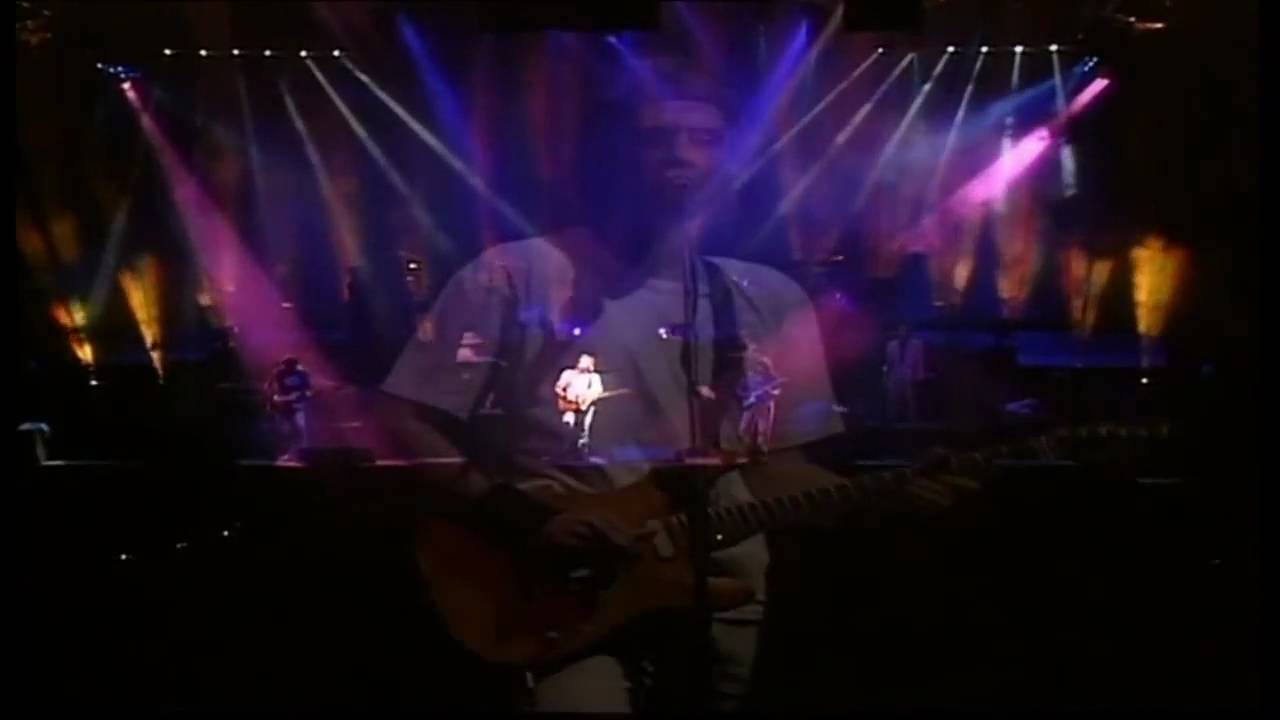
Dire Straits – Brothers In Arms (Live On the Night, 1993)
- LUD:
Mark Knopfler wrote it in 1982 as young men died in the South Atlantic — and it became the song played to carry soldiers to their graves.
It is the song that gets played when soldiers are buried. Brothers in Arms, the closing track on Dire Straits’ 1985 album of the same name, has become a fixture at military funerals across the English-speaking world — a slow, grieving farewell that seems to have been written for exactly that purpose. It wasn’t, quite. Mark Knopfler wrote it in 1982, as Britain and Argentina fought over the Falkland Islands and young men on both sides came home in coffins. He wasn’t after a slogan or a protest chant. He wrote from inside the head of a dying soldier, looking at the hills of a place he’d been sent to fight for, and finding no enemy there worth the cost.
By the time Dire Straits recorded it, Knopfler had spent three years letting the song settle. The band cut most of Brothers in Arms at AIR Studios on the Caribbean island of Montserrat, with additional work at the Power Station in New York, between late 1984 and early 1985. The title track was built on a slow six-eight pulse, warm synthesized pads, and a guitar tone unlike Knopfler’s usual bright, clipped attack. He reached for a Gibson Les Paul instead of his familiar Stratocaster-style guitars, and played with enormous restraint — long, aching notes left hanging in the air, a solo that says more by holding back than his earlier showpieces ever said by racing ahead. Producer Neil Dorfsman, who had engineered the band’s Love over Gold, helped shape a recording where the silence between the notes carries as much weight as the notes themselves.
The record that ushered in the CD age
The album around it was a phenomenon. Released in May 1985, Brothers in Arms became the first album in history to sell a million copies on compact disc, arriving at the precise moment the CD was replacing vinyl and giving a generation a reason to buy their first disc player. It spent weeks at number one in the United Kingdom, sold somewhere north of thirty million copies worldwide, and stands among the best-selling albums ever made. Its singles — Money for Nothing, with Sting’s falsetto hook, plus Walk of Life and So Far Away — dominated radio and the young MTV. The title track was released as a single in October 1985, late in the album’s run and never pushed hard in America, where the label preferred the upbeat songs. It didn’t need the push. It found its audience slowly and then kept it for decades.
What separated Brothers in Arms from the hits around it was its refusal to date. As the years passed, listeners attached it to conflicts far beyond the Falklands, and its plainspoken grief — the idea that the soldiers facing each other across a battlefield are, in the end, brothers who share the same fate — traveled easily from one war to the next. It became a standard at remembrance services and funerals, and it settled into rock radio as one of the most quietly devastating things the era produced.
A song that kept working
Knopfler never let it go, either. In 2007, on the twenty-fifth anniversary of the Falklands War, he returned to Abbey Road Studios and recorded a new version to raise money for British veterans still living with the psychological wounds of that conflict — men, as he put it, still suffering the effects of a war most of the country had filed away as history. It was a rare act of an artist reopening his most sacred song to serve the people it had been written about. Dire Straits were inducted into the Rock and Roll Hall of Fame in 2018, their catalog secure, but few of their records carry the weight this one does. Mark Knopfler, born on August 12, 1949, wrote a great many songs across his career. This is the one that people reach for when there are no words left — the sound of a man saying goodbye, gently, to someone who isn’t coming back.
SONG INFORMATION
Artist: Dire Straits
Song: “Brothers in Arms”
Album:Brothers in Arms
B-side: “Going Home (Live)”
Released: October 18, 1985 (single); album May 17, 1985
Recorded: November 1984 – February 1985
Studio: AIR Studios, Montserrat; Power Station, New York
Label: Vertigo (UK); Warner Bros. (US)
Songwriter(s): Mark Knopfler
Producer(s): Mark Knopfler, Neil Dorfsman
Length: 6:58 (full version)
Lineup: Mark Knopfler (guitar, vocals); John Illsley (bass); Guy Fletcher, Alan Clark (keyboards)
Chart Performance: Album Brothers in Arms No. 1 UK (9 weeks); 14× Platinum










![David Lee Roth – California Girls (Official Video) [HD]](https://musicvideosclub.com/wp-content/uploads/2026/10/david-lee-roth-california-girls-360x203.jpg)