It sat almost unnoticed on country radio for two months — then a single music video turned it into the most fiercely argued-over song in America and rocketed it to the first No. 1 of Jason Aldean’s career.
When Try That in a Small Town arrived on country radio on May 22, 2023, almost nobody outside Jason Aldean’s core audience noticed it. For two months it behaved like an ordinary mid-tier country single. Then, in mid-July, Aldean released the music video — and within days the song was the most ferociously debated record in the country, the subject of cable-news segments, celebrity feuds, and a national argument that has never entirely cooled. It became, improbably, the first No. 1 hit of a career that was already two decades old.
The song itself was written by Kelley Lovelace, Neil Thrasher, Tully Kennedy, and Kurt Allison, and produced by Aldean’s longtime collaborator Michael Knox. Its lyric draws a sharp line between city and small town: it catalogs urban disorder — carjackings, cussing out a cop, stomping on the flag — and warns that such behavior wouldn’t be tolerated “in a small town,” where, as Aldean sings, “we take care of our own.” A reference to a gun handed down from a grandfather sharpened the edge. As a piece of music it was a hard-charging, rock-leaning country track in the lane Aldean had worked for years; as a statement, it was about to become something far larger than the song.
Two quiet months, then a video lit the fuse
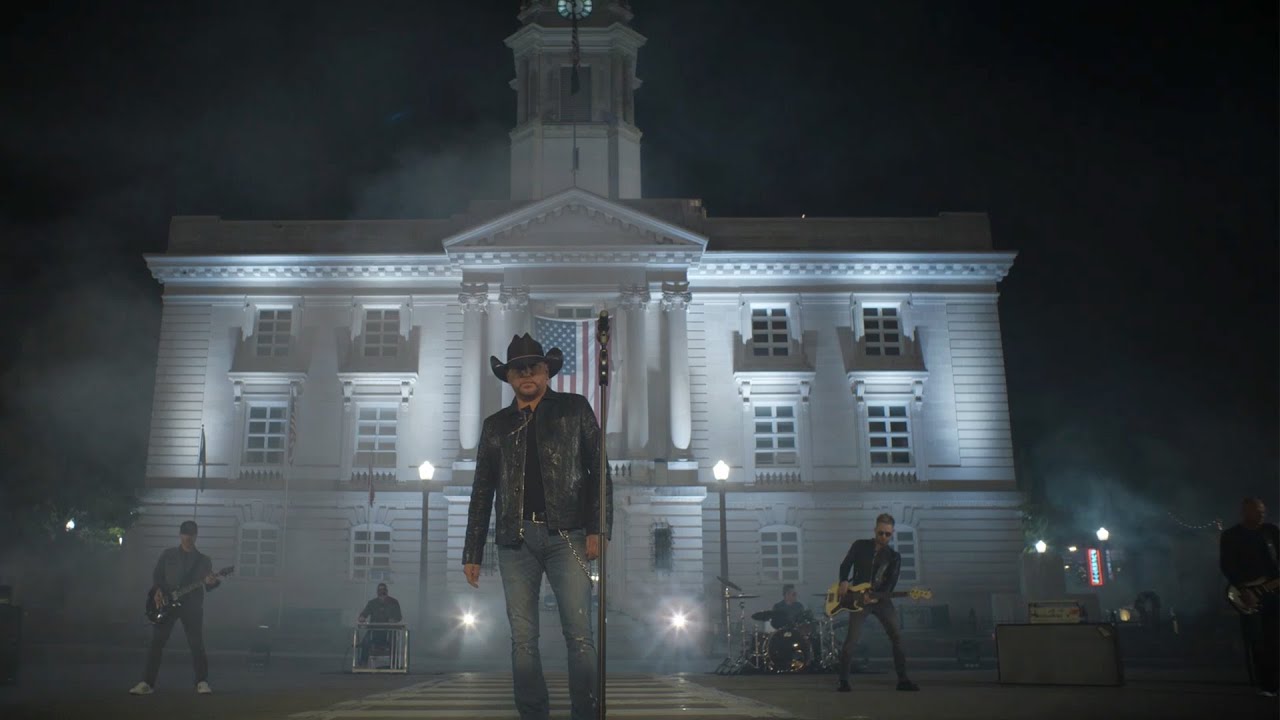
The flashpoint was the video. Released in July 2023, it projected news footage of protests, confrontations with police, and robberies onto the facade of a courthouse, intercut with Aldean and his band performing. Critics seized on both the imagery and the location: the building was the Maury County Courthouse in Columbia, Tennessee, the site of a 1927 lynching of a Black teenager and a 1946 race riot. Detractors — including the singer Sheryl Crow and a number of commentators and academics — argued the song and video amounted to a defense of vigilante violence and carried, in their reading, racist undertones and a “sundown town” subtext. Four days after the video premiered, the network CMT pulled it from rotation.
Aldean rejected the interpretation flatly. He said the song was about community solidarity and a reaction to what he called lawlessness and disrespect for police, and denied any racial intent, stating there was “not a single lyric” referencing race. He later said he had been unaware of the courthouse’s history when the location was chosen, and the official video was quietly edited to remove a clip of Black Lives Matter protest footage. Defenders, including the country singer Travis Tritt, framed the backlash as an overreach and characterized the song as simply expressing a point of view. The result was a clean split along familiar cultural and political lines, with each camp reading the same three minutes of music and footage in opposite ways.
The backlash that became a No. 1
Whatever else it did, the controversy sold records — spectacularly. In the week after CMT pulled the video, streams jumped more than 500 percent, and the single posted one of the biggest sales weeks for a country song in over a decade. It vaulted onto the Billboard Hot 100 and climbed to No. 1, the first chart-topping single of Aldean’s career, after nearly twenty years and dozens of country hits. It also reached the top of the country chart and went top ten in Canada. Industry observers noted the irony bluntly: the attempt to suppress the video had handed it the kind of promotion no marketing budget could buy.
More than two years on, Try That in a Small Town remains a cultural marker as much as a song — shorthand for a particular moment in America’s culture wars, and a case study in how outrage and algorithm can combine to turn a modest single into a phenomenon. Aldean, who has never hidden his conservative politics, weathered the storm and kept touring and recording. The debate over what the song “really means” has never been settled, and by now probably never will be — which, in its way, is exactly why it endures.
SONG INFORMATION
Artist: Jason Aldean
Song: “Try That in a Small Town”
Album:Highway Desperado
Released: May 22, 2023
Genre: Country, Country Rock
Label: BBR Music Group
Songwriters: Kelley Lovelace, Neil Thrasher, Tully Kennedy, Kurt Allison
Producer: Michael Knox
Length: 3:01
Chart Performance: No. 1 Billboard Hot 100 (Aldean’s first); No. 1 Hot Country Songs; No. 9 Canada
Filmed: Maury County Courthouse, Columbia, Tennessee