





Jethro Tull – Aqualung
His wife took a photograph of a homeless man on a London street, and the band’s best-known song came out of her feeling guilty about it.
The song began as a photograph. Jennie Franks, then married to Ian Anderson, had been taking pictures of homeless men around London, and one of them became the thing Anderson could not stop looking at. He has described what he felt looking at it as a mix of guilt, unease and a half-romantic notion of somebody living outside every arrangement the rest of us have agreed to. Franks wrote the first verse. Anderson wrote the rest, in a hotel room in Los Angeles, and took the credit jointly with her. It became the best-known song Jethro Tull ever recorded and it was never released as a single anywhere.
Keep watching: Jethro Tull – Thick as a Brick · Jethro Tull – Too Old to Rock’n’Roll
They cut it at Island Studios in London between December 1970 and February 1971, with Anderson and Terry Ellis producing, and it opens the album that carries its name, released on March 19, 1971. Anderson has spent fifty years denying that Aqualung is a concept album, with limited success. What is not in dispute is what it did commercially: it became the band’s first American top 10 record, reaching No.7 that June, and turned a British folk-rock group with a flautist into an arena act in a country that had barely noticed their first two albums.
The song itself is built on a structural joke that most rock bands would not have attempted. It opens on one of the heaviest guitar figures of the era, drops without warning into an acoustic middle passage that sounds like it belongs to a different record entirely, then climbs back out through a Martin Barre solo that regularly turns up on lists of the best ever played. Six and a half minutes, three distinct pieces, no chorus in the usual sense. It is the second most frequently performed song in the band’s history, behind only Locomotive Breath.
The show you watched on one machine and heard on another
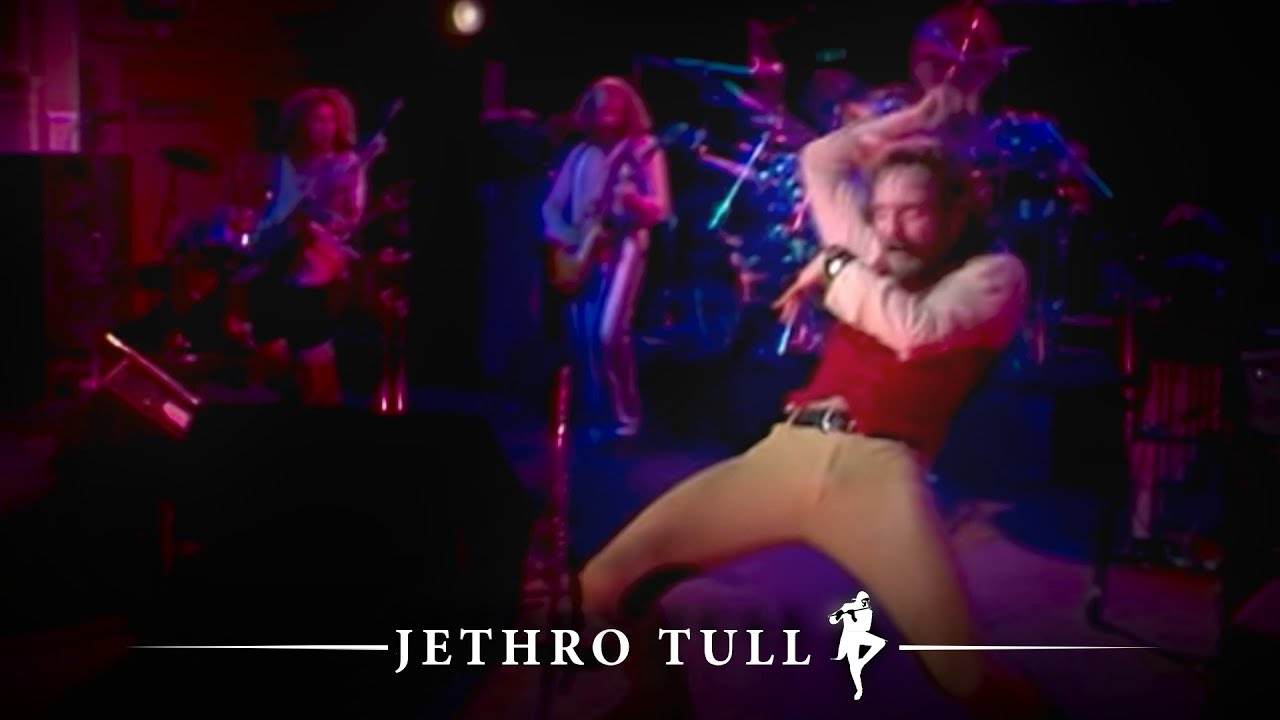
The band taped it at the Golders Green Hippodrome on February 10, 1977, with Songs from the Wood barely a week old and the British leg of the tour just starting — they played the Hammersmith Odeon the following night. The BBC took roughly sixty minutes of it and broadcast the result on February 19 at half past six as part of Sight and Sound in Concert, which was an odd and rather brilliant piece of engineering: British television sound in the seventies was mono and thin, so the pictures went out on BBC Two and the audio went out simultaneously on Radio 1 in stereo. Viewers who cared were expected to set up a television and a radio in the same room and run both. Bob Harris introduced it and explained the arrangement on air.
The set that night came mostly from the new record — Songs from the Wood, Velvet Green, Jack in the Green, Hunting Girl — with Thick as a Brick, Aqualung and Locomotive Breath carrying the weight of everything before it. Anderson was thirty and played directly to the cameras in a way that suggests he had worked out exactly what the format was for.
What survives is therefore a compromised document and a valuable one. The stereo half of the original broadcast went out over the air and was never married back to the picture, so what you hear now is not what the audience at home heard in 1977. The BBC nevertheless kept the tape, which is more than can be said for a great deal of British television from the same decade, and the footage is licensed from its archive rather than pulled from a bootleg.
The argument the song makes has not softened with age. Anderson wrote it out of discomfort at his own reaction to a man sleeping rough, and he never resolved the discomfort into a position — the song is not sympathetic exactly, and it is certainly not charitable, and the character in it is neither ennobled nor dismissed. That refusal to land anywhere comfortable is why it still works. Fifty-five years on, most rock songs written about poverty read as either condescending or naive. This one reads as honest, because its subject was never really the man in the photograph. It was the person looking at him.
SONG INFORMATION
Related videos
 Watch LaterAdded
03:46
 Watch LaterAdded
03:13
 Watch LaterAdded
04:41