



Queen – Bohemian Rhapsody
Queen built the middle of Bohemian Rhapsody from 180 overdubs, then walked off stage every night and let the tape sing it
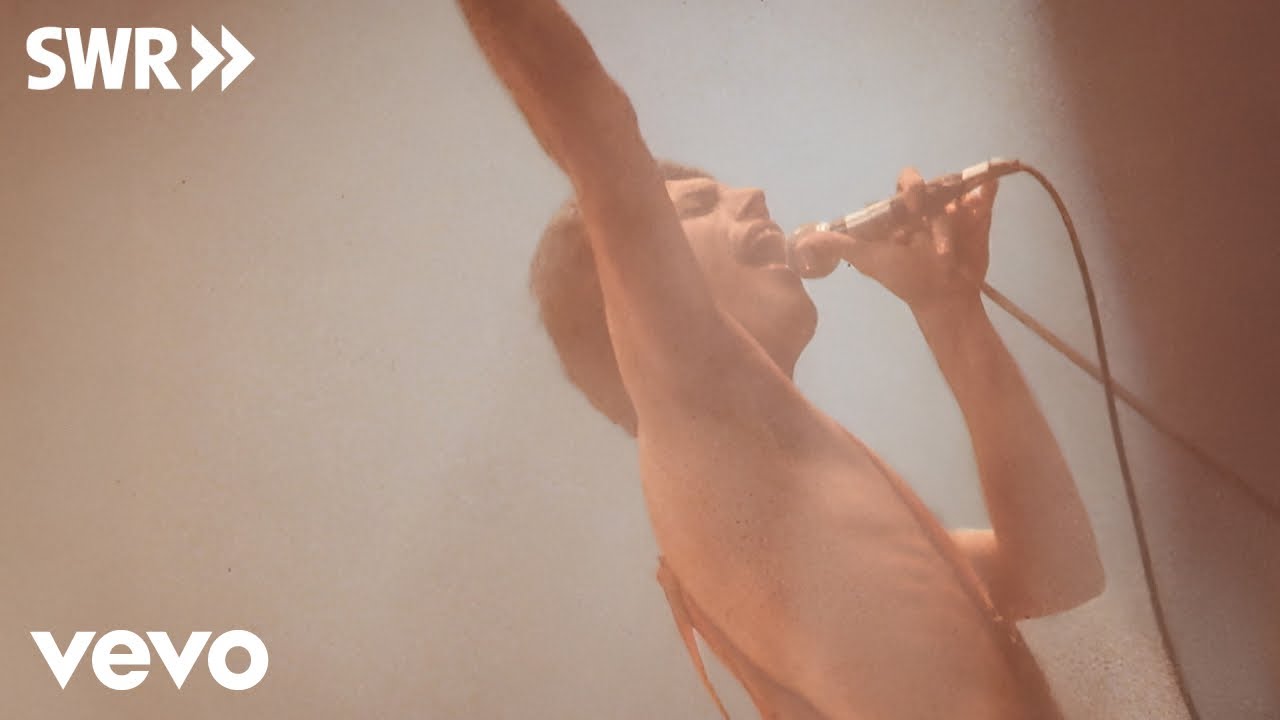
It took about three weeks and roughly 180 overdubs to build the operatic middle of “Bohemian Rhapsody.” Freddie Mercury, Brian May and Roger Taylor sang their parts for ten to twelve hours a day, bouncing them down through generation after generation of 24-track tape until May could hold a reel up to the light and see through it. No four people could reproduce that on a stage. By the time Queen reached Munich in February 1979 they had long since stopped trying. Their solution was to walk off and let the record play, the most candid moment in a Queen concert, and the one audiences waited for.
Keep watching: Queen – Now I’m Here (Munich 1979) · Queen – Don’t Stop Me Now
Mercury called the song a mock opera, and he built it by joining three pieces he had been carrying around for years. Recording began at Rockfield in Monmouthshire on August 24, 1975, and spread across four more studios in London. When it was finished, it ran five minutes and 55 seconds with no chorus, and EMI was alarmed. Mercury refused to cut it. Kenny Everett got hold of a reel-to-reel copy on the promise that he would not broadcast it, then played it on Capital Radio 14 times in two days. EMI released the single on October 31, 1975. It held No.1 in Britain for nine weeks, through Christmas and into the new year.
The problem in the middle
The opera section was a problem from the first tour. Queen had no break between tours in which to work out how to play it, so they broke the song apart. On the 1975 dates, the taped opera section opened the show, with Mercury briefly appearing to sing one line live in silhouette behind a white sheet. The band then came out for the hard rock section, played live, and the two ballad sections turned up later in a medley. It worked, but the song was in pieces.
From the A Day at the Races tour in 1977, Queen settled on the form they would keep until their last tour in 1986. Mercury played and sang the opening ballad at the piano. After May’s guitar solo, the lights went down, the four of them left the stage, and the opera section played from tape while the lighting rig followed the voices. A blast of pyrotechnics after Taylor’s top note announced their return, and they played the hard rock section and the closing ballad live. Nobody disguised the gap. The empty stage became a set piece in its own right.
Munich, February 1979
The European leg of the Jazz tour ran through January and February 1979, and Queen played two nights at Munich’s Rudi-Sedlmayer-Halle, on February 10 and 11. Recordings from that European run became Live Killers, the band’s first live album. Queen Official dates this performance February 11, the same night as the band’s “Now I’m Here,” and German television’s Musikbox broadcast it on March 9, 1979.
The five-part a cappella opening was another thing the stage could not hold, and on that tour Mercury often reached the song by another route. On Live Killers he leads into it with the single-voice opening of “Mustapha,” which one singer could manage. By 1979 the song was more than three years old and fixed at the heart of the set, the point where an arena full of people who knew every overdub sat through the one passage they knew Queen would not be playing.
Queen kept the method for the rest of Mercury’s life, and the tribute concert after his death used it again, with Elton John singing the opening ballad and Axl Rose taking the hard rock section after the tape. That staging tells you something the polished promo film never could. “Bohemian Rhapsody” is the most studio-bound single of its decade, a record made in a way that could not be repeated live, and Queen turned it into a concert staple by showing the seam rather than hiding it. Every night the band left the stage and let the record admit what it was, and every night the crowd treated the empty stage as the high point of the show.
SONG INFORMATION
Enjoyed this one? New forgotten gems every day — tap Music Videos Club below to visit and follow us on Facebook: