





![David Lee Roth – California Girls (Official Video) [HD]](https://musicvideosclub.com/wp-content/uploads/2026/10/david-lee-roth-california-girls-360x203.jpg)


Lee Greenwood – God Bless The U.S.A.
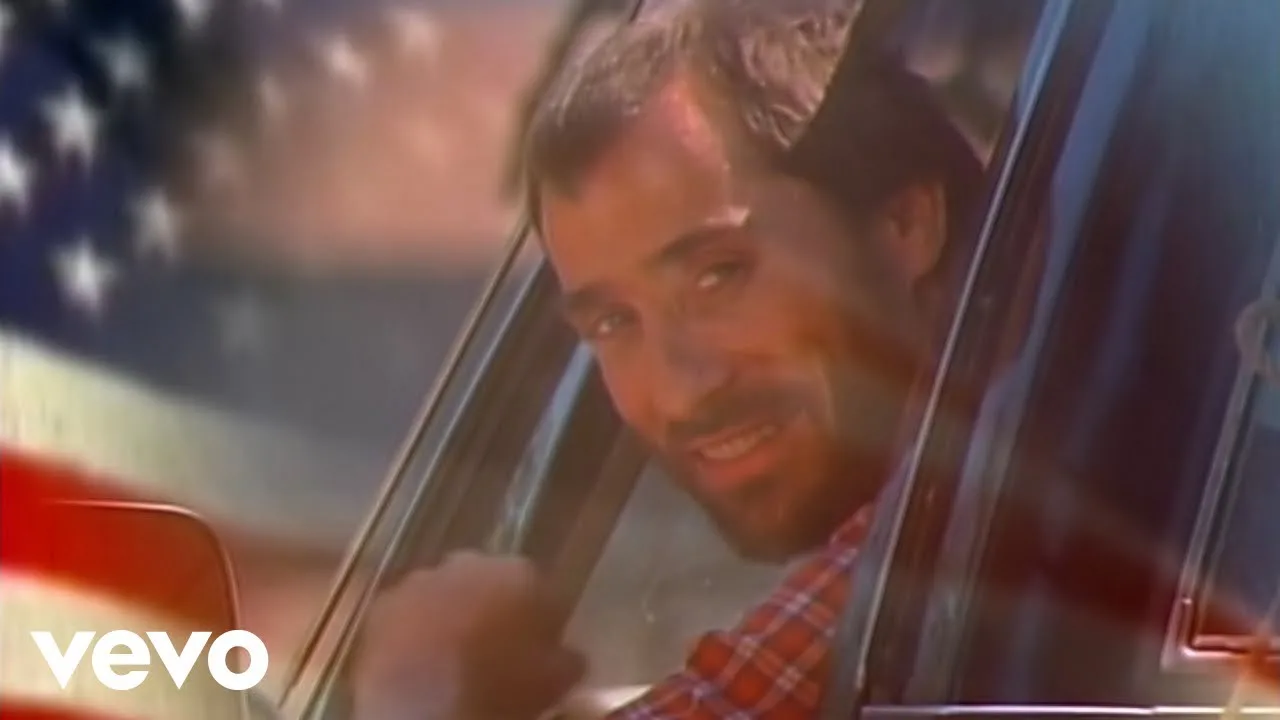
The most-sung patriotic song in modern America was born out of a tragedy in the sky — a passenger jet shot down with 269 people aboard — and it flopped short of the country Top 5 before it ever became the fixture it is today.
Everyone knows the chorus. Fewer know that God Bless the U.S.A. was not an overnight smash, and that the emotion behind it came from a specific horror: on September 1, 1983, a Soviet fighter shot down Korean Air Lines Flight 007 after it strayed into restricted airspace, killing all 269 people aboard. Lee Greenwood, a journeyman singer who had spent decades in Las Vegas lounges and on the road before Nashville ever noticed him, was moved by the tragedy and by the veterans he saw at his own concerts. He had wanted to write a song about America his whole life. This was the moment it finally came.
Keep watching: Toby Keith – Courtesy of the Red, White and Blue · more Country →
Greenwood always described the writing as something close to effortless — he later said the song “just about wrote itself,” the words flowing naturally out of the melody. He built it deliberately: he put God first, reflecting his own faith, and reached back to the John Philip Sousa marches he had played as a high-school drum major for the music’s rising, martial swell. One crucial piece of advice shaped its reach. A collaborator suggested he name specific corners of the country to make it feel like everyone’s song — and so came the famous roll call, “from the lakes of Minnesota to the hills of Tennessee,” Detroit down to Houston, New York to L.A. That geography is a big part of why the song belongs to the whole map rather than any one region.
The song the label almost didn’t release
His record company wasn’t sure what to do with it. When Greenwood brought God Bless the U.S.A. to MCA, executives hesitated over whether a flag-waving ballad could work as a radio single. Greenwood forced the issue by walking straight into the Los Angeles office of label chief Irving Azoff and playing it for him directly; Azoff liked it but was uncertain of its commercial chances, and promised only that Greenwood could record it for his next album. Released on May 21, 1984, as a single from his third album, You’ve Got a Good Love Comin’, and produced by Jerry Crutchfield, it was no instant phenomenon. It climbed to No. 7 on the Billboard Hot Country Songs chart and then faded, earning a Grammy nomination for Best Country Song but stalling short of the top of even the country chart.
What the song had was staying power that no chart could measure. Its first big political moment came almost immediately, when it was folded into a film about Ronald Reagan shown at the 1984 Republican National Convention. From there it became a recurring presence in American public life — sung at the 1988 convention, played endlessly during the 1991 Gulf War at parades and troop homecomings, adopted across decades by campaigns of both parties. Greenwood has often noted, with some weariness at the partisanship, that he has performed it for five different presidents, Republican and Democrat alike.
The song America returns to
Its most profound resurgence came after September 11, 2001. Greenwood sang God Bless the U.S.A. twice at Yankee Stadium that autumn — once at a memorial for the city’s firefighters, and again before Game 4 of the 2001 World Series — and the re-released single finally reached the Billboard Hot 100, peaking at No. 16, its highest pop showing ever, nearly two decades after it first appeared. The song has since been covered by artists as different as Beyoncé and Dolly Parton, sung on talent shows, and certified platinum. In an almost unbelievable postscript, it did not officially top any Billboard chart until July 2020 — 36 years after its release — when it reached No. 1 on the Digital Song Sales list.
Greenwood, still touring into his eighties, has spent a career watching audiences rise to their feet when those opening lines begin. He has been candid that the song’s political uses can cut against its meaning; what he set out to write was something unifying, born from grief over a plane full of the dead and gratitude for the freedom he sings about. Whatever a listener brings to it, the core has never changed: a man imagining losing everything he owns and declaring he would still choose to start over, right here, because at least he knows he’s free.
SONG INFORMATION
Related videos
 Watch LaterAdded
04:41
Watch LaterAdded
04:41  Watch LaterAdded
04:50
Watch LaterAdded
04:50  Watch LaterAdded
04:30
Watch LaterAdded
04:30