




Motörhead – Killed By Death
The Label Wanted to Bury Them. Lemmy Had Other Ideas.
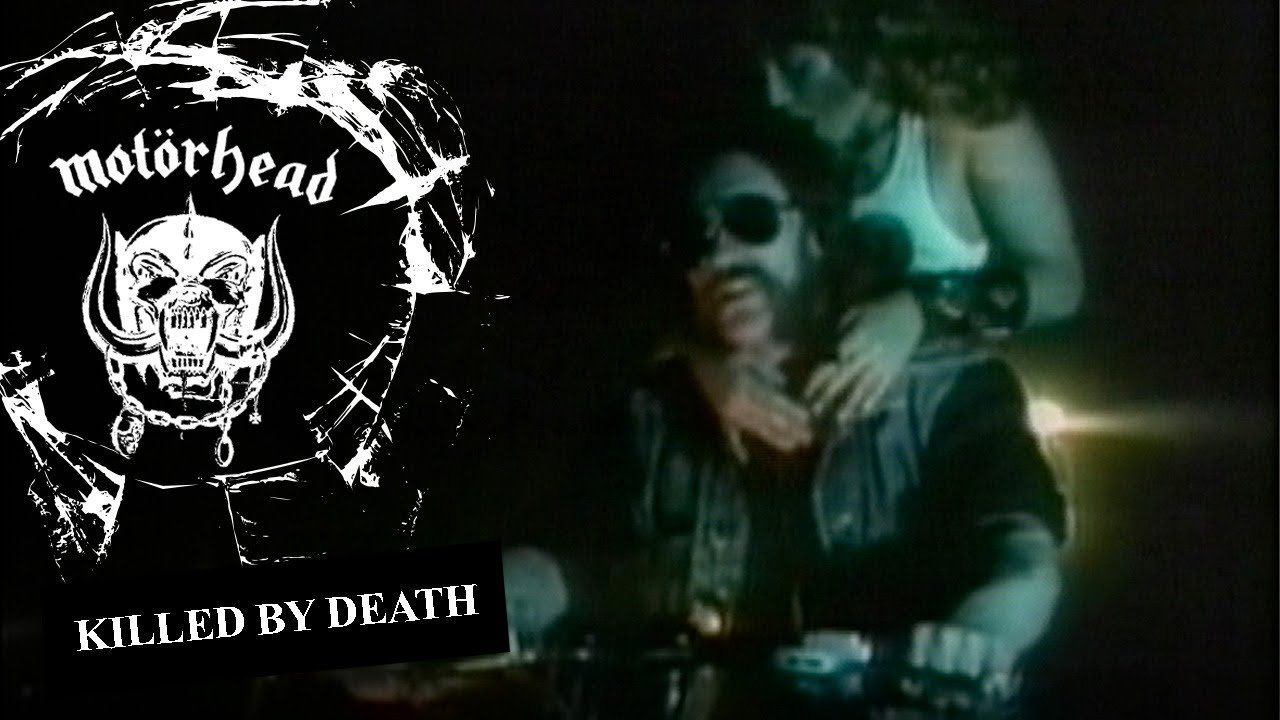
When Bronze Records decided that Motörhead’s new lineup wasn’t worth investing in, their plan was simple: release a greatest hits package, cash out the back catalog, and quietly close the chapter. What they had not fully accounted for was Lemmy Kilmister. When he found out what the label had in mind, he seized control of the project — chose the tracks, wrote the sleeve notes, and flatly insisted the band record four brand new songs specifically to prove the label wrong. One of those songs was “Killed by Death,” and it became the most enduring thing Motörhead ever put their name to. The label released the compilation to bury the band. Lemmy turned it into a calling card that would still be rattling amplifiers four decades later.
Released as a single on September 1, 1984, “Killed by Death” peaked at Number 51 on the UK Singles Chart — a figure that disappointed Lemmy so visibly that he began making sardonic jokes about it from the stage at almost every show afterward, for years. The parent compilation, No Remorse, fared considerably better, reaching Number 14 on the UK Albums Chart and going silver. The label’s US arm pressed a 12-inch promo for radio play, and it became one of the rarest Motörhead releases in existence. Bronze also issued a limited shaped picture disc version — and a pressing error on some copies meant buyers who cracked the shrink wrap were greeted not by Lemmy but by a King Kurt track called “Banana Banana.” The band had lost control of almost nothing in the making of this song. The pressing plant managed it in the end.
The genesis of “Killed by Death” was a band fighting on two fronts simultaneously. On one side, Bronze Records — the label that had signed them in 1977 and released everything from Overkill to Ace of Spades — had decided the reconstituted lineup of Lemmy, Phil Campbell, Michael “Würzel” Burston, and new drummer Pete Gill was not worth the investment. On the other, Lemmy was dealing with the cumulative fallout of two departures: guitarist “Fast” Eddie Clarke, who had left during the difficult 1982 sessions that produced a cover of “Stand by Your Man” with Wendy O. Williams, and the subsequent exit of original drummer Phil “Philthy Animal” Taylor. Lemmy’s assessment of Clarke’s departure was characteristically blunt: “He was always leaving anyway, Eddie — every two months — so this time we just got fed up with it.” The lyric he wrote for the new song — menacing, absurdist, loaded with the same serpentine double entendres that had threaded through Ace of Spades — read partly as a statement of survival. In retrospect, it was a manifesto.
The sessions ran from May 19 to 25, 1984 at Britannia Row Studios in London — the facility Pink Floyd had built and used for Animals and The Wall. Produced by Vic Maile and Guy Bidmead, the recordings captured the four-piece Motörhead at a pace and ferocity that was designed, in Lemmy’s own framing, to remind everyone of what the band actually was. Maile, who had engineered Ace of Spades, knew exactly how to capture that sound without sanitizing it. The full-length version ran to four minutes and thirty-nine seconds. The 7-inch single was edited to three-fifty. Both versions are essentially the same freight train at slightly different lengths. The music video, directed by Rod Swenson — manager of the Plasmatics — was banned by MTV for what the channel described as excessive and senseless violence, which, given that this was 1984 MTV, was an almost impressive distinction to earn.
No Remorse was both an ending and a reset. It closed Motörhead’s nine-year relationship with Bronze Records — a relationship that concluded in a two-year court case, during which the label banned the band from recording studios entirely. The four new songs it contained, including “Killed by Death,” were the first recordings to feature the expanded lineup that would carry Motörhead through to 1995 and define the band’s middle era. Lemmy had spent those May sessions acutely aware that the label regarded this as a farewell. He used it as a foundation. When Motörhead signed with GWR Records and returned to making studio albums with Orgasmatron in 1986, the momentum built on those four new No Remorse recordings — and the commercial exposure of the No Remorse tour, including a ferocious live performance on Channel 4’s The Tube in October 1984 — was a significant part of why the new chapter worked.
What “Killed by Death” became in the decades that followed is the real story. It logged over 1,200 documented live performances — the fourth most-played song in the band’s catalog. Loudwire ranked it second in their all-time Motörhead top ten. It appeared in the video game Scarface: The World Is Yours, served as the soundtrack to Hell in the British comedy-drama Heist, and was covered by Beast in Black, Crucified Barbara, and Paragon. Phil Campbell still performs it with the Bastard Sons, and it closed their 2023 live album. The lyric from the first verse was used as an epigraph in a 1993 novel. A re-recorded version exists in the Rock Band Metal Track Pack. The song that flopped at Number 51 turned out to have infinite half-lives.
Lemmy died on December 28, 2015, four days after his 70th birthday and eleven days after being diagnosed with an aggressive cancer. He told Ozzy Osbourne near the end: “I could have lived a lot longer and taken care of myself, but I lived my life the way I want to live and I ain’t got no regrets.” The title of his most beloved song appeared in virtually every obituary written. It was not ironic. It was fitting — a man who built an identity around confronting mortality without flinching, leaving behind a song called “Killed by Death” that sounds, every time it starts up, like it will never stop.
SONG INFORMATION
Related videos
 Watch LaterAdded
03:37
Watch LaterAdded
03:37  Watch LaterAdded
04:38
Watch LaterAdded
04:38  Watch LaterAdded
07:00
Watch LaterAdded
07:00