


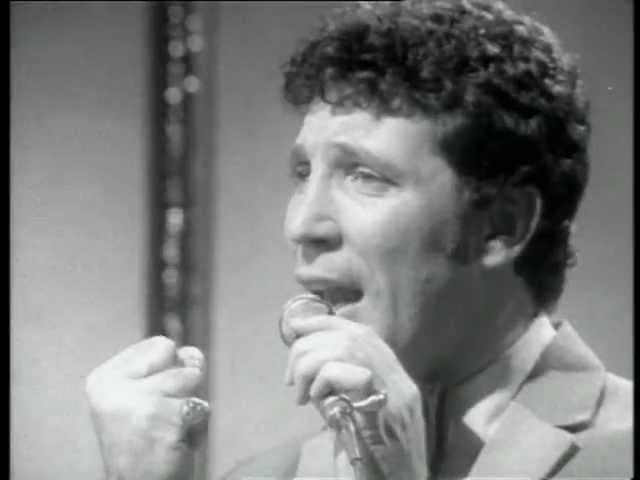









Tom Jones – Delilah
A jaunty, flamenco-flecked singalong that is, on close listen, a confession of murder — and more than half a century later it would get a Welsh singer’s most beloved terrace song thrown off the rugby stadium playlist.
It is one of the strangest hits in the British pop canon: a bright, hand-clapping, flamenco-tinged singalong that millions have bellowed in pubs and stadiums, and which is, if you actually listen to the words, a first-person account of a man stabbing his lover to death. Delilah hides its darkness in plain sight, wrapped in one of the most irresistible melodies of the 1960s and delivered with full-throated relish by Tom Jones. That tension — between the joy of the tune and the horror of the story — is the whole reason the song has never stopped causing arguments.
Keep watching: Tom Jones & Janis Joplin – Raise Your Hand (1969) · explore more Tom Jones →
For all that Jones owns the song, he did not write a note of it — he rarely did. Delilah came from the English songwriting team of composer Les Reed and lyricist Barry Mason, who between them supplied hits to half the singers in Britain. Reed had the idea of writing a modern Samson-and-Delilah story and came up with the title; Mason later said he was inspired partly by Frankie Laine’s old hit Jezebel and by a girl he had met as a teenager on holiday in Blackpool. There is a long-running dispute over the credit, too: Mason’s then-wife, Sylvan, has maintained for decades — backed by divorce-court records — that she co-wrote the lyric, a claim Jones himself has acknowledged in his memoir. Whoever held the pen, the song won the 1968 Ivor Novello Award for Best Song Musically and Lyrically.
A line the censors couldn’t stomach
Jones recorded Delilah at Decca’s London studio on December 20, 1967, with producer Peter Sullivan, set to a dramatic, big-band arrangement built around a Spanish-flavored sweep. Released in February 1968 with “Smile” on the B-side, it reached No. 2 on the UK chart — held off the top by The Beatles’ “Lady Madonna” and then Cliff Richard’s “Congratulations” — and climbed to No. 15 in the United States, his best American showing since “Green, Green Grass of Home.” When Jones performed it on American television in 1968, network censors objected not to the killing but to a single suggestive line implying the other man had spent the night, and pushed for a change. Jones refused, later dismissing the demand in blunt terms. The murder, apparently, was fine; the implied infidelity was the problem.
The song’s secret was always how completely the music disguised the words. Set in a minor key but propelled by that bouncing, almost celebratory rhythm, Delilah invites a crowd to sing along long before anyone stops to parse the confession at its center. That quality made it a natural for mass singing — and turned it, over the following decades, into something its writers could never have predicted.
From cabaret to the terraces — and back off them
In Wales, Delilah became a fixture of the rugby terraces, roared by tens of thousands of fans at international matches and treated as an unofficial badge of Welsh identity, alongside Jones’s “Green, Green Grass of Home.” Jones embraced the association, saying it made him proud to be Welsh. But the lyric’s subject matter eventually caught up with it. The song was quietly dropped from the Principality Stadium’s half-time playlist in 2015, and in February 2023 the Welsh Rugby Union formally barred choirs from performing it at internationals, calling it “problematic” given its depiction of a woman’s murder — a decision that landed in the same week the WRU was engulfed by allegations of a toxic internal culture. The ban split opinion sharply, and Jones, then 83, responded from a Cardiff Castle stage that summer with defiance: the choir might be stopped, he told the crowd, but the fans never would be.
That a 1968 pop single could still be making national headlines in the 2020s says everything about its strange staying power. Delilah has been recorded by Connie Francis, Jerry Lee Lewis, The Platters, and others, and given a hard-rock charge by The Sensational Alex Harvey Band, whose 1975 version also reached the UK top 10. But it remains, indelibly, Tom Jones’s — a song whose gleeful surface and grim heart have kept audiences singing, and arguing, for well over fifty years.
SONG INFORMATION