



![Rod Stewart – Da Ya Think Im Sexy? (Official Video) [HD Remaster]](https://musicvideosclub.com/wp-content/uploads/2025/02/rod-stewart-da-ya-think-im-sexy-360x203.jpg)
![Van Halen – Eruption (Live at the Tokyo Dome 2013) [PROSHOT]](https://musicvideosclub.com/wp-content/uploads/2026/01/van-halen-eruption-live-at-the-t-360x203.jpg)
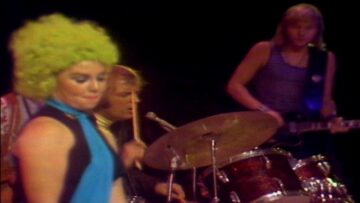
Tracey Ullman – They Don’t Know
That High Note Isn’t Ullman—It’s The Original Singer Taking It Back
Released on September 9, 1983, in the UK and rushed to American release in early 1984, “They Don’t Know” peaked at number two on the UK Singles Chart and number eight on the Billboard Hot 100, becoming Tracey Ullman’s biggest hit and her only American Top 40 single. The song spent 11 weeks on the Hot 100, reaching its peak for two consecutive weeks in March 1984, and climbed to number 11 on the Adult Contemporary chart. It topped the Irish Singles Chart for two weeks and spent an astonishing nine weeks at number one in Norway, while reaching number 23 on Billboard’s year-end chart for UK singles in 1983. The track propelled Ullman’s debut album You Broke My Heart in 17 Places to number 14 in the UK and number 34 in America. What stunned listeners who paid close attention was the piercing high note on the word baby before the final verse—that wasn’t Ullman singing at all, but Kirsty MacColl, who’d written and recorded the original in 1979, stepping back into her own song because Ullman couldn’t hit the note. MacColl confirmed in 2021 on BBC’s Desert Island Discs that her voice appears throughout Ullman’s version on backing vocals.
While “They Don’t Know” peaked at number two in the UK, blocked from the top spot by Culture Club’s “Karma Chameleon,” it became the number 23 single of 1983 according to year-end tallies. Smash Hits magazine readers voted it the fourth best single of 1983 and named Ullman Best Female Singer, while the comical music video finished second only to Duran Duran’s “Union of the Snake” in the magazine’s video poll. MTV cofounder Robert Pittman saw the video and invited Ullman to be a guest MTV VJ for the week of February 13–18, 1984, despite having zero American exposure. The resultant positive response caused MCA Records to rush-release the single in the United States, where it eventually reached number eight. The song became the theme for the final three seasons of Ullman’s HBO series Tracey Takes On… from 1997 onward. Ullman later reflected in a 2017 Guardian interview that if she could edit her past, she would have stopped making records after this song, acknowledging it was the peak she’d never match.
Kirsty MacColl wrote “They Don’t Know” at age 16 in 1976, though she didn’t record it until 1979. She’d been performing with an R&B band called Drug Addix when Stiff Records expressed interest in her as a solo artist, rejecting the band entirely. When Stiff asked if she had any songs, MacColl panicked and claimed she had loads despite having none written. She rushed home and composed “They Don’t Know” specifically for that meeting, drawing inspiration from 1960s girl group records she’d grown up loving. MacColl’s version was released as a single on June 1, 1979, and reached number two on the Music Week airplay chart, sandwiched between Wings and ABBA. Despite massive radio play, a strike at Stiff Records’ distributor prevented enough copies from reaching stores to chart on the official UK Singles Chart, which was based entirely on sales. MacColl’s original became one of British pop’s great what-if stories—a massive airplay hit that never received commercial recognition because of labor disputes beyond anyone’s control.
Recording sessions for Ullman’s version took place in 1983 with producer Peter Collins, who’d been working with Stiff Records through Loose End Productions alongside Pete Waterman. Waterman suggested to MacColl that she pitch her song to Ullman, who’d recently scored a number four UK hit with her debut single “Breakaway.” MacColl agreed, recognizing an opportunity to finally see her composition chart properly. Collins built the arrangement around layers of synthesizers, creating what engineer Phil Chapman called everything plus three kitchen sinks, though somehow it all congealed into a wonderful solid whole. The production emphasized the retro 1960s girl group sound even more than MacColl’s stripped-down original, adding Phil Spector-style wall-of-sound production techniques. Ullman sang with her limited but capable voice, perfectly capturing the innocent yearning MacColl had written into the lyrics. The song was pitched up a semitone from MacColl’s original key, giving it slightly brighter energy. MacColl re-sang the backing vocals and harmonies, making subtle changes to the last verse arrangements, but neither she nor Ullman could replicate that soaring bay-ay-be-ee, so they pitched up MacColl’s original recording and flew it into Ullman’s version.
You Broke My Heart in 17 Places arrived in 1983 via Stiff Records in the UK and MCA Records in America, featuring covers recorded in a deliberate 1960s girl group aesthetic. Beyond “They Don’t Know,” standout tracks included “Breakaway,” originally written by Jackie DeShannon and Sharon Sheeley and first recorded by Irma Thomas in 1964, the Dells’ “Oh What a Night,” Doris Day’s “Move Over Darling,” Marcie Blaine’s “Bobby’s Girl,” Blondie’s “(I’m Always Touched by Your) Presence, Dear,” and Dusty Springfield’s “I Close My Eyes and Count to Ten.” The UK B-side featured a bizarre spoken-word piece called “The B Side,” where Ullman performed various comic monologues complaining about the uselessness of B-sides, reviving a questionable 1960s practice of putting unlistenable novelty tracks on flip sides. American pressings replaced this with “You Broke My Heart in 17 Places.” The follow-up single “Move Over Darling” reached number eight in the UK, while “My Guy,” a gender-swapped cover of Madness’ “My Girl” featuring Labour leader Neil Kinnock in the video, peaked at number 23.
The music video became legendary for its Paul McCartney cameo. Ullman had just finished filming a role in McCartney’s movie Give My Regards to Broad Street, and McCartney agreed to appear in her video, playing a character named Paul who drives a car with Ullman in the passenger seat. The clip featured Ullman in various 1960s-inspired scenarios, perfectly capturing the song’s retro aesthetic. Director Dave Robinson, who was also Stiff Records boss, crafted a comical narrative that showcased Ullman’s comedy chops alongside her singing. MTV played the video constantly throughout 1984, introducing American audiences to Ullman’s talents before The Tracey Ullman Show debuted on Fox in 1987. That variety show became famous for launching The Simpsons, which started as animated shorts between Ullman’s sketches before spinning off into its own series in 1989. Ullman later starred in HBO’s Tracey Takes On… and appeared in films including Plenty, I Love You to Death, Robin Hood: Men in Tights, Bullets Over Broadway, and Small Time Crooks.
Kirsty MacColl continued her career as both solo artist and session vocalist, providing vocals on tracks for numerous artists and scoring her own hits including “A New England,” produced by Billy Bragg, and the Pogues duet “Fairytale of New York,” which became a perennial Christmas classic. Her father was folk legend Ewan MacColl, who wrote Roberta Flack’s “The First Time Ever I Saw Your Face.” On December 18, 2000, Kirsty MacColl died tragically at age 41 after being struck by a speedboat while diving in Cozumel, Mexico. The boat was owned by Mexican millionaire Guillermo González Nova, whose employee took responsibility for the accident in a controversial plea deal that many believed was arranged to protect González Nova’s sons. MacColl later said she didn’t mind Ullman having the hit version, noting it gave her reflected glory and that quite a few people heard her original when it reached number two on the airplay charts between Wings and ABBA. Leslie Carter recorded a version for her cancelled 2001 album Like Wow!, while Katrina Leskanich of Katrina and the Waves recorded an acoustic version in 2006, later remixed by Sleaze Sisters in 2008.
Tracey Ullman’s recording career lasted just two albums before she focused entirely on acting and comedy, where her talents proved far more enduring than her brief pop stardom. “They Don’t Know” remains her lasting musical legacy, a perfect slice of retro-pop confection that captured the innocence of 1960s girl groups filtered through 1980s production sensibilities. As Ken Tucker wrote in The Philadelphia Inquirer, Ullman’s rendition made the song palatable to American audiences by replacing MacColl’s fervent intensity with bouncy cheerfulness and layers of synthesizers. The song’s chart success vindicated MacColl’s songwriting genius while proving that sometimes the right combination of performer, production, and timing can transform a failed single into a transatlantic hit. MacColl’s piercing bay-ay-be-ee remains embedded in Ullman’s version, a ghostly reminder that the original writer never truly left her creation, even when someone else took it to heights she’d been denied by circumstance and labor disputes beyond her control.
SONG INFORMATION
Related videos
 Watch LaterAdded
02:43
Watch LaterAdded
02:43  Watch LaterAdded
 Watch LaterAdded
03:37
Watch LaterAdded
03:37