






Kid Rock – Til You Can’t
Kid Rock Wrote One New Verse to Cody Johnson’s 2021 Grammy-Winning Ballad, Debuted It at the Turning Point USA Halftime Show on Super Bowl Night 2026, and Released the Personal Music Video on May 13, 2026.
The music video Kid Rock released to his official YouTube channel on Wednesday, May 13, 2026 is, at its core, a video about one verse. The verse is fifty-seven words long. Robert James Ritchie — fifty-five years old, six studio albums beyond his 1998 commercial breakthrough Devil Without a Cause, sixteen years into the country-leaning second half of his recording career — wrote it himself. He has said in interviews, including with the conservative news outlet Whiskey Riff and on the stage of Turning Point USA’s All-American Halftime Show on Super Bowl Sunday, February 8, 2026, that the verse came to him one Sunday morning, alone in his Detroit-area home, weeks after Charlie Kirk — the founder of Turning Point USA — was assassinated at Utah Valley University in September 2025. Kid Rock has called the source of the verse “someone or something,” and he has been clear in his public framing that the writing process felt to him like a Christian-spiritual experience rather than a creative one. The verse is built around a direct evangelical call: a book sitting in your house somewhere, a man who died for all our sins hanging from the cross, a life given to Jesus, a second chance. The phrase he uses to close it — “‘Til you can’t” — anchors it to the song he is adding it to. That song is not his.
‘Til You Can’t was written by two Nashville songwriters, Ben Stennis and Matt Rogers, in 2021. It was recorded by the Texas country singer Cody Johnson under the production direction of Trent Willmon at Johnson’s home studio set-up that year, and released by Warner Music Nashville on October 18, 2021, as the lead single from Johnson’s eighth studio album, Human: The Double Album. The song is a carpe-diem lyric structured as a list of small things the narrator could do today and might not be able to do tomorrow — fishing trips with his father, telephone calls with his mother, dances with the woman he loves. It was a slow-build country radio record. It reached number one on Billboard’s Hot Country Songs chart and number one on Country Airplay in 2022, won Single of the Year and Music Video of the Year at the 2022 Country Music Association Awards, took the 2023 Grammy for Best Country Song (with Stennis and Rogers collecting the songwriting award), and was certified six-times platinum by the RIAA. Johnson’s original recording is, by every measure of country-radio achievement, one of the most successful singles of the early twenty-twenties.
The Verse, the Halftime Show, and the Decision to Cover
Kid Rock first performed his version of the song on stage at the Hondo Rodeo Fest in Arizona in November 2025, when he was filling in last-minute for Cody Johnson — who had a burst eardrum and could not play his scheduled headline slot. By the time he stepped onto the stage of the Turning Point USA All-American Halftime Show three months later, on the evening of Super Bowl LX — counter-programming the Bad Bunny halftime performance that was running concurrently on the NFL broadcast — he had decided to make the cover an official release. The Halftime Show set opened with his 1999 rap-rock hit Bawitdaba. Then the lighting changed. Kid Rock reintroduced himself to the audience by his birth name, Robert Ritchie. He explained that the song he was about to perform was, in his estimation, “one of the greatest written songs that I’ve heard in a long time.” Then he played it. The version he played included his own added verse, the one about the Bible and the cross and the second chance — placed as the song’s final verse, after the closing original chorus, just before the song’s final phrase. By midnight that night — a little over four hours after he left the stage — Kid Rock released the studio recording of the cover, with the new verse, on his own Top Dog Records imprint through DistroKid. By Monday afternoon, February 9, 2026, the single was at number one on the all-genre iTunes chart, ahead of Bad Bunny — a position the iTunes chart measures by paid-download share over a rolling forty-eight-hour window, not by streaming, but still a meaningful real-time snapshot of what people were paying for. The Whiskey Riff country-music news site posted Cody Johnson’s tweet within hours: “A big thank you to @codyjohnson and the songwriters Ben Stennis and Matt Rogers for giving me their blessing.”
The studio recording itself runs five minutes — over a minute longer than Cody Johnson’s original — and is built around a slowed-down arrangement that pulls the song’s tempo down to roughly seventy beats per minute, replaces Trent Willmon’s steel-guitar-and-acoustic country production with an orchestral and gospel-coloured arrangement on piano and strings, and routes Kid Rock’s vocal closer to a country-soul ballad delivery than to the rap-rock vocal styles that defined his earlier catalogue. The recording is self-produced — as Kid Rock has self-produced every one of his albums since 1998 except two — and features the working members of his Twisted Brown Trucker Band: drummer Stefanie Eulinberg (with him since 1996), guitarist Marlon Young, and bassist Aaron Julison among the session credits. The cover reached number one on Billboard’s Hot Christian Songs chart in late February 2026, peaked at number fourteen on the Hot Country Songs chart, and reached number nine on the Hot Rock & Alternative Songs chart — a cross-format performance that traced the song through three of Billboard’s genre-specific summits in a way the Cody Johnson original had not done.
The Video, the Family, and the Stool
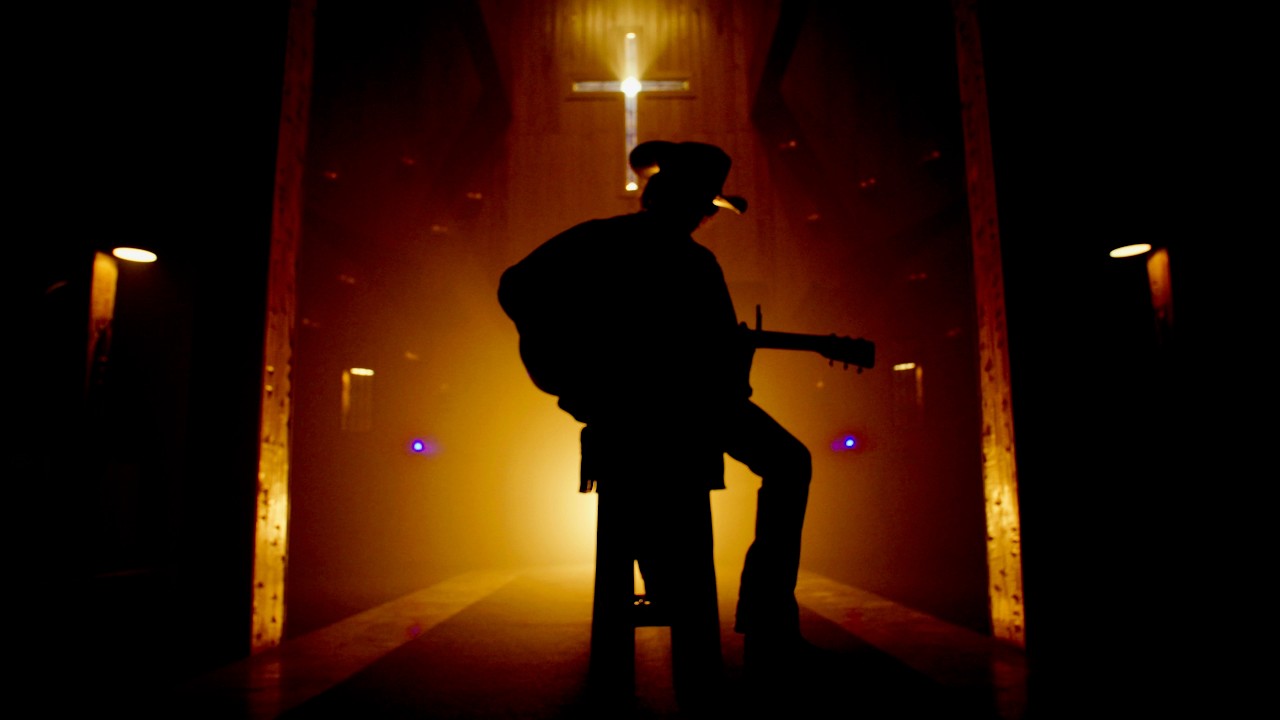
The music video posted on May 13, 2026 — three months after the audio release, on the day Kid Rock chose for it — opens with Robert Ritchie sitting alone on a wooden stool in a sparely furnished room, dressed in a black jacket, dark sunglasses, and a hat. As the song progresses, holographic images of his family, friends, and fans materialize and move around him: his son Robert James Ritchie Jr., now thirty-two years old, raised by Kid Rock as a single father from age six; his granddaughter Skye, born to Junior in 2014, now eleven; his late father Bill Ritchie, who died in 2024 at eighty-three after a long life owning Michigan car dealerships and the orchard property where Robert grew up; touring crew members; friends from the band; fans photographed from his audiences. The first three verses of the song are performed in this configuration — the chorus, the verses about fishing with your dad and dancing with your wife, the original Stennis-Rogers lyric Kid Rock has chosen to deliver almost note-for-note in fidelity to the Cody Johnson recording. Then the new verse arrives. The arrangement strips back. Kid Rock removes his sunglasses. He removes his hat. He stands. He kneels at the wooden stool. A Bible has been placed on the stool. He sings the verse he wrote — the book that needs dusting off, the man hanging on the cross, the second chance — kneeling in front of it. The room darkens around him. By the closing line, the only light in the frame comes from a cross-shaped window cut into the wall behind him. The post Kid Rock made on social media to introduce the video read, in part: “This song — and now video, means more to me than most will ever know.”
The cover sits, as commercial and cultural object, at the intersection of three different currents in American popular music as of the spring of 2026. It is country, in that the song originated as a country radio record and that Kid Rock — sixteen years past his 2010 pivot toward country rock — continues to record and tour primarily in the country and roots-rock space. It is Christian, in that the added verse is explicit gospel content that placed the record at number one on Billboard’s Hot Christian Songs chart for an extended run in March and April 2026. It is, by Kid Rock’s own framing in the press cycle around the Halftime Show release, a politically situated work, made in the period after Charlie Kirk’s assassination and released on the stage of a programme designed to counter the Super Bowl halftime show’s Latin-pop centrepiece. Whether the song works for a particular listener as a piece of grief processing, a piece of faith witness, a piece of political statement, or a piece of cover-version craft is, finally, a question each listener will answer differently. What is not in dispute is the small clean mechanical fact at the centre of the record: a working country songwriter, Ben Stennis, and his co-writer, Matt Rogers, wrote a song in 2021 about not letting life pass you by, and four years later a different songwriter from Detroit, who has spent his career working in several genres, added one more verse to it about what specifically he believes a person ought to be doing while they still can. The video that went up on YouTube on May 13, 2026 is the visual setting for that verse.
![Ed Sheeran & Elton John – Merry Christmas [Official Video]](https://musicvideosclub.com/wp-content/uploads/2025/12/ed-sheeran-elton-john-merry-chri-360x203.jpg)