



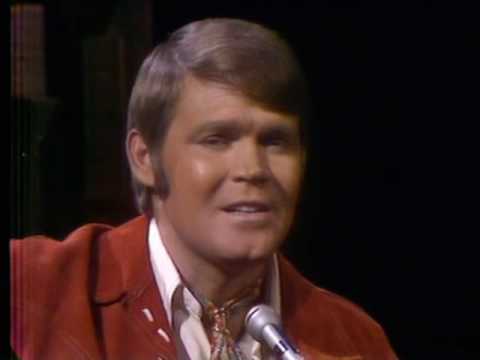





Glen Campbell – Wichita Lineman
Webb Handed In the Demo Labeled “Unfinished” — No Third Verse, No Bridge. Campbell Cried When He Heard It, Recorded It Immediately, and Filled the Gap Himself. Bob Dylan Called It the Greatest Song Ever Written.
In the early spring of 1968, Jimmy Webb was sitting behind a green piano in an old Hollywood Hills mansion that had once been the Philippine Embassy, trying to write new material and not finding it, when his telephone rang. Glen Campbell was calling from the Capitol Records studio. He needed another song like “By the Time I Get to Phoenix” — geographical, emotionally specific, something that could follow one of the best-performing country-pop crossovers of 1967 without looking small beside it. Webb said he would try. He had a memory stored from years earlier, driving through the high plains of the Oklahoma panhandle past a long line of telephone poles in the summer heat, the poles materializing out of the distant perspective and rushing toward him, and at the top of one of them a man in work clothes speaking into a handset. The image had stayed. Webb put himself atop that pole and imagined what the man might be thinking — not about the work, but about someone he loved, somewhere he couldn’t be, the vastness of the land around him and the thin wire he was responsible for carrying the voice of the world across. He wrote the song quickly, under deadline, and delivered the demo to producer Al De Lory with a warning: it wasn’t finished. He hadn’t completed a third verse. The bridge wasn’t there. He labelled the tape accordingly.
De Lory played it to Campbell. Campbell, who had grown up in rural Arkansas — the seventh of twelve children born to a sharecropping family in the small town of Delight — heard the opening line and cried. He said later it was because he was homesick. He recorded it immediately, on May 27, 1968, at Capitol Studios in Hollywood, backed by members of the Wrecking Crew — the uncredited collective of Los Angeles session musicians who had played on more hit records than any other group of players in the country. Carol Kaye contributed the descending six-note bass intro that opens the recording and has been recognisable ever since. Jim Gordon was on drums. A second Kaye bass lick was copied by De Lory for strings and used as a fill between the rhyming couplets of each verse. The gap where the third verse should have been was filled by Campbell himself, playing a tremolo-inflected Danelectro bass melodic interlude — a solution that turned an absence into one of the most emotionally charged moments in the recording. Webb didn’t know any of this had happened. A few weeks later he ran into Campbell somewhere and said he guessed they hadn’t liked the song. Campbell told him they’d already cut it. Webb said it wasn’t done — he’d only been humming the last bit. Campbell’s answer was: “Well, it’s done now.”
What Al De Lory Built Around It
The orchestral arrangements are entirely De Lory’s work, and they constitute one of the great acts of producer-as-collaborator in popular music. He had an uncle who had been a lineman in Kern County, California, and when he heard the opening line — a man working on the railroad, overloaded, can’t stop calling her name — he could visualize his uncle up a pole in the middle of nowhere. That personal connection translated into something architecturally extraordinary. The high-pitched, ethereal violins De Lory wrote for the passages around “singing in the wire” are designed to evoke the sound of wind blowing across power lines — the aeolian effect of moving air turning thin metal into something like a voice. The repeating monotonic keyboard and flute motif that runs through the track mimics what a lineman might hear through a telephone earpiece attached to unprocessed line: signal in the whine, presence in the noise. Everything in the arrangement is working as literal translation — not decoration but description. The session returned to Capitol on August 14, 1968, for overdubs, and at some point Webb came in and played three notes on his Gulbransen electric organ, over and over, through the intro and fadeout. He had been showing the instrument to Campbell during a break from the sessions — its bubbling, distinctive sound had struck them both as evoking something like signals moving through wire. A cartage company dismantled and reassembled the massive organ in the studio. Webb played his three notes. The recording was finished.
Released in October 1968 as the title track of Campbell’s twelfth studio album, “Wichita Lineman” reached number three on the US pop chart and remained in the Top 100 for fifteen weeks. It topped the country chart for two weeks and the adult contemporary chart for six consecutive weeks. In Canada it reached number one on both the national and country singles charts. In the United Kingdom it peaked at number seven. The album sold over two million copies in the United States, eventually earning RIAA double-platinum certification, and reached number one on the pop album chart for five weeks — Campbell’s first album to do so. The single was certified gold in January 1969. At the Grammy Awards that year, the recording won Best Engineered Recording, Non-Classical, credited to engineers Hugh Davies and Joe Polito. It was additionally nominated for Record of the Year and Best Male Contemporary Pop Vocal Performance. In 2000 it was inducted into the Grammy Hall of Fame. In 2019 the Library of Congress added it to the National Recording Registry for being culturally, historically, and aesthetically significant.
The Song That Never Resolved
Webb’s chord progressions — laced with major sevenths and suspended fourths, modulating between F major and D major without ever fully coming home to the tonic — are not accidental. The song opens with a broken F-major tonic chord heard twice during the bass intro and then never returns there. The music never resolves, just as the lineman’s situation never resolves: he is still up the pole, still overloaded, still unable to stop calling her name, still needing her more than want. The unfinished third verse, rather than leaving the song incomplete, became its defining structural choice — the song ends because the fade ends, not because anything has been settled. This is what Webb was later asked about when writer Dylan Jones described the song as the world’s greatest unfinished song. It is unfinished by necessity, Webb acknowledged — but what feels like incompleteness on the page is exactly right on the record, because that is what the man at the top of the pole is feeling. Campbell called “Wichita Lineman” his favourite out of the hundreds of songs he recorded across fifty-plus years. Bob Dylan has called it the greatest song ever written. Stuart Maconie, one of Britain’s most respected music critics, called it the greatest pop song ever composed. The covers — by Johnny Cash, R.E.M., James Taylor, Ray Charles, Guns N’ Roses, Smokey Robinson, and hundreds of others across every genre — have continued arriving across more than five decades and show no sign of stopping. The man at the top of the pole is still up there, still singing in the wire, still overloaded and still on the line.
SONG INFORMATION
Enjoyed this one? New forgotten gems every day — tap Music Videos Club below to visit and follow us on Facebook:
Related videos
 Watch LaterAdded
04:17
Watch LaterAdded
04:17  Watch LaterAdded
04:03
Watch LaterAdded
04:03  Watch LaterAdded
03:29
Watch LaterAdded
03:29