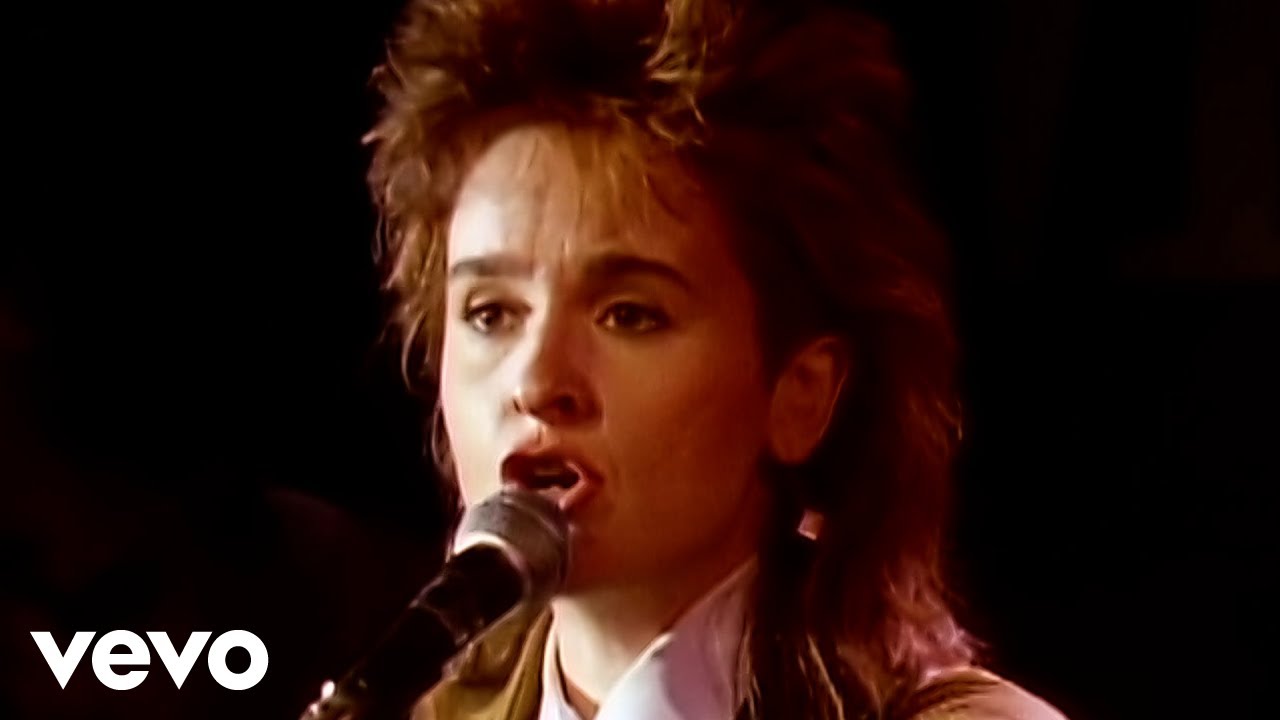
A roar of a song she had already been playing in clubs for years before anyone signed her — the one her audience kept demanding back, written about a woman she wasn’t yet able to say she’d loved.
Long before Melissa Etheridge had a record deal, she had Like the Way I Do. She had been playing it in California bars and small clubs for years, and it was the first of her own songs that audiences kept demanding back — the kind of request that comes scrawled on cocktail napkins and shouted between sets. By the time she actually got into a studio to record her self-titled debut in October 1987, the song was already battle-tested. What ended up on tape was less a studio recording than a transcription of a thing that already worked.
The album was nearly not the one we know. Island Records rejected the initial version of Etheridge’s debut and gave her four days to come back with new material; the result included “Bring Me Some Water,” which she wrote inside that window. Like the Way I Do survived the cut because it was already proven. Recorded at Cherokee Studios in Hollywood between October 19 and 25, 1987, and produced by Etheridge with Craig Krampf, Kevin McCormick, and Niko Bolas, the basic tracks were captured live in the room so the song would keep the urgency of how she played it on stage. It runs five and a half minutes, builds slowly, and ends with Etheridge tearing the lyric apart at the seams.
The lyric is jealousy at full voice. The narrator is watching the lover she lost give herself to someone else, and asking — daring — that new partner to match what she had. Does she love you like the way I love you. Does she want you like the way I want you. It is not a polite song. It is the sound of someone refusing to be replaced quietly.
A song that came out before the world was ready to know who it was about
Etheridge wrote it about a relationship with a woman. In 1988, at the suggestion of her label, she did not say so. Her early lyrics were deliberately gender-neutral, the pronouns kept open enough that the song could land in any listener’s life without complication. She did not publicly come out as gay until 1993, at the Triangle Ball celebrating Bill Clinton’s first inauguration, by which point fans had spent five years filling in the blanks for themselves. The song’s history carries both versions of its life — the one it lived before that night, and the one it lived after.
Commercially, Like the Way I Do was a slow burn rather than a chart hit. Released as the second US single from the album in late 1988, it did not break the Billboard Hot 100; it peaked at #28 on the Album Rock Tracks chart that December. The album itself climbed steadily to #22 on the Billboard 200 over the next two years, doing the kind of word-of-mouth, touring-band work that builds a real audience rather than a quick one. The song traveled abroad in interesting ways: a live version recorded at the Roxy in West Hollywood on October 11, 1988 was released as a single in the Netherlands four years later and went all the way to number two there, a piece of trans-Atlantic recognition the original US release never managed.
In 1995, the song got a second life at home. It was paired as a double A-side with If I Wanted To, the fourth single from her breakthrough album Yes I Am, and finally entered the Hot 100 — peaking at #42, seven years after it had first been released. By then Etheridge had won her first Grammy, sold millions of copies of Yes I Am, and become one of the most recognizable rock voices in America. The song that had taken her into the studio in the first place was still the one her audience would not let her stop playing. Watch the video and the reason is obvious.
SONG INFORMATION
Artist: Melissa Etheridge
Song: “Like the Way I Do”
Album:Melissa Etheridge
B-side: “Like the Way I Do” (live, recorded at the Roxy, West Hollywood, October 11, 1988)
Released: 1988 (album May 2, 1988; single later that year as the second US single)
Recorded: October 19–25, 1987
Studio: Cherokee Studios, Hollywood
Label: Island
Songwriter: Melissa Etheridge
Producers: Craig Krampf, Kevin McCormick, Niko Bolas, Melissa Etheridge
Length: 5:25
Chart Performance: #28 Billboard Album Rock Tracks (December 1988); #42 Billboard Hot 100 (1995 reissue as double A-side with “If I Wanted To”); #2 Netherlands (1993, live version)