



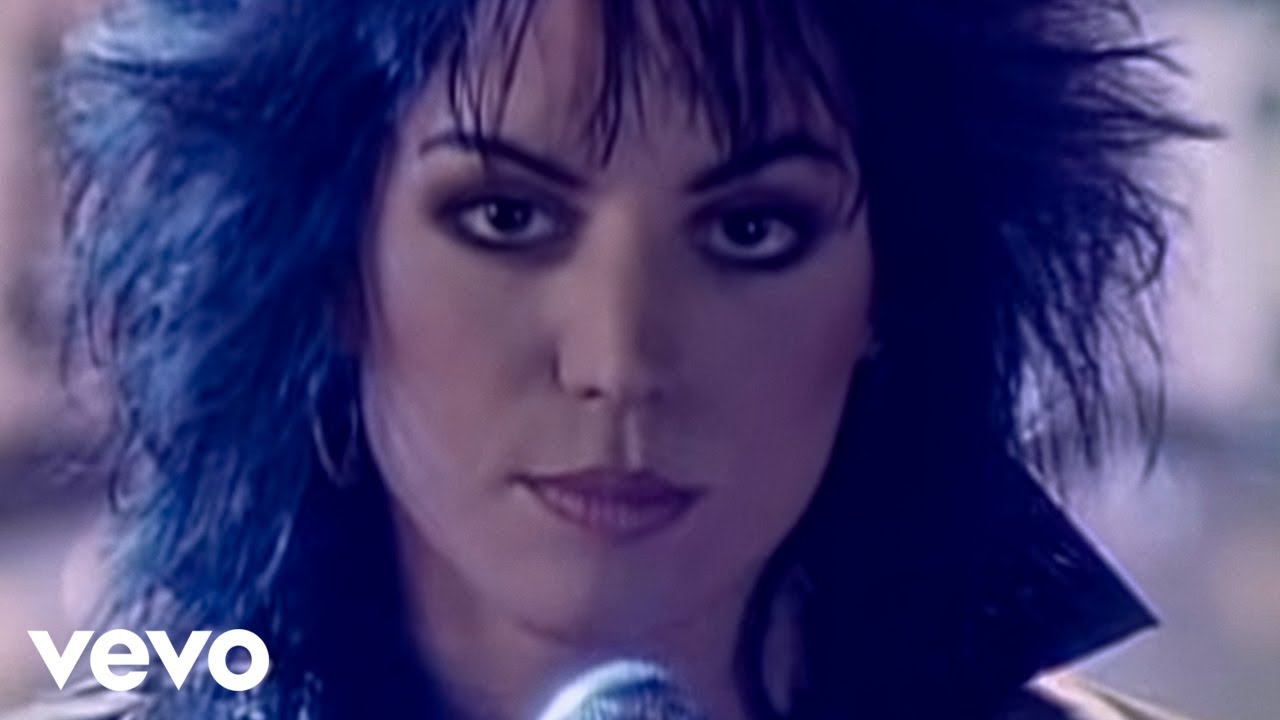



Joan Jett & the Blackhearts – I Hate Myself for Loving You
She Brought the Riff to Desmond Child with the Working Title “I Hate Myself Because I Can’t Get Laid.” He Talked Her Into Changing It. Mick Taylor Played the Solo. Twenty-Six Weeks on the Hot 100 Later, Joan Jett Had Her Comeback — and a Song NBC Would Eventually Pay Her by the Week to License for a Decade of Sunday Nights.
Joan Jett walked into Desmond Child’s office in 1987 with a guitar riff and a working title. She had written the song after a long stretch of frustration — career frustration with two underperforming albums since 1983’s Album, romantic frustration of a more direct kind — and she had given the song the title that summarised both states: I Hate Myself Because I Can’t Get Laid. Child, the Bronx-born songwriter who had recently co-written Bon Jovi’s You Give Love a Bad Name and was already working on what would become Aerosmith’s Permanent Vacation, listened to what she had and told her the title would never make it to radio. He pushed her to keep the rhythm, the riff, and the emotional spine of the song, but to make the conflict romantic rather than physical. They worked through the lyric together. The new title was I Hate Myself for Loving You. Child took a co-writing credit. Kenny Laguna — Jett’s longtime producer, manager, and creative partner since the start of her solo career — produced the record alongside Child and the band. The song they finished was a different song than the one Jett had walked in with, and the difference was the difference between a personal complaint and a number-eight hit.
Joan Jett needed a hit. She had been Joan Marie Larkin from Wynnewood, Pennsylvania, then the rhythm guitarist of The Runaways, then the launcher of one of the most successful self-released debut albums in rock history when she put out the original Bad Reputation on Blackheart Records in 1980 after twenty-three labels rejected her. She had hit number one on the Billboard Hot 100 in 1982 with I Love Rock ‘n’ Roll. She had followed it with Crimson and Clover, a Tommy James cover that reached number seven later that year. Her 1983 album Album had produced no major hits. Her 1984 follow-up Glorious Results of a Misspent Youth had performed worse. Her 1986 album Good Music, recorded after she had taken a co-starring role with Michael J. Fox in the 1987 film Light of Day, had performed worse still. By 1987, her commercial position was precarious. The label was uncertain about her future. Kenny Laguna was uncertain about the radio. The Desmond Child connection was the lifeline.
Compass Point, The Hit Factory, and a Mick Taylor Solo
The album sessions for Up Your Alley took place primarily at Compass Point Studios in Nassau, the Bahamas — the studio where Talking Heads had cut Remain in Light, where AC/DC had recorded Back in Black, and where the Rolling Stones had recorded most of Emotional Rescue. Additional work was done at The Hit Factory in New York City. Kenny Laguna and Desmond Child co-produced the record with the band. Jett’s working Blackhearts lineup at the time included Ricky Byrd on lead guitar, Lee Crystal on drums, and Gary Ryan on bass. What Jett also acquired for the recording was a guest soloist: former Rolling Stones lead guitarist Mick Taylor, the player who had defined the Stones’ Sticky Fingers and Exile on Main St. era between 1969 and 1974, and who in 1987 was working as a freelance session and touring guitarist out of New York. Taylor had jammed with the Blackhearts at a New York gig the previous year through his friendship with Ricky Byrd. He came in to record the song’s brief, melodic solo. “It’s a very minimalist type of solo, almost,” Taylor told Jazzed magazine years later, “but I’ve spoken with a few people who really like what I did. I had no idea the song would be such a big hit record — but there you go. I like working with different types of musicians.”
The song was released as the lead single from Up Your Alley in June 1988, with a B-side that paired the song with a live version of Love Is a Pain and a studio cover of The Troggs’ I Can’t Control Myself. The album reached the stores on May 23, 1988. The single climbed slowly. Kenny Laguna later told Songfacts that radio resisted it through most of the summer — “we couldn’t get I Hate Myself for Loving You on the radio, but it was Number One requested, so we were able to overcome a lot of that. But it took a long time to break that record. Partly because she’s a rock ‘n’ roller, partly because she’s a punk rocker, and partly because she’s a woman.” The song eventually peaked at number eight on the Billboard Hot 100, Jett’s third and final Top 10 single, and her first since Crimson and Clover six years earlier. It spent twenty-six weeks on the chart — six weeks longer than I Love Rock ‘n’ Roll had managed in 1982. The album was certified Platinum. Joan Jett and the Blackhearts were nominated for the 1988 Grammy Award for Best Rock Performance by a Duo or Group with Vocal. The comeback was complete.
The Long Tail: A Football Theme, a Royalty Stream, and a Live Set Anchor
The song’s second life began nearly two decades later. In 2006, NBC selected it as the theme for Sunday Night Football, with rewritten lyrics — “Waiting All Day for Sunday Night” — performed by Pink. Jett initially declined the licensing offer. Sources later suggested NBC’s first proposal had been low — 2006 was a quiet period for her commercially — but the deal was eventually struck, and the song became one of the most-aired pieces of music on American network television for the following decade. Pink performed the rewritten version through 2007. Faith Hill took over from 2007 through 2012. Carrie Underwood replaced her from 2013 through 2015. Across ten seasons of regular Sunday-night use, the song generated steady writer-share royalties for Jett and Desmond Child. “I’m not Kanye West and I’m not on the radio all the time,” Jett told the New York Post, “so it helps keep my band paid. I’m just glad I don’t have to sing the new versions. I’d probably end up singing the football version onstage by accident.”
The song that began as a private complaint about romantic and physical frustration, that Desmond Child rewrote into a commercial proposition, that Mick Taylor improvised a brief solo on, and that radio resisted before request lines pulled it onto the air, has settled into the unusual position of being a rock anthem and a network television theme simultaneously. Joan Jett was inducted into the Rock and Roll Hall of Fame on April 18, 2015. The performance video that her official channel hosts has accumulated views in the hundreds of millions, the song one of the most-streamed pieces of late-1980s rock on YouTube. Jett, for her part, has described I Hate Myself for Loving You as her best-paying composition. Desmond Child went on to co-write further hits with Bon Jovi, Aerosmith, Cher, Ricky Martin, and dozens of others. Mick Taylor returned to his solo career, occasional Stones reunions, and the long catalogue of session work he had been building since 1969. The song held its place in Jett’s live set for the next four decades, the sing-along that audiences have not stopped wanting to participate in. Joan Jett, who once self-released her debut album because twenty-three labels turned her down, had — by way of a song that started as the wrong title and became the right one — secured both her commercial standing and a stretch of Sunday nights.