






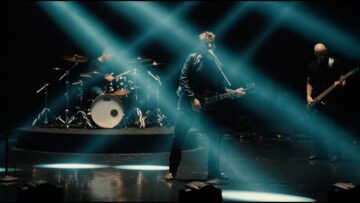




Damn Yankees – Come Again
A record-company executive looked at three rock stars whose original bands had all stalled and decided they should be one band instead. The supergroup he assembled was improbable on paper — and it sold two million copies.
Damn Yankees existed because one record executive could not stop thinking about a combination that, on its face, made no sense. By the late 1980s, the American rock landscape had developed a habit of building supergroups out of musicians whose original bands had cooled — Bad English, Mr. Big, and Badlands all formed in roughly the same window — and the A&R executive John Kalodner, the famously bearded industry figure who had steered Aerosmith’s late-1980s comeback, had an idea of his own. Tommy Shaw, the singer and guitarist who had defined much of Styx’s catalog, was between things. Jack Blades, the singer and bassist of Night Ranger, was in a similar position. And Ted Nugent — the Detroit hard-rock showman whose solo career had been built on a loud, unsubtle, deliberately provocative public image — was, in Kalodner’s words, “not really doing anything.” Kalodner had dinner with one of them, got an idea in his head, and decided the three should become a single band. Shaw and Blades had already met during a hiatus from their respective groups; the addition of Nugent, and of the then-unknown drummer Michael Cartellone, who had played in Shaw’s solo band, completed the lineup. They named themselves Damn Yankees.
The combination worked better than the paper suggested it would. The band’s self-titled debut album, produced by Ron Nevison and released by Warner Bros. on March 13, 1990, sold two million copies and was certified double platinum. It reached No. 13 on the Billboard 200. The record’s commercial engine was the power ballad “High Enough,” which climbed to No. 3 on the Billboard Hot 100 and gave Ted Nugent — improbably, given everything his career had been built on — his first mainstream Top 10 single. But the album had depth beyond its hit. “Come Again” was the third single, released in December 1990, and it is the track that most clearly belonged to Tommy Shaw.
The song that opens like a ballad and then refuses to be one
“Come Again” begins by misdirecting the listener. It opens on a quiet, almost acoustic figure — the kind of gentle introduction that, in 1990, signaled another power ballad was coming, another “High Enough.” About ninety seconds in, the song discards that expectation entirely: a hard-driving riff arrives, Cartellone’s drums lock in underneath it, and the track becomes something with considerably more weight than its opening implied. The vocal is Shaw’s, and the writing carries his melodic instincts — the same instincts that had produced Styx’s most enduring songs. Like every track on the album, “Come Again” is credited as a three-way songwriting collaboration between Blades, Nugent, and Shaw, the band having committed to splitting all writing credits equally. The recording was done at A&M Studios in Hollywood and Can-Am Recorders in Tarzana, California, across 1989 and 1990, with Nevison producing, Alan Pasqua adding Hammond organ across the album, and Jimmie Haskell handling orchestral arrangement. At five and a half minutes, “Come Again” was the longest single the band released from the debut — a song built to breathe rather than to be compact.
It performed the way an album-rock track was built to perform in that era. “Come Again” reached No. 50 on the Billboard Hot 100 in early 1991 and charted on Billboard’s Mainstream Rock Tracks listing, where it picked up the extensive AOR radio airplay that was the real measure of a rock single’s reach in 1990 and 1991. It did not match the commercial scale of “High Enough” — few songs that year did — but it was a substantial radio presence and one of the four or five tracks that kept the Damn Yankees album in rotation across a long chart life. The album’s structure had, in a sense, been designed for exactly this. Kalodner’s working philosophy for commercial rock records of the period, as he later described it, was that a band needed four or five genuinely commercial songs and could fill the rest of the record with whatever they wanted. “Come Again” sat in the commercial tier — radio-ready, melodically sharp, and built to be heard between the album’s harder Nugent-driven material and its ballad.
Four careers, briefly converged
The music video for “Come Again” — the version on this page, drawn from the Rhino catalog channel — is a straightforward black-and-white performance clip, the band playing against a stark white background, the visual language stripped down to the four musicians and the song. There was no narrative, no concept; the video’s entire premise was the band itself, which in 1990 was a sufficient selling point. Damn Yankees toured the debut album for eighteen months and returned in 1992 with a second record, Don’t Tread, which went gold and produced the Top 20 single “Where You Goin’ Now” but did not approach the debut’s reach — by 1992, the rock audience’s attention was turning toward grunge, and the polished melodic hard rock that Damn Yankees represented was sliding out of fashion. The band became dormant after Don’t Tread. Ted Nugent returned to his solo career. Tommy Shaw and Jack Blades, who had discovered during the Damn Yankees years how naturally their voices fit together, recorded as the duo Shaw Blades before returning to Styx and Night Ranger respectively. Michael Cartellone, the drummer who had been the unknown of the four, went on to join Lynyrd Skynyrd, where he has held the drum chair for more than two decades.
Damn Yankees reconvened briefly a few times over the following years, but the debut album remains the band’s defining statement — and “Come Again” remains one of its clearest examples of why the improbable combination worked. The song is the sound of four musicians from four different rock lineages, assembled by an executive’s hunch, finding that their instincts genuinely fit. The acoustic opening is Shaw’s melodic patience. The riff that interrupts it is the band’s harder collective edge. The result is a five-and-a-half-minute rock single that has outlived the supergroup trend that produced it, still circulating decades later through the catalog channels that keep the era’s records in view.
SONG INFORMATION
Related videos
 Watch LaterAdded
03:30
Watch LaterAdded
03:30  Watch LaterAdded
06:49
Watch LaterAdded
06:49  Watch LaterAdded
02:46
Watch LaterAdded
02:46