








Bryan Adams – Please Forgive Me
They Needed One New Song for the Greatest Hits Album — Mutt Lange Had an Idea, Adams Had Never Allowed a Key Change Before, and the Dog in the Video Wasn’t in the Script
When A&M Records and Bryan Adams agreed that the upcoming So Far So Good compilation needed more than a repackaging of existing hits, neither of them had a plan for what the new track would be. The record required one original song — a reason for the fans who already owned everything to buy in again. Robert John “Mutt” Lange, Adams’ production partner, had the idea. They flew to Paris, booked into Studio Guillaume Tell, and assembled a band that was larger and looser than anything Adams had worked with in years. The session they ran there in the summer of 1993 produced “Please Forgive Me” — a song that arrived without a promotional campaign or a film attached to its name, and subsequently hit number one in seven countries.
The approach to recording marked a genuine departure. The previous Adams–Lange collaboration, Waking Up the Neighbours, had been constructed instrument by instrument — a precise, layered method Lange favored for its control. Paris was different from the first day. Adams walked into Studio Guillaume Tell and found himself surrounded by a full live band: David Paich of Toto alongside session veteran Robbie Buchanan at the keyboards, Shane Fontayne and longtime Adams collaborator Keith Scott on guitars, James “Hutch” Hutchinson anchoring the bottom end on bass, and Mickey Curry behind the drum kit. Adams later described it as invigorating — it was good to be back with a band in a room. That collective energy is woven into the finished recording. The track breathes differently to almost anything Adams had made in the preceding four years.
The Take They Didn’t Plan On
There was one more detail that marked “Please Forgive Me” as genuinely new territory for Adams. He had spent his career resisting key modulation — the dramatic upward shift that defines the climax of countless radio ballads and that he considered too obvious a technique, too blunt an emotional lever. Lange built one into the song anyway, and Adams, who later recalled this as one of the first times he had ever agreed to let a modulation into a recording, went with it. He has always drawn the line at the live performance, though: when Adams sings “Please Forgive Me” on stage, the shift is dropped entirely, and the song holds up without it. On record, however, that lift arrives at precisely the moment radio programmers across Europe and North America needed it to, and it helped carry the track to audiences who might otherwise have skipped a bonus cut on a greatest hits compilation.
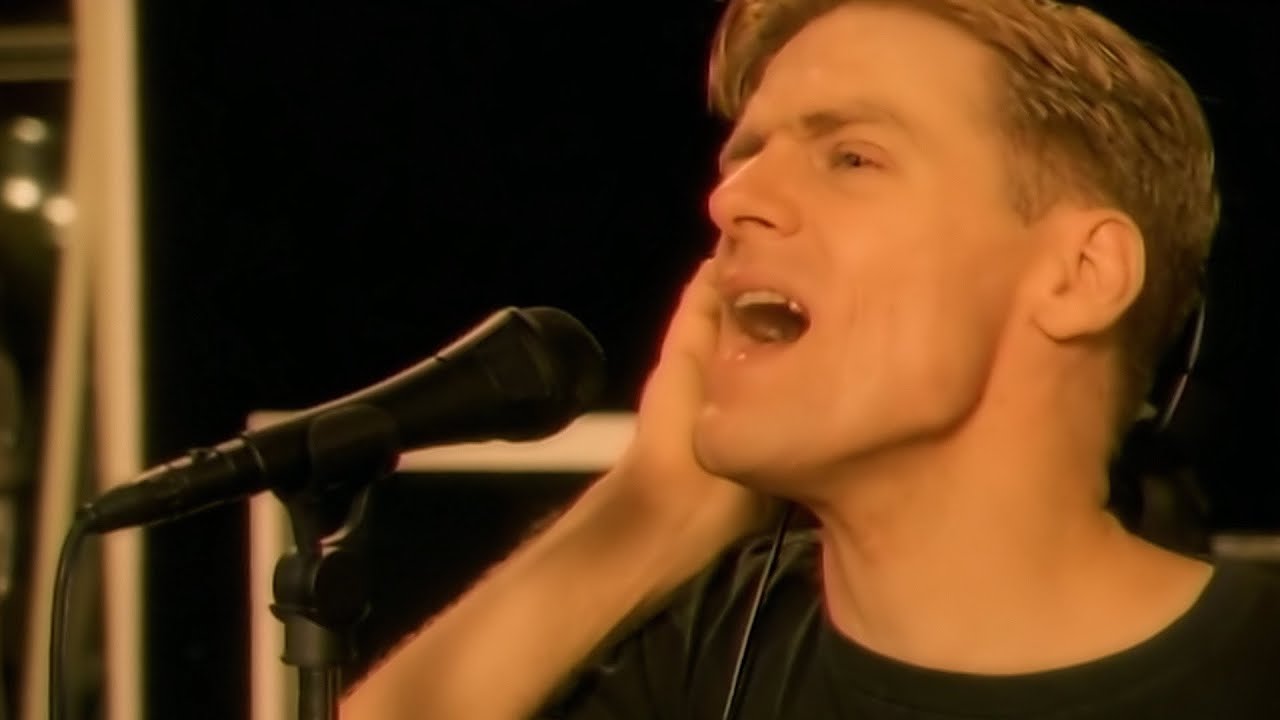
The music video is, in the most literal sense, a document of the recording itself. Director Andrew Catlin, the English photographer and filmmaker known for his instinctive, non-choreographed approach, brought a camera into the Studio Guillaume Tell sessions and filmed the band at work. There was no constructed set, no narrative arc written in advance. What the cameras caught instead was Adams and the band in the room — and a German Shepherd that belonged to the studio owner, which wandered in during the sessions, stayed, and ended up in frame for most of the video. Adams and the musicians had already befriended the dog during the tracking dates, and Catlin allowed the relationship to play out naturally on camera. The result is a video that feels found rather than manufactured: warm, unguarded, and operating at an entirely different register to the high-production MTV aesthetic of 1993. That quality helped it accumulate enormous television airplay on both sides of the Atlantic.
Seven Countries at Number One
Released in October 1993, “Please Forgive Me” moved more quickly and more widely than anyone at A&M had reasonably expected from a greatest hits bonus track. Australia took to it first and hardest: it reached number one on the ARIA chart, where it held for seven weeks, making it Adams’ only Australian chart-topper that had not been written for a film soundtrack. Simultaneously, it topped the singles charts in Belgium, Canada, France, Ireland, Norway, and Portugal. In the United Kingdom it peaked at number two on the singles chart while going to number one on the UK airplay chart — a position it held for multiple weeks, suggesting the gap between what people were being played and what they were buying was narrower than usual. In the United States it climbed to number seven on the Billboard Hot 100 and number two on the Adult Contemporary chart, spending 28 weeks on the Hot 100 in total. The single ultimately sold more than three million copies worldwide. The album it anchored, So Far So Good, entered the UK Albums Chart at number one and went on to be certified six-times Platinum in the United States, three-times Platinum in the United Kingdom, and eleven-times Platinum in Australia.
Three decades later, the official music video on Bryan Adams’ YouTube channel has passed one billion views — a figure that translates, more simply than any certification, into the same thing happening millions of times across millions of devices: someone choosing to spend six minutes with this song. Adams rarely performs the modulation live, and the song never seems to need it. What Lange built around that Paris band session — the guitar tones, the unhurried tempo, the way Adams’ voice sits in the arrangement without straining for effect — turns out to have been more durable than a greatest hits format typically demands. The dog wandered in and stayed. So did the song.
SONG INFORMATION
Enjoyed this one? New forgotten gems every day — tap Music Videos Club below to visit and follow us on Facebook:
Related videos
 Watch LaterAdded
04:11
Watch LaterAdded
04:11  Watch LaterAdded
05:03
Watch LaterAdded
05:03  Watch LaterAdded
04:11
Watch LaterAdded
04:11