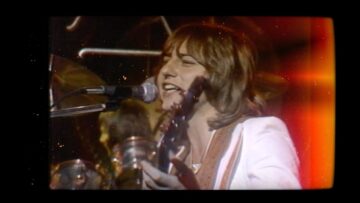
The Eagles set out to stop being a country-rock band. This is where it happened.
Don Henley put it plainly enough afterwards: the band wanted out of what he called the ballad syndrome. Four albums in, the Eagles had become extremely good at a particular thing — close harmony, acoustic guitars, songs about the West — and were being praised for it in terms that were starting to sound like a boundary. One of These Nights is the sound of four minutes spent deliberately somewhere else.
What is underneath it is a bassline. Randy Meisner plays something closer to R&B than to anything on Desperado, and Henley puts a straight four-on-the-floor pattern under it, which in 1975 meant one thing to anyone listening on a radio. The band had noticed what was happening on dance floors and decided they were allowed to use it. Henley sings the verses low and unhurried. Meisner comes in above him on the refrain — **high harmony, not lead**, which is a distinction that gets lost constantly and matters, because the whole effect depends on that voice arriving from somewhere above rather than taking over.
They cut the basic track at Criteria in Miami in December, then took the tape back to the Record Plant in Los Angeles and built the rest on top: layers of sustained guitar underneath, and then Don Felder’s solo. Glenn Frey’s account of the process has the sequence exactly that way round — the foundation in one city, the character in another.
Felder’s ninety seconds
The solo is why guitarists still talk about this record. It is blues phrasing played through a distortion tone considerably heavier than anything the Eagles had put on a single before, all sustained bends and space, and it sits in the arrangement as the one element that has not been smoothed. Felder had joined the band the previous year, initially brought in to add exactly this — a player who could do something the existing lineup could not.
Bill Szymczyk produced, as he had since On the Border, and the difference between his records and the Glyn Johns albums that preceded them is audible here in the low end and the amount of air around each part.
Asylum put the single out on May 19, 1975, three weeks ahead of the album, and shortened it for radio — most of the intro gone, most of the fade gone, four fifty-five down to three twenty-eight. It reached No. 1 that summer, the band’s second American chart-topper after Best of My Love, and it was also the first Eagles single to register in Britain at all, where it stopped at No. 23. The album went to No. 1 as well, the first of theirs to do it, and has sold past five million copies.
The last one with all of them
One of These Nights is the final Eagles album featuring Bernie Leadon, who had been there from the beginning and whose bluegrass and country playing was a substantial part of what the band had been. It is also the first with Don Felder as a full member. Those two facts sitting on the same record are not a coincidence — Leadon left after the supporting tour, and Joe Walsh arrived, and the group that made Hotel California the following year was a harder and more electric proposition than the one that made Take It Easy.
Which makes this song the hinge. Everything the Eagles were is still audible on it, and everything they were about to become is already there in Felder’s solo. The album title track was the last moment where both versions of the band existed at once.
Which makes this song the hinge. Everything the Eagles were is still audible on it, and everything they were about to become is already there in Felder’s solo. The album title track was the last moment where both versions of the band existed at once — which is more or less what the band’s own retrospective film of it demonstrates, cutting between lineups that share a song and not much else.
Which makes this song the hinge. Everything the Eagles were is still audible on it, and everything they were about to become is already there in Felder’s solo. The album title track was the last moment where both versions of the band existed at once — which is more or less what the band’s own retrospective film of it demonstrates, cutting between lineups that share a song and not much else.
SONG INFORMATION
Artist: Eagles
Song: “One of These Nights”
Album:One of These Nights
B-side: “Visions”
Released: May 19, 1975
Recorded: December 1974 – early 1975
Studio: Criteria Studios, Miami; Record Plant, Los Angeles