



![The Beatles – The Beatles – Eleanor Rigby (From Yellow Submarine) [Official Music Video]](https://musicvideosclub.com/wp-content/uploads/2026/08/the-beatles-the-beatles-eleanor-360x203.jpg)
John Mayall – The Train
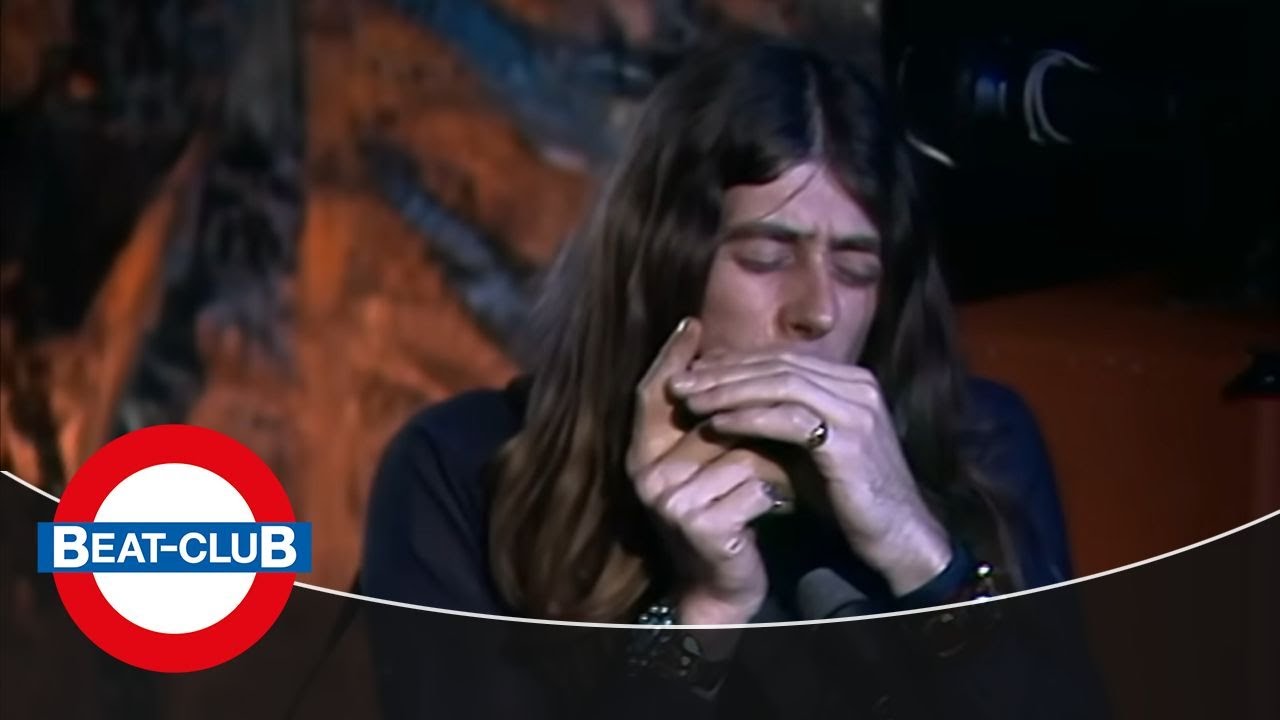
John Mayall did not take “The Train” into a studio. He and the Bluesbreakers recorded themselves on the road across two months of club dates — roughly sixty hours of tape — and pulled the rawest British blues of the era out of it.
By the late 1960s, John Mayall had earned a reputation as the most important bandleader in British blues — not because he was the flashiest player on any stage, but because of who passed through his band. The Bluesbreakers were a finishing school for a generation of British musicians: Eric Clapton, Peter Green, Mick Taylor, and John McVie all spent formative time under Mayall before going on to Cream, Fleetwood Mac, and the Rolling Stones. Mayall was the bandleader and the talent scout, the constant around whom the players rotated. But that framing has always slightly undersold him as a performer in his own right, and “The Train” is one of the clearest pieces of evidence for the case. It is, above all, a showcase for Mayall the harmonica player — an extended workout that puts the bandleader’s own instrument at the center of the music.
“The Train” appears on The Diary of a Band Volume Two, one half of a two-volume live set released by Decca in 1968. The Diary of a Band project was unusual in how it was made. Rather than booking a studio or hiring a crew to capture a single prestige concert, Mayall and the Bluesbreakers recorded themselves — documenting their own club performances across a two-month stretch of touring in late 1967, building up a tape archive that reportedly ran to around sixty hours. The two volumes were then assembled from that raw material. The result is a record with no studio polish on it at all: the sound of a working band in small rooms, playing for club audiences, caught without the smoothing and correcting that a studio session imposes. For listeners who wanted to hear what British blues actually sounded like on a given night in 1967 — rather than what it sounded like after a producer had shaped it — the Diary of a Band volumes were as close to the unfiltered article as the era produced.
A standalone harmonica feature
On The Diary of a Band Vol. II, “The Train” stands as its own track — the second song on side one, credited to John Mayall alone, sitting between the Spencer Davis Group cover “Gimme Some Lovin'” and Mayall’s “Crying Shame.” Streaming services have sometimes bundled the first two together as a single “Gimme Some Lovin’ / The Train” entry, but the original Decca pressing lists them separately, and “The Train” is its own Mayall composition. It is the track on the side where the bandleader steps fully forward and turns the music over to an extended harmonica feature.
Mayall’s harmonica playing has always been one of the underrated elements of his long career. He was never a showman in the mold of the guitarists he employed, and the sheer fame of those guitarists — Clapton above all — tended to draw attention away from what the bandleader himself was doing. But Mayall was, by the assessment of many blues critics, one of the genuinely fine blues harmonica players of his generation, and a piece like “The Train” exists precisely to demonstrate it. The title itself points at the tradition the playing draws from: the harmonica’s long association in blues with the sound and motion of trains, the instrument used to imitate the rhythm of wheels on track and the cry of a whistle. “The Train” is Mayall working inside that tradition, in front of a live audience, with no studio between the playing and the tape.
Mayall’s harmonica playing has always been one of the underrated elements of his long career. He was never a showman in the mold of the guitarists he employed, and the sheer fame of those guitarists — Clapton above all — tended to draw attention away from what the bandleader himself was doing. But Mayall was, by the assessment of many blues critics, one of the genuinely fine blues harmonica players of his generation, and a piece like “The Train” exists precisely to demonstrate it. The title itself points at the tradition the playing draws from: the harmonica’s long association in blues with the sound and motion of trains, the instrument used to imitate the rhythm of wheels on track and the cry of a whistle. “The Train” is Mayall working inside that tradition, in front of a live audience, with no studio between the playing and the tape.
The bandleader who kept the blues moving
The Diary of a Band volumes captured the Bluesbreakers at a specific moment — late 1967, between the more famous studio albums, with the band’s lineup in its usual state of flux. What the volumes preserve is not a landmark hit single but something arguably more valuable: an honest document of a touring blues band at work, the kind of recording that is easy to overlook next to the marquee studio albums and far harder to fake. “The Train” sits inside that document as the moment the bandleader takes the solo.
John Mayall continued performing and recording for more than five decades after The Diary of a Band, remaining active as a touring bluesman into his later years and continuing to be regarded as the elder statesman of British blues — the man whose band had launched more careers than almost any other in the music. He died in 2024. His legacy is usually told through the players he discovered, and that telling is not wrong: the Bluesbreakers genuinely were the route by which a generation of British guitarists reached the world. But recordings like “The Train” are the necessary correction to it. Before he was anyone’s mentor, and through all the years he was, John Mayall was a blues musician — and the harmonica on this performance is the proof.
SONG INFORMATION
Related videos
 Watch LaterAdded
03:04
Watch LaterAdded
03:04  Watch LaterAdded
05:54
Watch LaterAdded
05:54  Watch LaterAdded
04:06
Watch LaterAdded
04:06