






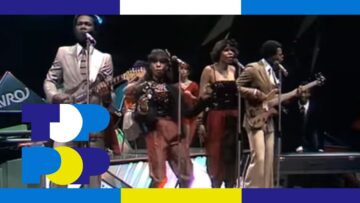
Humble Pie – Black Coffee
Steve Marriott Changed One Line in the Lyric — Swapping Tina Turner’s “My Skin Is Brown” for “My Skin Is White” — and Then Had to Explain Himself to the NME. The Old Grey Whistle Test Performance Explains the Rest.
The song belonged to someone else and everyone watching knew it. “Black Coffee” was written by Tina Turner and recorded by Ike and Tina Turner for their 1972 album Feel Good on United Artists — a raw, blues-drenched statement of purpose from one of the most powerful live acts in American music. Steve Marriott heard it and wanted it. When Humble Pie recorded their version for the double album Eat It in early 1973, Marriott changed one line: where Tina had sung “my skin is brown but my mind is black,” Marriott sang “my skin is white but my soul is black.” James Johnson of NME asked him about it. Marriott’s answer was unambiguous: he sang it because he loved the song, it was his interpretation, and people should have known by then that he had been devoted to Black music for years. What he didn’t add, because he didn’t need to, was that the performance Humble Pie gave on The Old Grey Whistle Test in March 1973 was itself the argument — six minutes of evidence that the obsession was real, the craft was earned, and the Blackberries standing beside him were not decoration but the point.
The road to that performance had begun on New Year’s Eve 1968 at the Alexandra Palace in London. Steve Marriott, twenty-two years old, frontman of the Small Faces — the band that had defined Mod Britain in the mid-sixties more completely than almost any other — walked offstage mid-show, went backstage, and told his bandmates he was done. His first call afterward was to Peter Frampton, nineteen years old, recently of The Herd, whom Marriott had taken under his wing and who shared his frustration with being treated as a pop commodity rather than a serious musician. By January 1969, Marriott and Frampton were rehearsing at Marriott’s cottage in Moreton, Essex, alongside former Spooky Tooth bassist Greg Ridley and a seventeen-year-old drummer named Jerry Shirley from the Apostolic Intervention. They signed to Andrew Loog Oldham’s Immediate label. Their debut single “Natural Born Boogie” reached number five on the UK Singles Chart. Humble Pie was a supergroup from day one, and it moved quickly.
What the Band Became After Frampton Left
Frampton departed in September 1971, driven toward his own vision of what his musicianship could become, and was replaced by guitarist Dave Clempson — known as Clem — who had come from Colosseum and proved to be exactly the foil Marriott’s heavier direction required. The band signed to A&M Records, came under the management of Dee Anthony, and developed into one of the most ferocious live acts on the American touring circuit. Performance Rockin’ the Fillmore in 1971 caught that power on record. Smokin’ in 1972 refined it, reaching number six on the US charts on the back of “30 Days in the Hole” and relentless road work. By the time Marriott began planning Eat It, the band was at their commercial peak and, characteristically, he decided to use that leverage to do something more ambitious and more expensive: a four-sided double album where every side would operate in a different register — original hard rock, R&B covers, acoustic originals, and a live concert recording from Glasgow.
The R&B covers side was the ambition that required the most justification — and the most support. Marriott contacted Venetta Fields, a former Ikette who had performed with Ike and Tina Turner’s revue, and asked her to assemble a backing vocal trio. Fields chose Clydie King, who had recently laid vocals on the Rolling Stones’ Exile on Main Street, and Sherlie Matthews, both previously members of Ray Charles’s Raelettes. They flew to London to record. When Marriott asked them to tour, Matthews declined for personal reasons and chose Billie Barnum — sister of H.B. Barnum — as her replacement. The touring trio of Fields, King, and Barnum became the Blackberries, and they were, by any fair measure, one of the great unheralded contributions to British rock of the early 1970s. The chemistry was not that of a rock band with background singers bolted on. Marriott had conceived the arrangement differently: the Blackberries were meant to be inside the sound, not beside it, linking Humble Pie directly to the gospel and soul tradition that had been the original source of everything he cared about in music.
Six Minutes on the Whistle Test
The Old Grey Whistle Test performance of “Black Coffee” in March 1973 — broadcast by the BBC just weeks before Eat It was released in April — shows what that integration looked like in practice. The show, hosted since its 1971 debut by Bob Harris, had established itself as the serious alternative to Top of the Pops, a programme concerned with albums and artists rather than singles and chart positions, and it suited Humble Pie precisely. What the cameras recorded that evening was Marriott at the full height of his powers: the voice an instrument of extraordinary range and grit, the kind of vocal that made critics reach for comparisons to Ray Charles and then stop themselves because the comparison, however flattering, also missed something. Clempson held the rhythm end while Marriott pushed the song’s emotional temperature higher. And the Blackberries — Fields, King, Barnum — answered him, called back to him, pushed him further, the three American voices and the one English voice finding a common language that the song’s original context had never required them to imagine.
Eat It peaked at number thirteen on the US Billboard 200. The Blackberries, after the Humble Pie touring cycle concluded, went on to join Pink Floyd’s Dark Side of the Moon tour in October 1973 — Gilmour had asked Shirley if he could borrow them, and Marriott, reluctantly, had agreed. Steve Marriott died in a house fire on April 20, 1991, aged forty-four, in what should have been the beginning of a new chapter: he and Frampton had been in Los Angeles working on material together just before the end. The Old Grey Whistle Test footage survives as one of the clearest records of what Marriott could do when the room was right and the song was real — a British singer in love with a tradition that was never his by birth, making the case through sheer conviction and company that love of the music was credential enough.
SONG INFORMATION
Enjoyed this one? New forgotten gems every day — tap Music Videos Club below to visit and follow us on Facebook:
Related videos
 Watch LaterAdded
04:11
Watch LaterAdded
04:11  Watch LaterAdded
04:17
Watch LaterAdded
04:17  Watch LaterAdded
04:11
Watch LaterAdded
04:11