



![David Lee Roth – California Girls (Official Video) [HD]](https://musicvideosclub.com/wp-content/uploads/2026/10/david-lee-roth-california-girls-360x203.jpg)

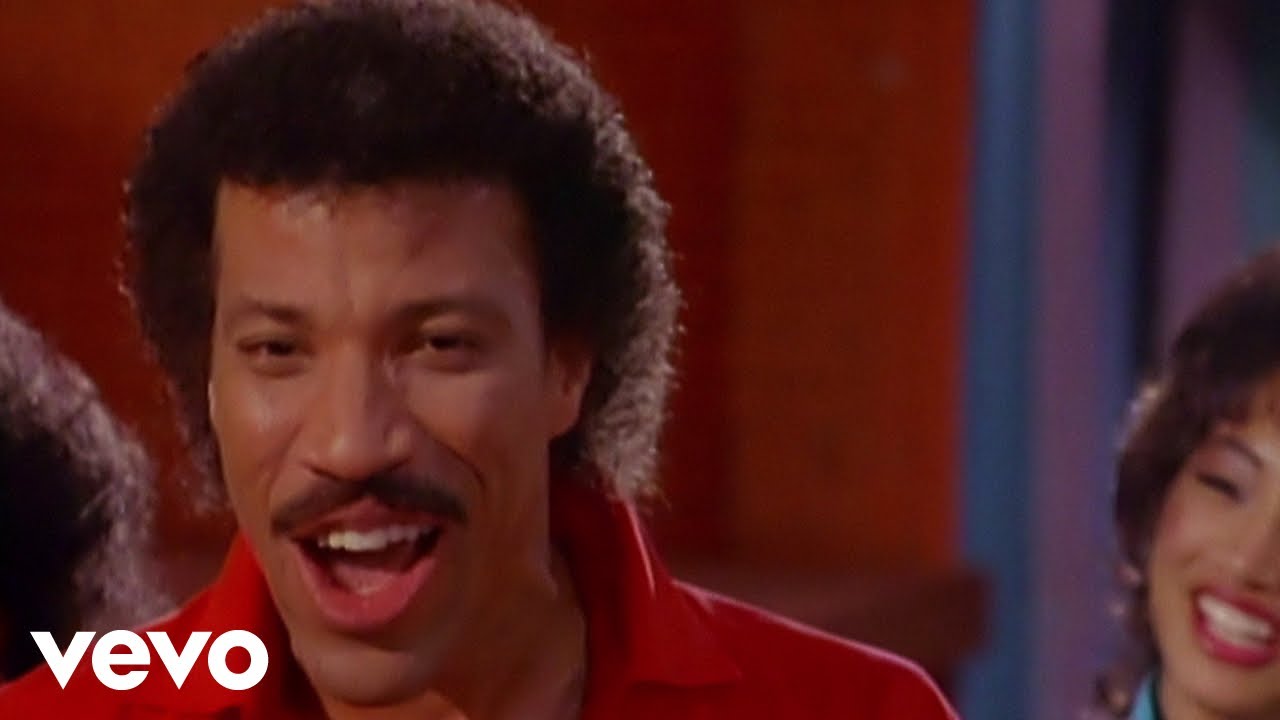
Lionel Richie – All Night Long (All Night)
The Caribbean chant that millions have sung along to for forty years — “Tom bo li de say de moi ya” — means absolutely nothing, and Lionel Richie made it up that way on purpose.
Tens of millions of people have happily sung along to the chant in the middle of All Night Long (All Night) — “Tom bo li de say de moi ya, yeah, jambo, jumbo” — and almost none of them know a secret Lionel Richie has cheerfully admitted for decades: it doesn’t mean anything. There’s no translation, no hidden African phrase, no Caribbean proverb buried in the syllables. Richie invented them to sound like the kind of chant you might hear on a Bob Marley record, then built one of the biggest hits of the 1980s around the feeling rather than the meaning. When a journalist pressed him on it at the height of the song’s success, he admitted that, like a lot of Marley’s chants, the words don’t really translate to anything — they just sound right.
Keep watching: Lionel Richie – Hello · Lionel Richie – Say You, Say Me
That invention was the whole point. By 1983, Richie had spent the better part of a decade as the king of the slow dance. He’d come up through the Commodores, the Motown band he fronted, where he learned his craft writing party-funk for sweaty arenas — but it was the ballads that made him rich. “Easy,” “Three Times a Lady,” “Still”: one tender, gooey love song after another, the kind of thing that could fill a wedding floor for the next forty years. When he went solo in 1982, the formula came with him, and his debut single “Truly” gave him his first solo No.1 in the same sincere mold. He could have kept making those records forever, and the world would have kept buying them.
Instead, working on his second solo album Can’t Slow Down, Richie deliberately reached for something else. He wanted to write a record people could dance to on vacation — a genuinely international party song, music with no single home country. He fused the up-tempo party-funk of his Commodores days with a bright, sunlit Caribbean lilt, the rhythms of calypso and reggae filtered through a Motown pop sensibility. The made-up chant was the keystone of that idea: real lyrics in a real language would have pinned the song to a place, but invented syllables let it belong to everyone and no one at once. It was a calculated act of universality, and it worked precisely because it refused to mean anything specific.
From ballad king to the top of three charts
Released as the lead single from Can’t Slow Down on August 31, 1983, All Night Long did exactly what Richie wanted, and then a great deal more. It had been climbing the pop chart since mid-September, already in the middle of a long run atop the R&B survey, when it completed its ascent to No.1 on the Billboard Hot 100 on November 12, 1983, seizing the crown from Kenny Rogers and Dolly Parton’s “Islands in the Stream.” It held the pop summit for four weeks, spent seven weeks at No.1 on the R&B chart, and topped the Adult Contemporary chart as well — a clean sweep of three entirely different Billboard surveys, the mark of a song that crossed every audience line at once. In the United Kingdom it reached No.2.
The record was cut at Ocean Way Studios on Sunset Boulevard in Los Angeles in the spring of 1983, co-produced by Richie with his longtime collaborator James Anthony Carmichael, and it carried the fingerprints of a small army of top session players. Greg Phillinganes, one of the most in-demand keyboardists of the era, handled synthesizers; the Brazilian percussionist Paulinho da Costa laid down the layered Caribbean rhythms that give the track its motion; and among the backing vocalists was a then-completely-unknown young singer named Richard Marx, years before his own run of chart-toppers. The song would go on to a strange afterlife on television, too, turning up in the pilot episode of Miami Vice — Richie was meant to appear and perform it on screen, but was away on tour, so an unnamed band mimed it in his place.
The album it launched became a phenomenon that dwarfed even the single. Can’t Slow Down produced five Top 10 singles — every one of its singles cracked the Hot 100’s top ten — sold more than ten million copies in the United States on its way to diamond certification, and over twenty million worldwide, making it one of the best-selling albums of the entire decade. In 1984 it won the Grammy for Album of the Year, beating a field that included Bruce Springsteen, Tina Turner, Cyndi Lauper, and Prince’s Purple Rain. It was the record that lifted Richie out of the ranks of successful balladeers and into the rarefied tier of early-’80s superstardom, the air that only Michael Jackson and a handful of others were breathing.
Two billion people, one song
The song reached its full potential nine months after it topped the chart, in a single staggering moment. In August 1984, Lionel Richie performed All Night Long at the closing ceremony of the Summer Olympics in Los Angeles, before a packed stadium and an estimated worldwide television audience of around two billion people — one of the largest audiences any pop song has ever commanded in a single performance. The made-up chant, designed from the start to belong to no nation and every nation, turned out to be perfect for the assignment: an entire planet singing the same joyful nonsense syllables in unison, with nothing to divide them and nothing to translate. A song engineered for universality got the most universal stage on Earth.
That is the quiet genius of All Night Long. It’s often filed away as a pleasant, low-stakes piece of feel-good pop, and on the surface it is — but underneath the easy smoothness sits a real act of craft: a ballad writer at the peak of his powers deliberately stepping outside everything that had made him famous, and inventing a brand-new musical language out of pure sound to do it. Lionel Richie was born on June 20, 1949, in Tuskegee, Alabama, and turns 77 in June 2026. More than four decades on, the song remains the sound of him at his most generous and most ambitious — the moment the king of the slow dance decided the whole world should get up and move, and then talked the whole world into it.
SONG INFORMATION
Enjoyed this one? New forgotten gems every day — tap Music Videos Club below to visit and follow us on Facebook:
Related videos
 Watch LaterAdded
04:41
Watch LaterAdded
04:41  Watch LaterAdded
04:50
Watch LaterAdded
04:50  Watch LaterAdded
04:30
Watch LaterAdded
04:30