







Sandra – Maria Magdalena
German radio turned down Sandra’s first international single, so Virgin sold it to tourists in Greece and let them carry it home.
Virgin released (I’ll Never Be) Maria Magdalena on July 15, 1985, and German radio would not play it. The label stopped pushing the home market and worked the Greek holiday circuit instead, putting the record into the hands of DJs playing to tourists. It went to No.1 in Greece. The tourists flew home and asked for it, and on September 13 the single reached No.1 on the West German chart, where it stayed for four weeks. Austria, Switzerland, Sweden, Norway, Finland, Portugal and the Netherlands followed. A German pop record had gone around the Mediterranean to reach German listeners.
Keep watching: More 80s music videos · explore more →
The singer at the center of it was twenty-three and already a veteran. Sandra Ann Lauer, born in Saarbrücken on May 18, 1962, had joined the disco trio Arabesque in 1979 and sung lead through nine albums. Arabesque were enormous in Japan and the Soviet Union and close to invisible in Western Europe, with one German top 10 hit, “Marigot Bay”, to show for six years of work. When the group folded, Sandra moved to Munich with keyboardist Michael Cretu, who had built his own studio there. Their first single together, in 1984, was “Japan ist weit”, a German-language cover of Alphaville’s “Big in Japan”. It sold 125 copies. The woman singing it had spent five years genuinely being big in Japan.
A name that had to have seven syllables
What changed the following year was a chorus, and the chorus came before the subject. Hubert Kemmler of the synth-pop act Hubert Kah, writing with Markus Löhr and Cretu, needed a seven-syllable name to fill the hook. English offers “Mary Magdalene”, which gives you six. The German form fit exactly, so the German form stayed, and the biblical allusion arrived as a consequence of the meter rather than the other way round. Richard Palmer-James, the English lyricist who had written the words for King Crimson a decade earlier, built the rest of the lyric around that borrowed name. Kemmler also sang co-lead on the recording, which means the male voice answering Sandra through the chorus belongs to a rival German chart act.
Cretu arranged and produced it, and the record is a compact demonstration of what he could do with a Munich studio in 1985: a bassline that never lets up, a drum sound bigger than the room it was made in, and a vocal mixed close enough to carry across a crowded floor. Nothing about the arrangement asks the listener to understand English. That was the point, and it is why the song worked in Portugal and Finland in the same month.
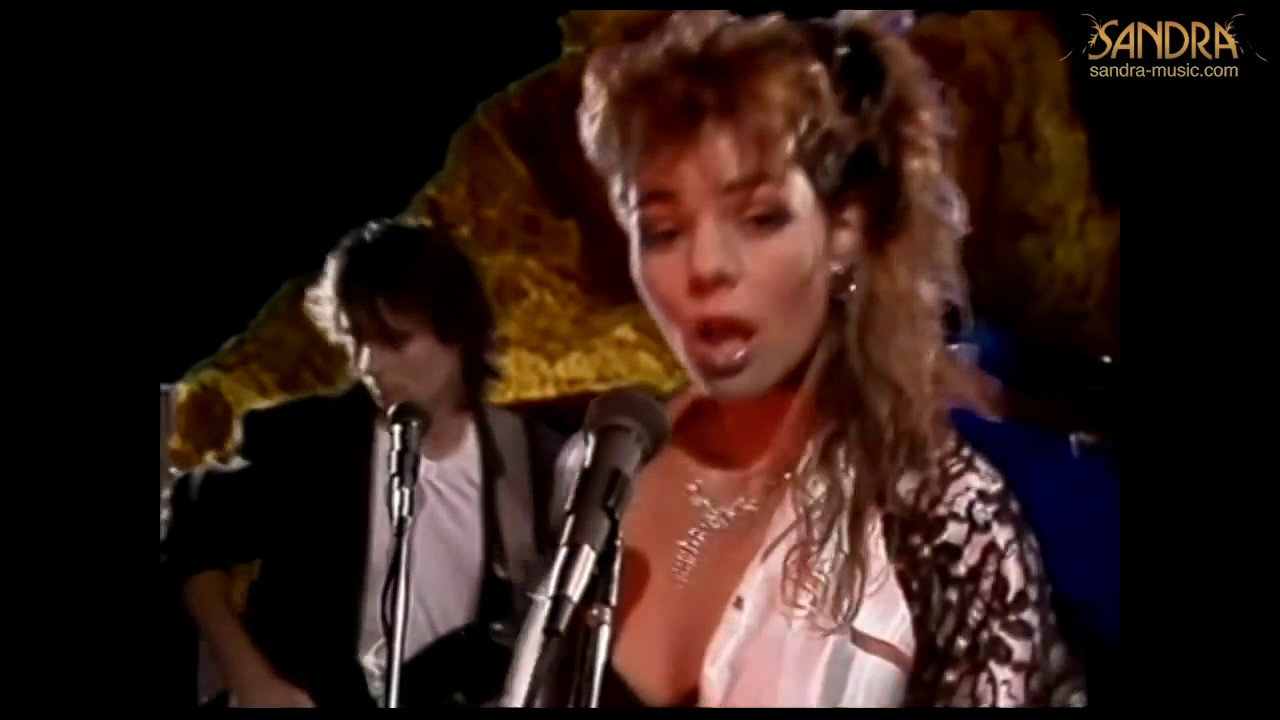
The video matches the modesty of the operation. It is a performance piece filmed in 1985 and directed by Mike Leckebusch, who had co-created Beat-Club in 1965 and then directed every episode of Musikladen until that show ended in November 1984. Nine months after German television’s most important pop director lost his program, he was shooting a debut solo artist with a three-piece band behind her: Peter Ries on bass and backing vocals, Wolfgang Filz on drums, Frank Peterson on keyboards. Peterson would contribute to the first Enigma album five years later, when Cretu wrapped Gregorian chant around a dance beat and Sandra’s whispered vocal and sold it to the world.
The hit did not travel everywhere. Britain put it at No.87, and America never heard it at all, which is why an artist with more than thirty million records sold remains a name most American listeners have to be introduced to. Germany certified the single gold and France silver. A techno re-recording in 1993, with a new video by Marcus Adams, reached the top 10 in Finland and went nowhere else. Sandra returned to the song herself in 2006 on a remix album and sampled the 1985 original on a track in 2012.
Forty-one years on, the record stands as the clearest evidence of something the American chart narrative of the 1980s tends to skip: a European pop hit did not need Britain or the United States, or even its own national radio, to become enormous. It needed a producer with a studio, a name a Greek, Dutch or Swedish listener could sing without parsing the verse, and a dancefloor willing to test it. Sandra got all three in one summer, and never needed another introduction anywhere in Europe again.