






Wilson Phillips – Hold On
Someone Told Her It Was Corny and Would Go Nowhere — It Became the Biggest-Selling Single of 1990
Chynna Phillips had barely made it home when the lyric arrived. Producer Glen Ballard had handed her a cassette — an instrumental track that needed words — and suggested she work on them overnight. She didn’t get through her front door before inspiration struck. The phrase that came to her, standing right there on the threshold, was drawn directly from what she was absorbing in Alcoholics Anonymous: the principle of taking recovery one day at a time, of not looking too far ahead, just holding on. She was in the middle of a destructive relationship and privately battling substance abuse, and the song that emerged from those circumstances was at once deeply personal and radiantly universal. When she returned the next morning and sang the finished lyric for Ballard and the Wilson sisters, they loved it immediately. Not everyone agreed. On another occasion, she played it for a man who told her flatly that it wasn’t going anywhere — that it was, in his estimation, really corny. She later recalled thinking quietly that she hoped he was wrong. Hold On became the best-selling single in the United States in 1990.
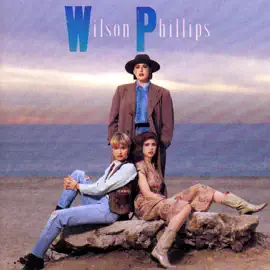
Wilson Phillips had been generating curiosity before anyone had heard them play. The group’s pedigree was exceptional even by Los Angeles standards: Carnie and Wendy Wilson are the daughters of Brian Wilson of The Beach Boys, while Chynna Phillips is the daughter of John and Michelle Phillips of The Mamas & the Papas. The three had grown up together in Los Angeles during the 1970s and ’80s, developing their vocal blend naturally — harmonies absorbed as much as learned. When producer Richard Perry introduced them to Glen Ballard in 1989, the collaboration clicked from the outset. Ballard was already a figure of real consequence: he had recently co-written Michael Jackson’s “Man in the Mirror,” a number one hit in 1988, and he would later co-write and produce Alanis Morissette’s Jagged Little Pill. Working at his home studio in Encino, the four of them recorded a four-song demo that included Hold On. That demo immediately set off a bidding war among record labels, and Wilson Phillips signed with SBK Records in 1989.
The group moved to Cherokee Recording Studios on Fairfax in Los Angeles for the full album sessions, with Ballard producing throughout. His approach in the studio reflected a philosophy shaped by his early career under Quincy Jones — bring in the finest musicians available, let them do their thing, then integrate their contributions. The recording of Hold On itself captured the group’s instinctive unity: all three sang their three-part harmony into a single microphone, which was simply how they always worked. The result was a sound that felt simultaneously polished and immediate — lush enough for adult contemporary radio, direct enough to reach anyone. SBK released Hold On in February 1990, a full three months before the debut album, sending the group out on a promotional tour that largely consisted of journalists asking them what it was like to have famous parents.
From Radio to Number One — on a Date That Meant Something Extra
The song moved through radio steadily and then decisively. By June 1990, Hold On was displacing Madonna’s “Vogue” from the top of the Billboard Hot 100. It reached number one on June 9, 1990 — a date that carried its own private symmetry: exactly 25 years earlier to the day, Brian Wilson’s Beach Boys had occupied that same chart position with “Help Me, Rhonda.” The daughters of two of pop music’s most storied families had just made history of their own. Hold On spent a single week at number one and also topped the Adult Contemporary chart, but its presence on radio far outlasted that brief summit. Billboard ranked it as the top song of the entire year — a striking outcome for a track that had held the top position so briefly. Outside the US, it reached number six on the UK Singles Chart following a performance on Top of the Pops, and peaked in the top three in both Australia and Canada.
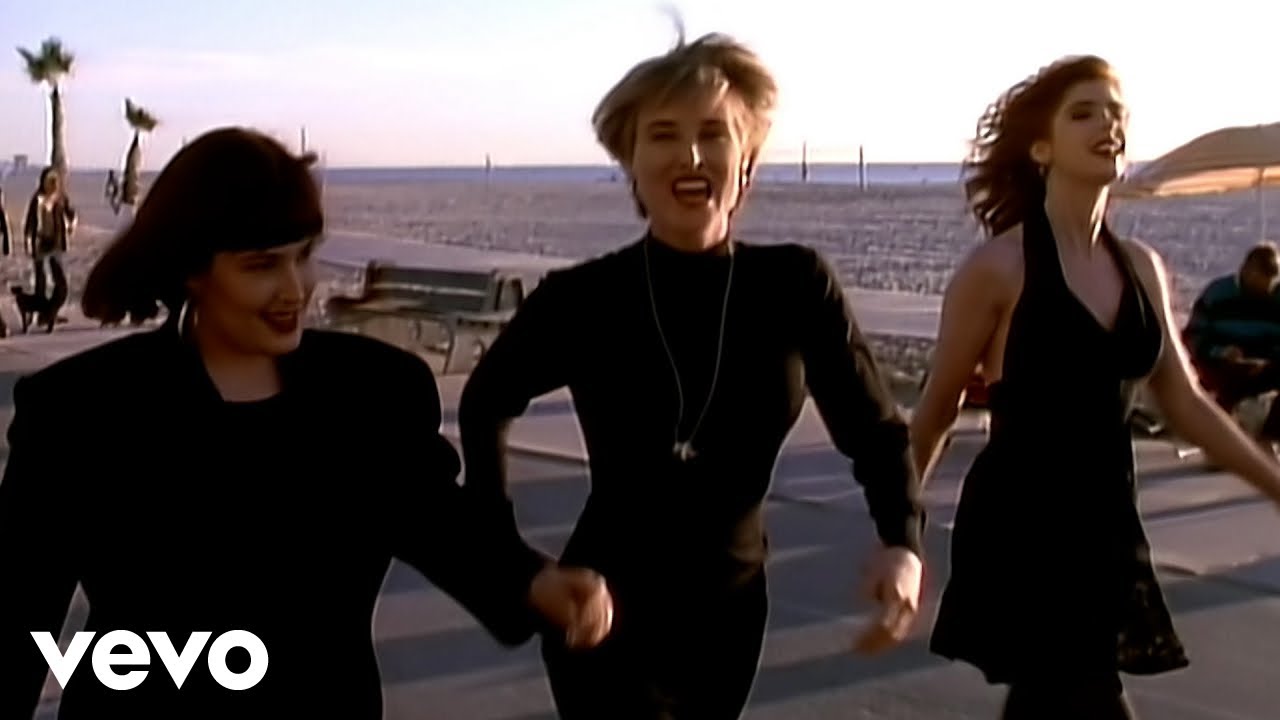
The music video for Hold On was directed by Julien Temple — a British filmmaker whose previous clients had run considerably harder: the Sex Pistols, Judas Priest, Depeche Mode, David Bowie, The Rolling Stones. For Wilson Phillips, Temple chose to lean into the breadth of the California landscape rather than reduce it to any single cliché. The video opens with aerial footage of the San Gabriel Mountains, the group positioned on the slopes at Mt. Baldy, before descending to the beaches and boardwalk of Venice. Wendy Wilson later recalled wanting the video to feel genuinely Californian, and Temple gave them that — wide-open, sun-saturated, the state itself as a frame around three voices. The contrast with Temple’s harder-edged catalogue was entirely deliberate; the song demanded a different register, and he found it.
A Second Life, and a Legacy That Kept Accumulating
At the 33rd Annual Grammy Awards, Hold On received nominations for Song of the Year and Best Pop Vocal Performance by a Duo or Group, competing in both categories without winning. The group’s debut also earned nods for Best New Artist and Album of the Year. Then the song did what durable pop songs do — it found new contexts. In 2011, Wilson Phillips appeared in the finale of the film Bridesmaids, performing Hold On at the wedding as Maya Rudolph and Kristen Wiig responded with the kind of full-body, lip-synced devotion that makes footage go viral. The scene became one of the most talked-about moments in a widely loved film, and it brought the song back into active rotation for a generation encountering it on its own terms. Billboard placed Hold On at number 15 in its “100 Greatest Girl Group Songs of All Time” in 2017; Pitchfork included it in “The 250 Best Songs of the 1990s” in 2022; Billboard placed it at number 312 on its “500 Best Pop Songs of All Time” the following year. When Glen Ballard was inducted into the Songwriters Hall of Fame in 2023, Wilson Phillips were present at the ceremony, each of them speaking to the contribution of the man they had come to regard as the group’s unofficial fourth member.
SONG INFORMATION
Related videos
 Watch LaterAdded
04:05
Watch LaterAdded
04:05  Watch LaterAdded
02:57
Watch LaterAdded
02:57  Watch LaterAdded
03:04
Watch LaterAdded
03:04