





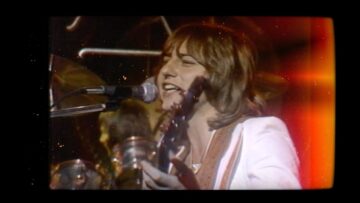



George Baker Selection – Una Paloma Blanca
He Named Himself After a Character in a Detective Novel, Was Working in a Lemonade Factory When His First Hit Reached Number One, and Then Wrote a Spanish-Titled Song About Freedom From the Netherlands That Went to Number One in Eleven Countries
The name George Baker was borrowed from a character in a crime novel. The man behind it, Hans Bouwens, was born in Hoorn in the Netherlands on December 8, 1944, months after his father — an Italian soldier put to labor by the Germans in nearby Grosthuizen — was killed while attempting to escape. He grew up on Otis Redding and Sam and Dave, joined a soul cover band called Soul Invention in Assendelft in 1968, and by 1969 had co-written a song with bassist Jan Visser during a rehearsal that was supposed to be called “Little Greenback” but went to press as “Little Green Bag” due to a printing error at the Negram label. He was still working at the lemonade factory when he heard it on the radio. It reached number 21 on the Billboard Hot 100. The second single, “Dear Ann,” was successful enough that he quit the factory. By 1975, the George Baker Selection had released five albums and Hans Bouwens had written “Paloma Blanca” — a Spanish-titled song about freedom, recorded in the Netherlands, by a Dutch band, that would become one of the most widely heard recordings of the decade.
George Baker has said the song is about a poor South American farmer who works hard all day and then sits by a tree and dreams of being a white bird with its freedom. The image is deceptively simple — the white dove as a symbol of escape from labour and limitation — and it landed with audiences across a remarkable range of territories simultaneously. Some have suggested the song was shaped by the mood of the 1974 Portuguese Carnation Revolution, which ended decades of authoritarian rule and became symbolically associated with liberation imagery including white doves and flowers. Whether or not that connection was intentional, the timing was right: “Paloma Blanca” emerged into a European cultural moment primed for exactly that metaphor. The arrangement matched the lightness of the theme — acoustic guitar providing the rhythmic foundation, a distinctive flute solo giving it an airy folk-like quality, the production open and unhurried. Baker produced the record himself, under his real name Hans Bouwens, on the Negram label.
Eleven Countries at Number One
The single went to number one in Austria, Finland, Flanders, the Netherlands, Norway, Sweden, Switzerland, West Germany, New Zealand, and South Africa. In the United States it reached number 26 on the Billboard Hot 100 and — a figure that tells the real story of where the song lived in American radio — number one on the Easy Listening Singles chart on February 14, 1976, becoming that chart’s overall number one song for the full year of 1976. It also reached number one on the Canadian Adult Contemporary chart and number two in Australia. In the United Kingdom, the chart picture was unusually complicated: music publisher Terry Noon had heard the song in Holland, was convinced it was a number one, badgered Jonathan King into recording it as “Una Paloma Blanca,” and the two versions — the George Baker Selection’s original and King’s cover — raced up the British charts simultaneously through the autumn of 1975. When the dust settled, King’s version had peaked at number five and the George Baker Selection’s at number ten: the cover had outperformed the original in the one major market where the song’s full potential was most contested. The single ultimately sold over seven million copies worldwide, making it one of the most successful Dutch singles ever recorded and one of the most played songs in the history of European radio.
The song attracted cover versions from across the continent almost immediately. Nina and Mike recorded a German-language version that reached number six in Germany and number seven in Austria. Siw Malmkvist took a Swedish rendering to number eight in Sweden. The Wurzels, an English Scrumpy and Western band, adapted it in 1976 as “I Am a Cider Drinker” — replacing the white dove and South American farmer with scrumpy, rabbit stew, combine harvesters, and evenings at the local pub — and reached number three on the UK singles chart, which remains one of the stranger metrics for any song’s cultural reach. A Serbian version, Afrikaans versions, Czech and Hungarian renditions, and many others followed. Across all languages and arrangements, the underlying melody proved to be genuinely universal — accessible enough to carry any cultural freight placed on top of it, sturdy enough to survive the Wurzels.
What the Lemonade Factory Produced
The George Baker Selection split in 1978. The band reformed in 1982 and stayed together until 1989. The catalog sold over 20 million records worldwide across both incarnations. Then, in 1992, Quentin Tarantino used “Little Green Bag” — the printing-error hit from 1969 — as the opening sequence music for Reservoir Dogs, the suits and shades walking in slow motion, and an entirely new generation encountered George Baker’s first decade of work from the opposite direction: the cool 1990s crime film pointing backward to the Dutch lemonade factory town where it had all started. That same year the song reached number one in Japan after being used in a whiskey commercial. “Paloma Blanca,” meanwhile, has never needed a film placement or a commercial to maintain its presence. It occupies a specific register of European collective memory — the kind of song that arrives at a party or on a radio in a car or through a speaker in a supermarket and produces an instant, involuntary response in anyone who was alive when it was everywhere. Hans Bouwens named himself for a detective novel character, borrowed the title of his biggest hit from another language, and wrote about a farmer dreaming of a bird in the sky. The song has never stopped flying.
SONG INFORMATION
Related videos
 Watch LaterAdded
03:13
Watch LaterAdded
03:13  Watch LaterAdded
03:21
Watch LaterAdded
03:21  Watch LaterAdded
03:05
Watch LaterAdded
03:05