


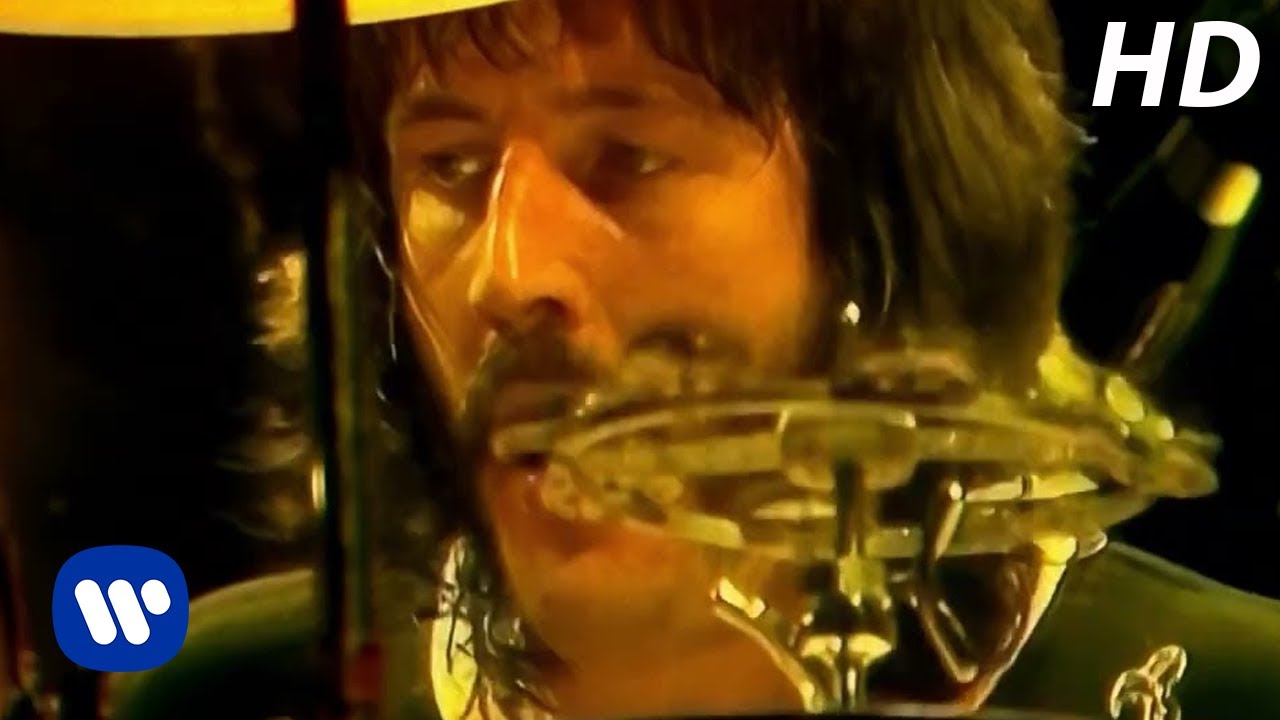
Led Zeppelin – Trampled Under Foot (Live at Earls Court 1975)
The Groove Stevie Wonder Started and Led Zeppelin Finished — Live at the Peak of Everything
Robert Plant’s introduction for “Trampled Under Foot” at Earl’s Court on May 24, 1975 placed the song squarely in its own tradition — naming the automotive metaphor, acknowledging the blues heritage, and then stepping back to let the music make the argument. The song that followed was five and a half minutes of the most propulsive funk-rock Led Zeppelin ever recorded, built around John Paul Jones’ Clavinet riff and John Bonham’s kick drum pattern, and delivered to 17,000 people in West London at a moment when Physical Graffiti was the biggest album in the world. Melody Maker’s Chris Welch, reviewing the show that night, called the band firing on all cylinders at their absolute best. Nobody who was in that room has disputed the assessment in the fifty years since.
“Trampled Under Foot” was released as a single in the United States, Canada, Australia, Japan, and a dozen other territories in 1975, reaching Number 38 on the Billboard Hot 100 and Number 41 in Canada. In the UK, Led Zeppelin did not release commercial singles — a policy they maintained from their 1969 debut until 1997, when “Whole Lotta Love” was finally issued twenty-eight years after recording. For the Earl’s Court residency, Swan Song pressed a limited run of UK 7-inch singles specifically as promotional incentives for record stores stocking Physical Graffiti — 5,000 copies, labelled “Special Limited Edition,” distributed and then shelved before commercial release. Those copies are now among the most sought-after collector’s items in the entire Zeppelin discography. The song was too good for the format the band refused to use.
The song’s origin sits in a studio jam from 1972 — the Houses of the Holy sessions at Headley Grange, where the basic rhythmic idea first surfaced and was set aside. Two years later, returning to Headley Grange for Physical Graffiti, John Paul Jones brought the concept back and built it into something structurally complete. His starting point was “Superstition” — Stevie Wonder’s 1972 Clavinet track, whose interlocking rhythm and keyboard-driven propulsion Jones had identified as the model for what he wanted the groove to do. The Hohner Clavinet D6 that Jones played on the recording was the same instrument Wonder had used. Page added backwards echo and wah-wah — a combination he described as producing sounds he couldn’t entirely account for in retrospect — while Plant’s lyric assembled an extended automotive metaphor that drew on Johnson’s “Terraplane Blues” thematically without sharing a single lyric line. The argument that Zeppelin had stolen the words rather than the idea was not supported by any direct comparison of the two texts. It was, however, a conversation that the band had decided to address head-on rather than avoid — which is why Plant named Johnson explicitly at Earl’s Court, and why Bonham’s mock accusation played as comedy rather than confession.
Recording took place at Headley Grange in January 1974, with Olympic Studios in London handling the mix in October of that year. Page produced using the Rolling Stones Mobile — the same remote recording unit that had captured “When the Levee Breaks” in the hallway at Headley Grange three years earlier, its positioning in the room giving the drums the kind of natural cavernous reverb that studio recording of the era struggled to replicate artificially. Bonham’s contribution to “Trampled Under Foot” was, like everything he played, technically straightforward and physically overwhelming: the kick drum pattern that locks against Jones’ clavinet riff creates the song’s basic premise before a vocal note has sounded. The song was credited to Jones, Page, and Plant — Bonham, as was the band’s standard practice with compositions of this kind, not listed despite his structural role in developing the groove from the original 1972 jam.
The Earl’s Court performances of “Trampled Under Foot” extended the studio version considerably — Jones taking the clavinet solo sections further than the recording allowed, Page adding wah-wah passages, Plant improvising verses from “Gallows Pole” in the extended live arrangement on some nights. The five-night residency had been expanded from three dates after tickets for the first three sold out within four hours — a feat promoter Mel Bush described as unprecedented in British rock history. Two additional nights were added. All five sold out. The band had arrived at Earl’s Court on the commercial crest of Physical Graffiti‘s Number One debut on both sides of the Atlantic, and the performances reflected both the confidence of that position and the genuine pleasure the band took in the new material. Critics noted that Zeppelin visibly enjoyed playing Physical Graffiti live more than their older catalog. “Trampled Under Foot” was, on this evidence, the most purely joyful thing they played.
“Trampled Under Foot” was performed at every Zeppelin concert from 1975 to 1980 — every tour, every show, without exception — and appeared at the O2 reunion on December 10, 2007 with Jason Bonham behind the kit. Plant sang it at his daughter Carmen’s twenty-first birthday party in November 1989. It was one of his favourite Zeppelin songs, he said — a piece of music that delivered what it promised without qualification. At Earl’s Court on May 24, 1975, Plant introduced it with a rolling growl and a grin. Bonham accused him of theft. The clavinet riff answered both of them. The band that played what followed was, on any honest assessment, the best rock band in the world performing at the peak of its ability. The motor cars and the parts of the human body have never sounded better together.