



![The Dead South – You Are My Sunshine [Official Music Video]](https://musicvideosclub.com/wp-content/uploads/2026/01/the-dead-south-you-are-my-sunshi-360x203.jpg)








Dua Lipa – Oye Mi Amor (Feat. Fher de Maná) [Live From Mexico]
For her entire 2025 world tour, Dua Lipa learned one local song in every country she played. In Mexico City, she picked a 1992 rock en español classic — and brought the man who wrote it onto the stage to sing it with her.
Dua Lipa had been doing this all year. Across the 2025 leg of the Radical Optimism Tour, the English-Albanian pop star had made a practice of learning one song native to each major market she played and performing it live, in the local language, as a gift to the audience in front of her. In Spain it was Enrique Iglesias’s “Héroe.” In Argentina it was Soda Stereo’s “De Música Ligera.” In Chile it was Mon Laferte’s “Tu Falta de Querer” and La Ley’s “El Duelo.” In Brazil she sang Sergio Mendes’s “Magalenha” alongside Carlinhos Brown. In Peru she performed “Cariñito” with Mauricio Mesones; in Colombia, Shakira’s “Antología.” When the tour reached Mexico City in early December 2025 for the three sold-out concerts at Estadio GNP Seguros that would close the entire global run, Lipa had three nights to fill and three covers prepared. On the first night, December 1, she sang “Bésame Mucho,” the Consuelo Velázquez bolero, in the arrangement Luis Miguel had recorded in 1997. On the final night, December 5, she danced through Selena’s “Amor Prohibido.” On the middle night, December 2, she did something she had not done in any other city. She brought the songwriter on stage.
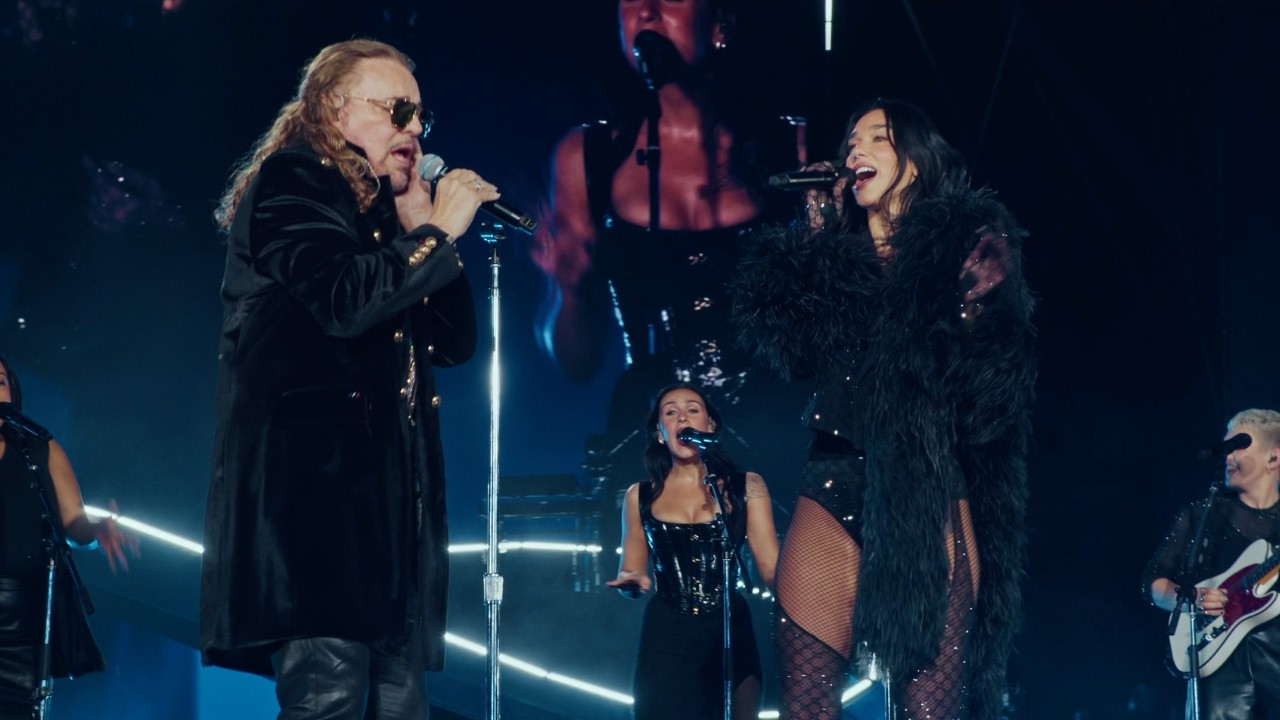
“Tonight we are very lucky,” Lipa told the 65,000 people inside the stadium, speaking in Spanish, “because we have someone very special who is going to sing with us.” Fher Olvera walked out. The co-founder and lead vocalist of Maná — the Guadalajara band that has been the defining force in rock en español for nearly four decades — stepped into a roar that grew louder still when the opening guitar figure of “Oye Mi Amor” began to play. The song belongs to Olvera in a specific way: he wrote it. “Oye Mi Amor” was the lead single from Maná’s 1992 album ¿Dónde Jugarán los Niños?, released as a single on September 7 of that year, and Olvera had composed it with the band’s drummer Alex González. It is a song about a man pleading for a chance with a woman who is committed to someone else — someone, in the lyric’s framing, who is not right for her — and it became the record that pushed Maná from a successful Mexican act into one of the most popular bands in the entire Spanish-speaking world. For Olvera to sing it in 2025 alongside a 30-year-old British pop star in front of a Mexico City stadium was, as one attendee put it on social media afterward, a bridge between global pop and Latin rock built in real time.
The song Mexico has carried for thirty-three years
“Oye Mi Amor” came out when ¿Dónde Jugarán los Niños? was released on October 27, 1992. The album was recorded at Devonshire and Ocean Way studios in Hollywood across 1991 and 1992, produced by Maná — Olvera, González, and José Quintana — with the Chilean-born engineer Humberto Gatica handling the recording. It reached No. 4 on Billboard’s Top Latin Albums chart, the band’s first top-ten entry on that chart, and went on to become one of the best-selling Spanish-language rock albums ever made, spending close to a hundred weeks on Billboard’s Latin sales listings. The album carried “Vivir Sin Aire,” “Cachito,” “De Pies a Cabeza,” “Te Lloré un Río,” and the title track alongside “Oye Mi Amor” — a run of singles deep enough that the album produced commercial hits in Latin America for the better part of two years after its release. Maná have since sold more than 40 million records worldwide, won four Grammy Awards and a string of Latin Grammys, received a star on the Hollywood Walk of Fame, and in early 2025 became the first Spanish-language rock band ever nominated for induction into the Rock and Roll Hall of Fame. Fher Olvera has been the band’s lead voice and primary songwriter through all of it. When he agreed to walk onto Dua Lipa’s stage, he was bringing a song that a generation of Mexican listeners has known by heart since childhood.
Olvera’s words to the crowd that night were brief. “Thank you, Mexico, for keeping this song alive all these years,” he said. “And thank you, Dua, for this tribute.” Lipa answered: “It’s an honor to sing with you, Fher, and to celebrate Mexican music with all of you.” The two voices traded the verses; the stadium sang the rest. The performance was captured by the tour’s film crew, working under the British concert-film director Paul Dugdale — whose previous work documenting live music includes concert films for Coldplay and Taylor Swift — across all three Mexico City nights.
From the stadium floor to a worldwide release
The footage has now been released. On May 21, 2026, Dua Lipa premiered Dua Lipa: Live From Mexico — the full concert film built from the three December shows at Estadio GNP Seguros — free on her official YouTube channel, with a companion live album arriving on streaming services the same day. The film runs a little over two hours and collects 21 tracks, the Radical Optimism material punched up to stadium scale alongside the catalog hits — “Levitating,” “New Rules,” “Don’t Start Now,” “Houdini,” “Physical,” “Training Season” — and a stripped-back reading of the deep cut “Anything for Love.” The “Oye Mi Amor” duet with Fher Olvera, drawn from the December 2 performance, sits inside the film as its single most location-specific moment: the one song on the setlist that exists because of where the tour ended rather than where it began. The film closes the Radical Optimism Tour as a permanent document — the tour itself wrapped on December 5, 2025, on the same Mexico City stage.
The performance featured on this page is the official “Oye Mi Amor” segment, released jointly through Dua Lipa’s channel and Maná’s official channel. It catches a 30-year-old British pop star at the close of the biggest tour of her career, standing next to the 66-year-old Mexican songwriter whose work she had chosen to honor, in front of a stadium crowd that knew every word before either of them sang it. Dua Lipa has spent the Radical Optimism era making the case that a global pop tour can be a conversation with each place it visits rather than a single show repeated in eighty cities. “Oye Mi Amor,” sung in Spanish with the man who wrote it, in the city that has carried the song for thirty-three years, is the clearest piece of evidence she has put on record for that idea.