





Grace Jones – I’ve Seen That Face Before (Libertango)
Grace Jones’s Then-Boyfriend Jean-Paul Goude Found a 1974 Astor Piazzolla Tango Instrumental Called “Libertango” and Brought It Home. Jones, Barry Reynolds, and Chris Blackwell’s Girlfriend Nathalie Delon Turned It Into a Song About the Dark Side of Parisian Nightlife.
The piece of music that Jean-Paul Goude — the Haitian-French photographer, illustrator, and image-maker who had been Grace Jones’s romantic and creative partner since 1979, and the man who had built her entire visual identity around the painted-mask aesthetic that was making her one of the most-photographed faces of the early 1980s — had brought home to Jones in the late autumn of 1980 was a four-minute Argentine tango instrumental called Libertango. The instrumental had been composed and recorded in 1974 by Astor Piazzolla, the seventy-year-old Argentine bandoneonist and composer who had spent his working life pulling tango out of the Buenos Aires nightclubs of his youth and reshaping it into a concert-hall art music that classical critics and tango traditionalists could agree on equally. Piazzolla’s recording was structured around the bandoneon — the Argentine button accordion — playing the song’s eight-note melodic figure over the steady tango pulse. The piece had become, across the late 1970s, a staple of European classical-crossover programming. Goude played the recording for Jones at her New York apartment. She decided, within hours, that the song needed to be reworked for the album she had been about to begin recording at Compass Point Studios in Nassau, Bahamas — the album that would become Nightclubbing.
The reworking was a collaboration between four people. Barry Reynolds, the British guitarist who had been part of Marianne Faithfull’s working band since the late 1970s and who had been brought into Grace Jones’s circle by Chris Blackwell, wrote a new verse melody and the English-language lyric structure. Jones herself wrote the chorus and shaped the song’s central performance. The dark thematic content — a first-person narrative situated in Parisian nightlife, describing the recognition of a face that has been seen before, the dangerous edge of late-night Paris, a meditation on death and desire — emerged from the writing sessions with Reynolds. The French spoken passage that runs through the song was contributed by Nathalie Delon, the French film actress (and Chris Blackwell’s romantic partner at the time) who wrote the words “Tu cherches quoi? À rencontrer la mort? Tu te prends pour qui? Toi aussi tu détestes la vie…” — translating loosely as “What are you looking for? To meet death? Who do you think you are? You too hate life…” The American songwriter Dennis Wilkey received a co-writing credit for additional structural contributions. The publishing rights to Piazzolla’s Libertango melody had been negotiated and licensed before the recording began. The final song had four credited writers: Piazzolla, Reynolds, Wilkey, and Delon.
The Compass Point All Stars and the Recording at Nassau
The recording session at Compass Point Studios in Nassau was produced by Alex Sadkin — the American engineer and producer who had been working with Bob Marley and the Wailers, Black Uhuru, and most of the major Caribbean and reggae crossover acts that recorded at Compass Point through the late 1970s — alongside Island Records founder Chris Blackwell, the British label owner who had built Compass Point Studios in 1977 specifically to capture the cross-pollination of reggae, dub, new wave, and Anglo-American pop he had identified as the emerging commercial sound of the 1980s. The backing band was the Compass Point All Stars — the assembled rhythm section that had recorded all three of Grace Jones’s Compass Point trilogy albums (Warm Leatherette in 1980, Nightclubbing in 1981, and Living My Life in 1982). Sly Dunbar played the drums; Robbie Shakespeare played the bass; Wally Badarou played the keyboards; Barry Reynolds and Mikey Chung played the guitars; Sticky Thompson played the percussion. The arrangement Sadkin and Blackwell built around Jones’s vocal pulled the tango-pulse foundation of Piazzolla’s original through a reggae-influenced rhythmic feel, with the bandoneon-style accordion replaced by a single keyboard line carrying the Libertango melody, the Sly and Robbie rhythm section locked tight underneath, and Jones’s vocal delivered at the front of the mix in the controlled mid-register chest voice that defined her early-eighties recordings. The song was completed in early 1981. Island released the single on May 11, 1981 with Warm Leatherette on the B-side, the same day the parent album was released.
The chart climb was rapid across Europe. I’ve Seen That Face Before (Libertango) reached the Top 20 across multiple continental European singles markets within weeks of release. In the United Kingdom the single peaked at number twelve on the UK Singles Chart — Grace Jones’s biggest British hit to that point. In Italy, France, the Netherlands, and West Germany the song reached the Top 10 and became, for the rest of the year, the principal Grace Jones recording in continental European radio rotation. The song also crossed back into the Spanish-speaking market. Jones recorded a Spanish-language version of the lyric — “Esta cara me es conocida,” translated by the songwriter Mary McCluskey — released on the Spanish-language compilation Nightclubbing (Deluxe). A third version with the spoken passage recited in Portuguese was also recorded and circulated regionally. The song became, in the four decades since the recording, the most-streamed Grace Jones recording on contemporary digital platforms and one of the most-covered songs in her catalogue.
The Jean-Paul Goude Video and the Rooftop on 16th Street
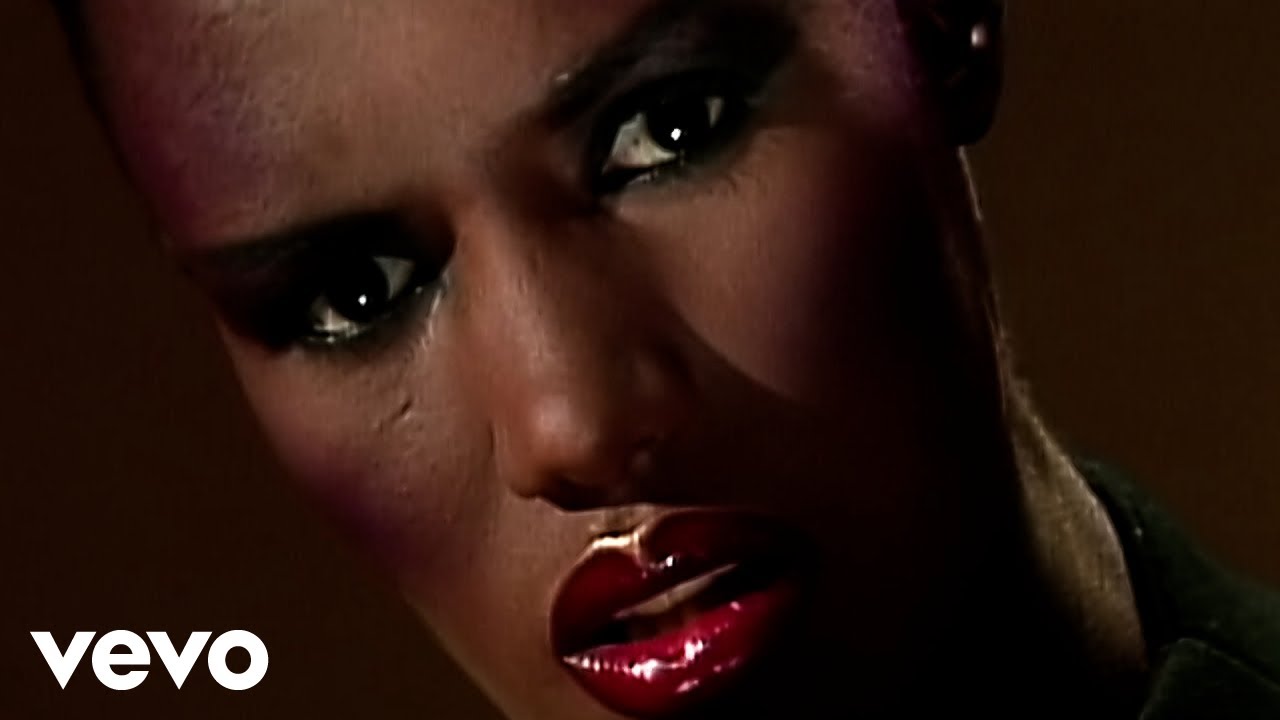
The music video for I’ve Seen That Face Before (Libertango) — directed by Jean-Paul Goude himself in the spring of 1981 — was filmed on the outdoor terrace of Grace Jones’s penthouse apartment on 16th Street in New York. The clip opens with a static photograph of Jones wearing a tall black hat, her face concealed behind a three-piece paper mask in the angular geometric style that Goude had developed across his previous work with Jones. The paper mask is removed in three quick cuts to reveal Jones’s signature flattop haircut, which Goude had originally devised and which had become — by 1981 — the most-imitated stylistic identifier of any contemporary female pop artist. Jones then begins to sing the song directly to camera, holding and playing an accordion in tribute to the bandoneon-driven Piazzolla original. The camera angles tighten on her face and the accordion for the first half of the song. The visual reveal comes near the end: the camera pulls back and rises in a slow tracking shot, revealing that the entire performance has been filmed on the rooftop of a New York tower block, with the Manhattan skyline visible in the background and the city sprawling below. The cover art of the single 7-inch release reproduces a still photograph from the rooftop reveal. The video would later be used as the closing sequence of A One Man Show — the Goude-directed concert film of Grace Jones’s 1982 New York stage performance, which was nominated for the 1984 Grammy Award for Best Video Album. The clip remains, more than four decades after the original 1981 broadcast, one of the most-watched performances on the Grace Jones official VEVO YouTube channel. Grace Beverly Jones turned seventy-eight years old on May 19, 2026.
SONG INFORMATION
Related videos
 Watch LaterAdded
06:49
Watch LaterAdded
06:49  Watch LaterAdded
04:05
Watch LaterAdded
04:05 ![David Lee Roth – California Girls (Official Video) [HD]](https://musicvideosclub.com/wp-content/uploads/2026/10/david-lee-roth-california-girls-360x203.jpg) Watch LaterAdded
04:37
Watch LaterAdded
04:37