






ZZ Top – Gimme All Your Lovin’
A Warner Bros. executive newly arrived at the label in 1983 watched MTV all year and decided ZZ Top needed their first music video. The result rewired the band’s career and put a 1933 Ford coupe on the cover of an eleven-million-selling album.
Jeff Ayeroff had only been at Warner Bros. Records for a few months when he made the pitch. The marketing executive — who had spent 1982 watching MTV transform popular music from a New York office at A&M and who had moved to Warner in early 1983 specifically because Warner had the kind of catalogue that the new medium could be used to relaunch — went into a meeting with the label’s senior staff and made his case for a band that had not historically been interested in music videos. ZZ Top, the Houston-based blues-rock trio that had been recording for London Records since 1971 before signing to Warner in 1979, had built their entire career on relentless touring, radio airplay, and the visual coherence of two beards, a rhythm section, and a drummer named Frank Beard who didn’t have one. They had never made a music video. Ayeroff thought their next single should be the first. Warner agreed to fund the production. The label hired Tim Newman — the New York filmmaker whose siblings David, Thomas, and Maria scored orchestral music and whose cousin was the songwriter Randy Newman — to direct it. Newman met with ZZ Top’s manager-producer Bill Ham and the band to talk through ideas. The single being released first from the new album was “Gimme All Your Lovin’.” The video Newman built around it would change everything.
The song itself had been recorded a year earlier at Ardent Studios in Memphis, the studio at the corner of Madison Avenue and Cooper Street where ZZ Top had been recording continuously since 1973’s Tres Hombres. Billy Gibbons, by 1982 the band’s clear creative leader after El Loco‘s synthesizer experiments the previous year, had been planning the band’s deeper move into the new wave and synth-rock territory that he had been hearing on European trips. He had worked with the Texas pre-production engineer Linden Hudson on tempo and song development at his Houston home; Hudson’s contributions to the album’s underlying rhythmic architecture became the subject of a lawsuit years later. Bill Ham and the Ardent engineer Terry Manning then took over at the studio. Most of the actual recording was done by Gibbons and Manning together — Dusty Hill and Frank Beard did not attend the majority of the sessions, though both are credited on the writing alongside Gibbons. Gibbons cut his guitar parts on a Dean Z electric with DiMarzio Super Distortion humbuckers, an instrument Manning later described as “very resonant, always on the verge of feedback, and difficult to keep in tune.” Manning edited Gibbons’s takes constantly to remove extraneous noise. The signature opening riff — the rising three-note figure that announces the song — was a guitar part Gibbons had been working on for months, played through a 50-watt Legend Rock ‘n’ Roll combo amplifier with a single 12-inch Celestion speaker. The whole album was built around three studio rooms: Beard’s home setup in Quail Valley for some pre-production, Ardent Studio A in Memphis for the main tracking, and Terry Manning’s home studio in Memphis for additional work.
The gas station, the 1933 Ford coupe, and the three girls
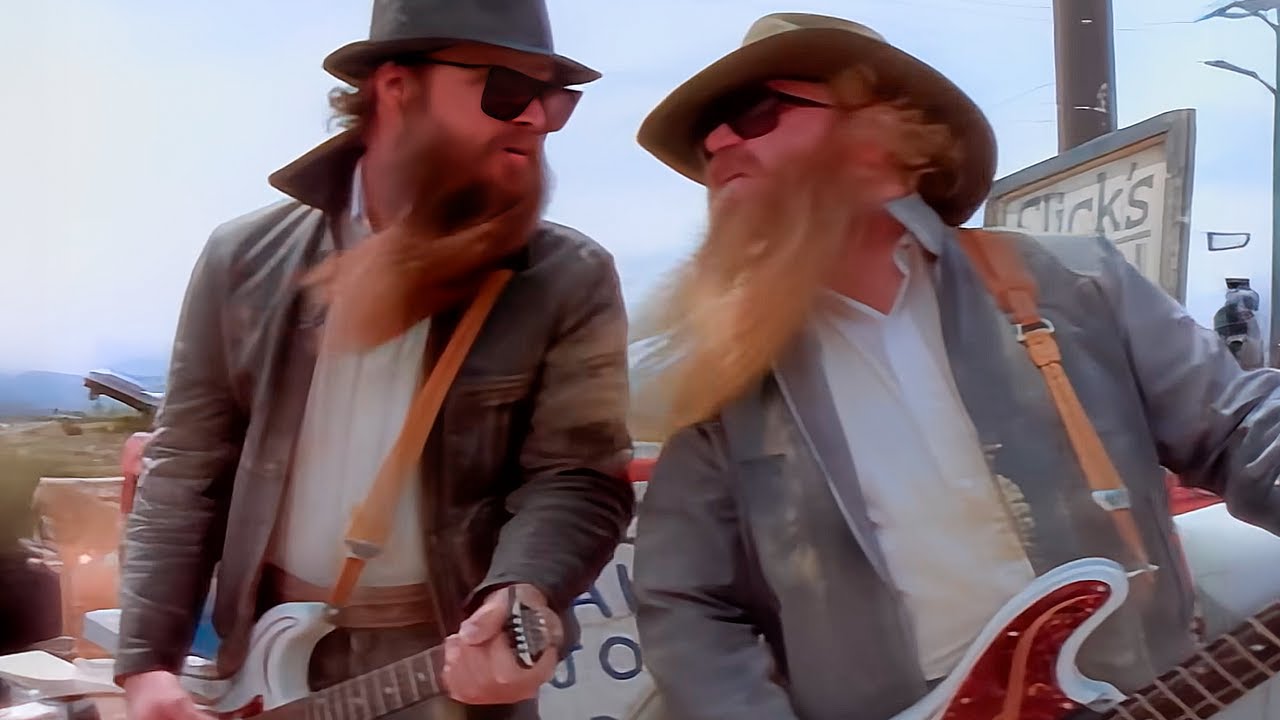
Newman built the music video around a four-character story. Peter Tramm, the actor-model cast as the lead, played a gas-station attendant working an empty highway pump in the American West. Three women arrive in a red 1933 Ford coupe — the customized hot rod Gibbons had personally commissioned from a California hot-rod shop in 1976 and that ran with a Corvette engine; the car had been street-ready by 1983 and would appear on the cover of Eliminator and in three subsequent ZZ Top videos. The women — Jeana Tomasino from Wisconsin, who had posed for Playboy in 1980 and would later become Jeana Keough of The Real Housewives of Orange County; Danièle Arnaud from Nice, France; and Kymberly Herrin, the model who would shortly appear in the 1984 Ghostbusters film — pull up to the station, hand Tramm a keychain shaped like the letters ZZ, and proceed to dress him in the clothes and confidence of someone who has been transformed by their attention. The band appears in the background and foreground intermittently throughout: Gibbons and Hill in matching long beards, dark glasses, and hats; Beard at his kit, clean-shaven. They never directly interact with the actors. Newman shot the whole thing in two days at a gas-station location outside Los Angeles. The video aired on MTV in spring 1983 and went into heavy rotation within weeks. By August, “Gimme All Your Lovin'” had reached No. 37 on the US Billboard Hot 100; the album Eliminator was on its way to selling eleven million copies in the United States alone and earning the RIAA’s Diamond certification.
The single took longer to break in Britain. Released in the UK in August 1983, it stalled at first. The follow-up “Sharp Dressed Man” arrived in the autumn — also directed by Newman, also built around the Eliminator car and the same three women, also rotating on MTV — and broke the band’s profile in Britain. Warner re-released “Gimme All Your Lovin'” on the strength of the second video’s momentum, and the re-release reached UK No. 10 in February 1984. The song ties with ZZ Top’s 1992 cover of Elvis Presley’s “Viva Las Vegas” as the band’s highest-charting UK single of all time. The third Newman-directed video, for “Legs,” won the MTV Video Music Award for Best Group in 1984 and completed what the music industry quickly began calling the Eliminator Trilogy. The 1933 Ford hot rod, the three ZZ Girls as a recurring narrative motif, and the band’s stylized appearances in the background became the band’s visual identity for the rest of the eighties and well into the nineties. ZZ Top, who had spent the seventies as one of the most successful touring acts in American rock, became — at the moment they had stopped touring as relentlessly — bigger than they had ever been.
Houston to Montreux, by way of Memphis
The band toured Eliminator worldwide through 1983 and 1984, sold over twenty million copies of the album globally, and followed it with Afterburner in 1985 — another multi-platinum success that took the synth-rock direction further still. The decades after were a steady run of records and constant touring: Recycler in 1990, Antenna in 1994, Rhythmeen in 1996, XXX in 1999, Mescalero in 2003, La Futura in 2012 — fifteen studio albums across fifty-two years with the same three musicians, one of the most stable lineups in the history of American rock. Rolling Stone placed Eliminator at No. 398 on the magazine’s 500 Greatest Albums of All Time list. In March 2004, ZZ Top were inducted into the Rock and Roll Hall of Fame; Keith Richards delivered the induction speech, calling Gibbons “the most exciting young guitar player to come along in 1969” — a line that landed as both a compliment and a recognition that no one had come along since to displace him.
The performance below is from one of the most documented late-career evenings the band ever played. ZZ Top arrived at the Auditorium Stravinski in Montreux on the night of July 10, 2013, to play the Montreux Jazz Festival’s main hall as part of a tour they had been running through Europe that summer. The set ran seventeen songs. “Gimme All Your Lovin'” was the fourth — sequenced between “Jesus Just Left Chicago” and a new song from La Futura, the previous year’s blues-roots album. The middle of the set was given over to a two-song tribute to Claude Nobs, the Montreux Jazz Festival founder who had died six months earlier; Mike Flanigin sat in on Hammond organ and Van Wilks on second guitar for the tribute section. The performance was filmed by the festival’s house production team for German television broadcast on 3SAT later that month, then released by Eagle Vision in July 2014 as ZZ Top: Live at Montreux 2013. The Austin Chronicle described the Blu-ray release as catching the trio in “a living piece of Lone Star history.” Gibbons was 63 years old that night. Hill was 64. Beard was 63. The three of them had been playing together for 44 years.
Dusty Hill died at his Houston home on July 28, 2021, of complications from a hip injury he had been managing through the band’s summer tour. He was 72 years old. His final directive to Billy Gibbons, given a few days before his death, was characteristically practical: “Give Elwood the bottom end, and take it to the Top.” Elwood Francis — Hill’s guitar tech of more than twenty years — took over on bass at the Tuscaloosa Amphitheater in Alabama on July 30, two days after Hill’s death, and has remained ZZ Top’s bassist since. Gibbons and Beard have continued the band exactly as Hill instructed. The band’s current touring catalogue still leads with “Gimme All Your Lovin'” — Hill’s bass line, now Francis’s, opening the set on most nights of the year. The 1933 Ford coupe still appears on stage as a backdrop projection. The Memphis-cut record from 1983, the Tim Newman-directed gas-station video, the song that gave ZZ Top their first US music-video hit, and the song the band has now been performing together since the spring of 1983, has outlived everything that has changed around it. The recording stayed exactly where it always was. The band kept showing up to play it.
The performance below was filmed live at the Auditorium Stravinski during the Montreux Jazz Festival on July 10, 2013:
SONG INFORMATION
Related videos
 Watch LaterAdded
06:49
Watch LaterAdded
06:49  Watch LaterAdded
04:05
Watch LaterAdded
04:05 ![David Lee Roth – California Girls (Official Video) [HD]](https://musicvideosclub.com/wp-content/uploads/2026/10/david-lee-roth-california-girls-360x203.jpg) Watch LaterAdded
04:37
Watch LaterAdded
04:37