



Don McLean – American Pie
Its Writer Refused To Explain It For 44 Years, Then Auctioned The Drafts For $1.2 Million
Sixteen pages crossed the block at Christie’s in New York on April 7, 2015: 237 lines in Don McLean’s handwriting and 26 more typed, the working drafts of American Pie. A bidder paid $1.2 million for them, reported at the time as the third-highest auction price for an American literary manuscript. What the money bought was the thing McLean had withheld since 1971. For 44 years he had declined to say who the song’s characters were, and that refusal had done as much for the record as its melody. The pages put his notes on the table, and they argued that the guessing game had been beside the point all along.
Keep watching: Madonna, who covered it in 2000 → · 70s Music Videos
The one reference he never hid was the first. On February 4, 1959, McLean was a paperboy in New Rochelle, New York, folding the morning edition when he read that a plane had gone down in Iowa the day before with Buddy Holly, Ritchie Valens and J.P. Richardson, the Big Bopper, aboard. He was thirteen, and Holly was his idol. His father died two years later. The grief sat for more than a decade while he earned a business degree at Iona College night school, worked the folk clubs, and in 1969 sailed the Hudson with Pete Seeger aboard the sloop Clearwater.
A loss carried that long had stopped being about one plane, and the song he finally wrote from it wasn’t either. McLean has said he wrote it in a gatehouse in Cold Spring, New York, and in Philadelphia, and he disputes the long-running claim that it came together in Saratoga Springs. He first sang it for an audience in the Philadelphia area in March 1971, opening for Laura Nyro. The lyric starts on the paper route and then moves through a decade of American music and public life in coded figures: a jester, a king, a quartet, a concert that turns violent. He named almost none of them.
The producer wanted a band. The writer wanted a guitar.
Getting it on tape took an argument first. Producer Ed Freeman heard a band record, while McLean, Freeman told Sound On Sound, “wanted to cut it with just the acoustic guitar.” Freeman rented a rehearsal room and drilled McLean with drummer Roy Markowitz and bassist Bob Rothstein for two weeks. On May 26, 1971, he took them into Studio A at the Record Plant on West 44th Street in New York, with Tom Flye engineering, David Spinozza on electric guitar and Paul Griffin on the gospel-leaning piano that carries the track. The body of the song went down live. The slow opening verse needed about sixteen splices, and Freeman assembled the lead vocal from 24 takes. The final chorus is credited to the West Forty Fourth Street Rhythm and Noise Choir; Freeman has said it included Pete Seeger, James Taylor, Livingston Taylor and Carly Simon, a lineup nobody has officially confirmed.
At roughly eight and a half minutes, the result would not fit on one side of a 45. United Artists released the album, dedicated to Buddy Holly, on October 24, 1971, and issued the single that November cut in two, 4:11 on one side and 4:31 on the other. The split cost it nothing. Billboard’s Hot 100 ranked it No.1 on January 15, 1972, and held it there for four weeks, and the album reached the top of Billboard’s album chart the same month. The Official Charts Company logged a No.2 peak in Britain that March. No longer song topped the Hot 100 until Taylor Swift’s All Too Well (10 Minute Version) in November 2021.
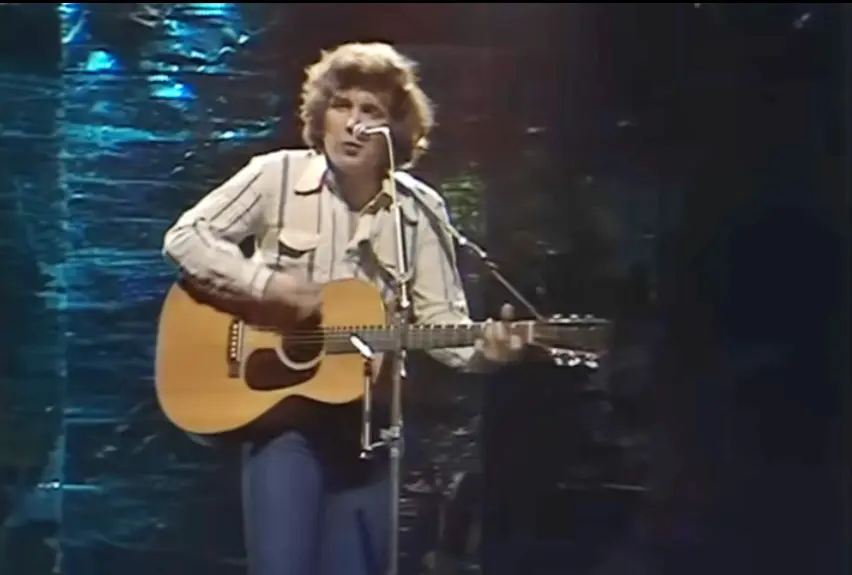
Britain’s appetite for the song is what put it in front of a BBC camera. In 1972 McLean performed it for the network’s Sounds for Saturday, and the version on screen is the one he had argued for in New York: one voice and one acoustic guitar, with no piano, no band and no choir. He tells the studio audience they are welcome to sing every word with him, and they take him up on it through all six verses and nearly nine minutes. Freeman won the argument on the record. On television, McLean played it his way, and the song held up without anything Freeman had added.
Everyone had a theory. He had a one-liner.
All that running time gave listeners something to study, and they treated the lyric as a cipher from the start. McLean met the decoders with two stock answers. One was that the words were poetry and beyond analysis. The other, when anyone asked what the song meant, was a joke: “It means I never have to work again.” The silence kept the record in circulation long after its chart run. Madonna cut a shortened version for the film The Next Best Thing in 2000 and took it to No.1 in Britain. The RIAA’s Songs of the Century project ranked the original fifth, and the Library of Congress named it to the National Recording Registry on March 29, 2017.
When the answers came, they gave the decoders partial credit. The notes sold with the manuscript, and a Paramount+ documentary in 2022, confirmed the two readings nearly everyone had already made: the king was Elvis Presley and the jester was Bob Dylan. McLean waved off other popular identifications as things he never had in mind when he wrote it. What he stressed in the auction notes was direction. The song, he explained, describes a country where things are heading the wrong way, and he called it a kind of morality song.
McLean was nearing 70 when he let the pages go, and he said he wanted anyone interested to see that the song was no parlor game. The drafts bear him out. They show a writer with one fixed event, a headline read on a paper route, and a conviction that something had been going wrong ever since. The names were the smallest part of it. His silence held for 44 years because the puzzle was more fun than the answer, and the manuscript proved he was right to keep it: the explanation is smaller than the song.
SONG INFORMATION
SONG INFORMATION
Enjoyed this one? New forgotten gems every day — tap Music Videos Club below to visit and follow us on Facebook: