










Modern Talking – Brother Louie
Dieter Bohlen Wrote the Song as a Tribute to His Co-Producer Luis Rodríguez — “Louie” Was “Luis.” Modern Talking Took the Single to Number One in Germany and Seven Other Countries Across Europe and to Number Four in the United Kingdom — the Band’s Biggest British Hit.
Dieter Bohlen had been working with the Spanish-born sound engineer Luis Rodríguez at Studio 33 in Hamburg for over two years by the time he sat down to write the song that would become Modern Talking’s commercial peak. Rodríguez had co-produced every Modern Talking record from the band’s 1984 debut single You’re My Heart, You’re My Soul onward, sharing the production credits with Bohlen on each of the three previous chart-topping German singles, engineering the falsetto layers that gave the duo their instantly recognisable choral identity, and operating quietly inside Bohlen’s working method as the rare collaborator Bohlen credited publicly and continued to credit through the next four decades. The song Bohlen wrote in late 1985 was a private tribute. The title encoded it. “Louie” was the English-language diminutive of “Luis.” The lyric Bohlen built around the name was the standard Modern Talking romantic-pop-drama vocabulary — a warning narrative about a man being tempted by another man’s lover, the third-person address (“Oh, she’s only looking for another man” / “Brother Louie, Louie, Louie, oh, she’s only lookin’ for her”) delivered with the dramatic urgency that had become the band’s commercial signature. The private joke between Bohlen and Rodríguez stayed embedded in the title. The rest of the world heard a pop record.
The recording was finished in a single concentrated month at Studio 33 in November 1985. Bohlen played the guitar, programmed the synthesizers, arranged the song, and produced with Rodríguez. The lead vocal was sung by Thomas Anders in the recognisable mid-tenor delivery he had built the band’s identity around since their meeting at the Hansa subsidiary Intersong two years earlier. The high-pitched falsetto chorus — the production element that more than anything else defined the Modern Talking sound across every record they ever released — was performed by three German session vocalists named Rolf Köhler, Michael Scholz, and Detlef Wiedeke. None of the three were credited on the original 1986 sleeve. None of them appeared on television with the band. They were paid as session musicians and went home, and would not formally receive credit for their work on Modern Talking’s records until they sued Bohlen successfully in the early 2000s. The result of the November 1985 sessions was a three-minute-forty-one-second pop record built on a tight Linn drum pulse, layered digital synth pads, a hooky three-chord progression, and the falsetto answer chorus locking Anders’s lead vocal into place. Hansa Records pressed it onto seven-inch and twelve-inch vinyl and released the single on January 27, 1986, with Doctor for My Heart on the B-side.
The German Chart Climb and the European Breakthrough
The single entered the German Bundesverband Musikindustrie chart in early February 1986 and reached number one on the chart dated March 3, 1986. It stayed at the top of the German chart for four consecutive weeks. It spent a total of seventeen weeks on the chart. It became Modern Talking’s fourth consecutive German chart-topper, following You’re My Heart, You’re My Soul in late 1984, You Can Win If You Want in spring 1985, and Cheri, Cheri Lady in late 1985 — a run of four number-one singles in sixteen months that established the duo as the most commercially dominant German pop act of the entire 1980s and the most successful continental European pop project since Frank Farian’s Boney M at the peak of their late-seventies disco production years. Brother Louie reached number one in Austria, Switzerland, Sweden, Finland, Norway, Spain, and France. In the United Kingdom — a market that had been slower to commercially accept Modern Talking than continental Europe, with You’re My Heart, You’re My Soul reaching only number fourteen, You Can Win If You Want stalling at forty-five, and Cheri, Cheri Lady failing to chart at all — Brother Louie reached number four on the UK Singles Chart in early summer 1986. It became the band’s commercial breakthrough in Britain, was certified silver by the British Phonographic Industry for shipments above 250,000 units, and remains, to the present day, Modern Talking’s highest-charting British single.
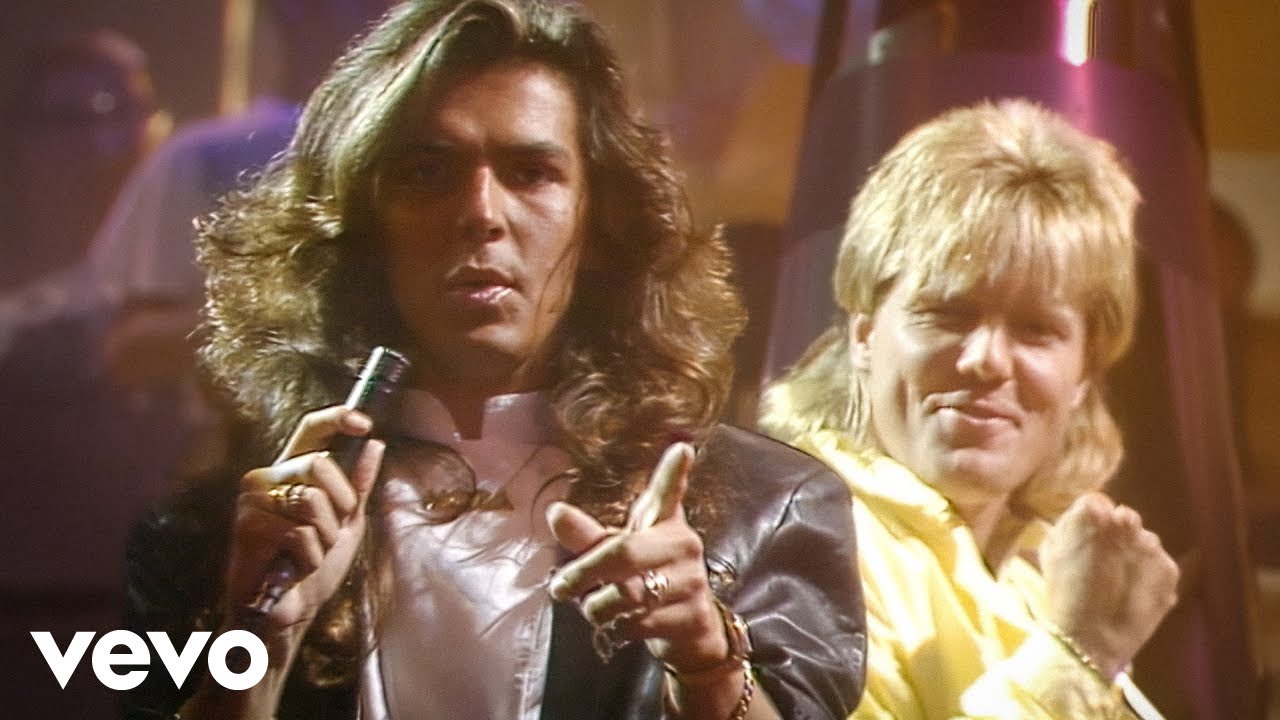
The parent album Ready for Romance arrived from Hansa on May 26, 1986. It spent five consecutive weeks at the top of the German albums chart, was certified platinum by the BVMI for shipments above 710,000 units in Germany alone, and produced a second number-one single in Atlantis Is Calling (S.O.S. for Love), released in late April 1986. The cumulative European chart performance of the two singles, combined with the album, made the summer of 1986 the commercial peak of the Modern Talking project. Bohlen and Anders performed the songs across European television throughout 1986. The original 1986 promotional music video for Brother Louie — directed by Pit Weyrich and built around lifted footage from Sergio Leone’s 1984 gangster epic Once Upon a Time in America, with Weyrich cutting between Anders performing the song on a darkened stage and scenes of the Robert De Niro character’s loss of his lover Deborah — became, for many of the song’s continental European audiences, the defining visual association.
The Falling-Out and the Long Afterlife
What followed for Modern Talking after the 1986 commercial peak was a steady decline. In the Middle of Nowhere arrived in October 1986 and produced two further German top-three singles. Romantic Warriors followed in March 1987 with diminishing returns. In the Garden of Venus, the sixth studio album, was released in October 1987 to a noticeably reduced commercial reception. The pace of release had become an issue — six studio albums in less than four years — and the working relationship between Bohlen and Anders had become, by Anders’s own subsequent account in his 2011 autobiography, deeply strained. Bohlen announced the project’s termination in a German press interview given while Anders was in Los Angeles. The two had been quarrelling consistently. After a final phone call that both men have since publicly described as profanity-laden, they broke off contact for over ten years.
Modern Talking reunited in early 1998 on the German television show Wetten, dass..? with an updated version of You’re My Heart, You’re My Soul and stayed together for a second active period that produced six further studio albums between 1998 and 2003. They dissolved a second time in 2003 after the publication of Bohlen’s autobiography, which Anders found unacceptably critical of him personally. Cumulative worldwide record sales across both eras of the project: approximately one hundred and twenty million units. Thomas Anders has continued to perform the Modern Talking catalogue on his own ever since, including releasing in 2025 the album … Sings Modern Talking: In the Middle of Nowhere, a re-recording of the duo’s 1986 fourth studio album in collaboration with the Royal Philharmonic Orchestra. Dieter Bohlen has continued working as a producer, judge on Deutschland sucht den Superstar, and one of the most-recognised figures in the German entertainment industry across the past two decades. The 1986 commercial peak — and the song Bohlen wrote that summer as a tribute to his co-producer Luis Rodríguez — remains the single most-played Modern Talking record on global radio and streaming services almost forty years on.
SONG INFORMATION
Related videos
![David Lee Roth – California Girls (Official Video) [HD]](https://musicvideosclub.com/wp-content/uploads/2026/10/david-lee-roth-california-girls-360x203.jpg) Watch LaterAdded
04:37
Watch LaterAdded
04:37  Watch LaterAdded
05:29
Watch LaterAdded
05:29  Watch LaterAdded
04:05
Watch LaterAdded
04:05