






Harry Styles – Dance No More
A Friend Named Chloe Said “DJs Don’t Dance No More” at a Club in Europe Sometime in 2024. Harry Styles Wrote a Song About the Phrase. The Music Video Premiered May 7, 2026, on His Channel — and Disproves the Title Three Times in Three Minutes.
The phrase came from a conversation. Harry Styles was at a club, somewhere in Europe, sometime in the long stretch of 2024 and early 2025 between the conclusion of his Love on Tour residency in 2023 and the writing sessions for what would eventually become his fourth studio album. He was with a friend named Chloe. They were watching a DJ play a set. At some point in the evening, Chloe made the observation that became the song. “DJs don’t dance no more,” she said. The phrase stuck with him. By the time Styles and his longtime co-writer and producer Thomas “Kid Harpoon” Hull began assembling the album that would become Kiss All the Time. Disco, Occasionally, the line had become both the chorus refrain and the title of one of the most propulsive recordings Styles had made in his solo career. Dance No More went on to be sequenced as the tenth track on the album, between American Girls and Pop. The album was released on March 6, 2026 and debuted at number one on the Billboard 200 with 430,000 album-equivalent units — the highest debut on the chart since Taylor Swift’s The Life of a Showgirl, and Styles’ fourth consecutive number-one album. The music video for Dance No More, the album’s third visual, premiered on Styles’ YouTube channel on May 7, 2026.
The song is a deliberate departure from the introspective pop-rock register that defined Styles’ three previous albums. Rolling Stone described it on release as “a no-parking-on-the-dance-floor Eighties synth fest with chorus shouts of ‘Respect your mother!’ invoking drag-ball culture.” Variety’s Jem Aswad called it “an outlier in the batch. With a funky groove, ’80s synthesizer stabs, party noises… it has a loose, fun, carefree vibe found nowhere else on the album.” Aswad also noted, in his review, that the song was “a prime early candidate for Song of the Summer 2026.” The lyric itself is a working musician’s argument with a working musician’s claim: that the people whose entire job is to make a club dance no longer dance themselves, having become professionalised out of the moment they were once part of. Styles’ response, across the song’s three minutes, is to argue that the absence of the DJ from the dance floor does not absolve the rest of the room from joining each other on it — that the act of being present in collective rhythm with strangers and friends is not, after all, something a professional has to model first. “We wanna dance with all our friends,” the chorus declares. “It’s feeling like the music has been Heaven sent / And that there’s no difference in between the tears and the sweat.”
Kid Harpoon, Drag-Ball Culture, and the Shape of the Disco Album
Thomas “Kid Harpoon” Hull produced the recording. Hull and Styles have collaborated as co-writers and producer-and-artist since the Fine Line sessions in 2018 — Hull producing every Styles album since, having moved across from his earlier work with Florence + the Machine, Maggie Rogers, and Shawn Mendes into the central producer-collaborator role on Styles’ three Grammy-nominated solo records. The arrangement of Dance No More sits in territory the two had not yet explored together. The introductory bars carry the kind of fluttering keyboard line associated with mid-1980s dance pop — the Pet Shop Boys and New Order register that British house music had absorbed and exported back to American clubs by the early 1990s. The drum programming is heavier than most of Styles’ previous catalogue, the bass-line punchier, the build into the chorus more deliberate. The chorus shouts — “Respect your mother!” — were borrowed from drag-ball culture, the New York and underground performance tradition that has inflected dance music for forty years and that Styles himself has referenced sporadically in his stage performance and visual aesthetic over the years. The song’s pulse is not subtle. The album as a whole, Rolling Stone’s review noted, is “more invested in being than meaning, experience rather than ego” — and Dance No More is the track on which that thesis is most clearly stated.
Styles told Runner’s World, in an interview tied to the album’s release, that the song’s source was the European club nights he had been spending across 2024 and 2025 between tours. “Good electronic music is so good, you know — especially the melodic aspect. When you’re out at night, it’s such a community, but you’re also watching people have such individual experiences. I wanted to recreate what I had on the dance floor, being lost in instrumentation and the musicality. It was so immersive, like, this is how I want to feel when I’m on stage too. I don’t want it to feel like a sermon I’m delivering.” That last sentence is, in some sense, the thesis of the entire album. Styles’ Saturday Night Live double-duty appearance on March 14, 2026, included a live performance of Dance No More alongside Coming Up Roses. The BRIT Awards performance in February 2026 featured Aperture, the album’s lead single. The Manchester Co-op Live show in early March 2026, streamed two days later on Netflix, included material from the album in a setlist Styles had been workshopping for the upcoming Together, Together Tour, which begins on May 16 in Amsterdam.
The Music Video, the Gym, and the Disco
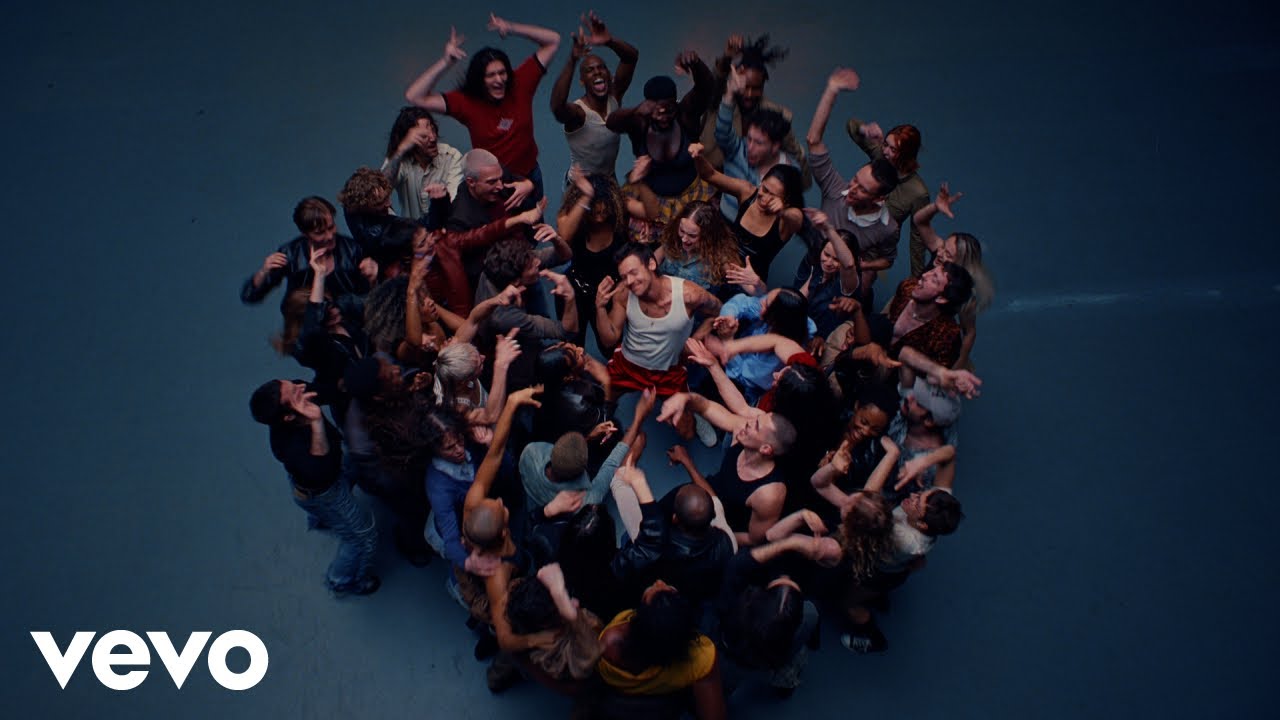
The music video for Dance No More, directed by French filmmaker Colin Solal Cardo, opens in what initially appears to be a high school gymnasium. Styles, dressed in white sneakers and red gym shorts, dances alone across a scuffed wooden floor. The setting does not stay literal for long. Within thirty seconds, more than two dozen choreographed dancers join him on the floor. The wood-floor gym becomes, as the song’s chorus arrives, a full-on disco — couples paired off, group routines forming and dissolving, the boundary between school assembly and adult dance club collapsing in a way that makes both readings simultaneously available. Solal Cardo, the French director who has previously made videos for Doja Cat, Sam Smith, and Charli XCX, builds the video around continuous motion: there are no narrative cuts back to a frame story, no character development outside the choreography, no resolution beyond the dancing itself. The clip runs four minutes. By the close, what had begun as the kind of high school setting that Styles’ songs often invoke as nostalgic shorthand has become, instead, the kind of dance club that the song’s lyric and the album’s title were promising all along.
The video’s release on May 7, 2026, on Styles’ YouTube channel, marks the third visual from Kiss All the Time. Disco, Occasionally — following Aperture (the album’s lead single, with its David Bowie-referenced stalker narrative) and American Girls (released the same day as the album, featuring Styles performing stunts on an action film set). The Together, Together Tour begins on May 16, 2026, with ten consecutive shows in Amsterdam. Dance No More will, by every reasonable expectation, anchor the album’s dance-music section in the tour setlist. The song that began as Chloe’s offhand observation at a European club, that Styles spent months turning into a chorus refrain, that Kid Harpoon arranged with the synthesizer architecture of mid-1980s British dance pop, that drew its central shout from drag-ball culture, that Saturday Night Live got the live debut of, and that Colin Solal Cardo has now framed in a four-minute video premiering on a Thursday in May 2026, has a long summer ahead of it. The song’s title has already been falsified by everyone involved. The math, by the most generous reading, agrees with what Chloe was actually saying: that the dance floor is for everyone except, occasionally, the DJ. And that the rest of the room, on any given night, does not need permission.