



John Mayall – My Pretty Girl
John Mayall’s most successful American band had no drummer, and an electric violin where the drums used to be
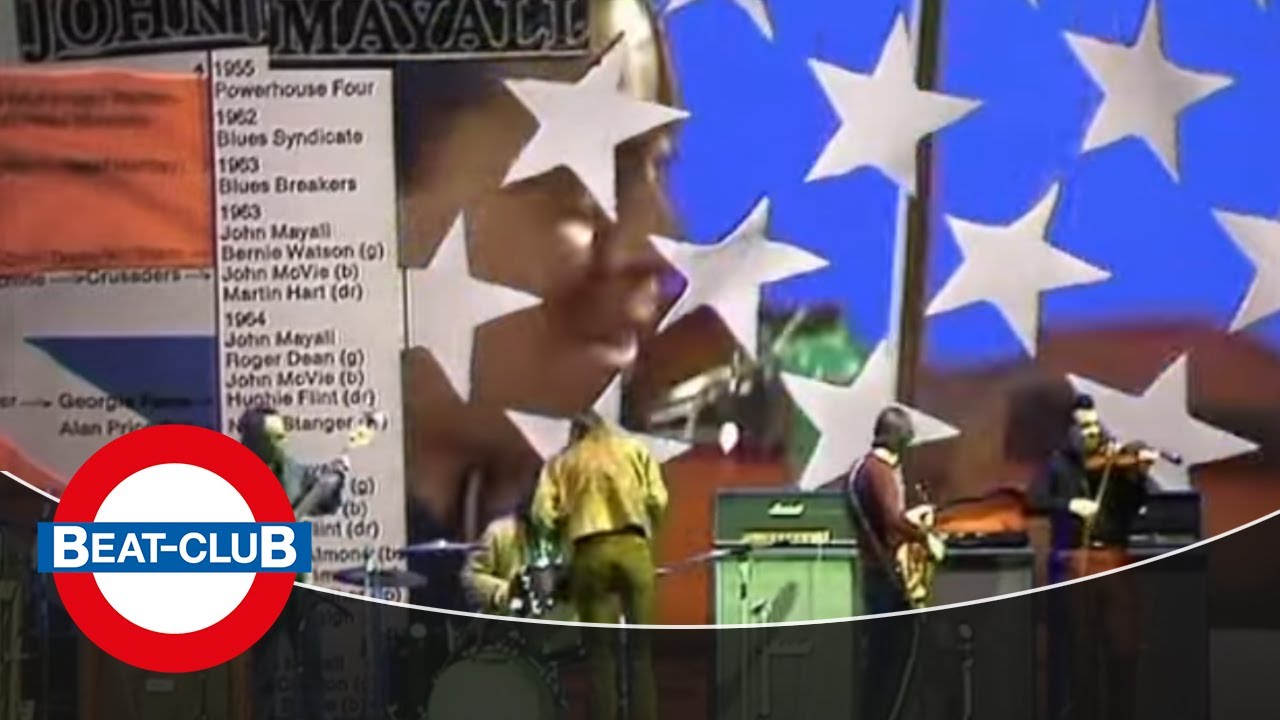
Where a drum kit would normally sit in John Mayall’s 1970 band, there was an electric violin. Don “Sugarcane” Harris, half of the rock ‘n’ roll duo Don & Dewey, played it on USA Union, the drummerless album that gave Mayall his best chart showing in America. My Pretty Girl strips even that away. It is one of the album’s sparest tracks, just Mayall with Harvey Mandel’s guitar and Larry Taylor’s bass, and in February 1971 it was the song his band, billed under the album’s name, played on West German television.
Keep watching: John Mayall – The Train · explore more →
Leaving out the drums was not new for Mayall by then. After breaking up the Bluesbreakers, the band that had passed through Eric Clapton, Peter Green and Mick Taylor, he wanted a quieter sound with no drummer and no rock lead guitar. That idea produced The Turning Point, recorded live at the Fillmore East in July 1969 with acoustic guitar, bass and Johnny Almond’s saxophones and flutes, and released that October. When that lineup broke up, Mayall played a British festival with an all-star group and then, by his own account in the album’s liner notes, had to put a new band together quickly because Polydor wanted another record.
He found it in Los Angeles. Mayall had met Frank Zappa on a 1968 trip there, stayed at Zappa’s place in Laurel Canyon, and in 1969 bought a house of his own on Grandview Drive for $30,000. He bought the empty lots around it so nobody could build next to him, and in the back he put together a Tudor-style bar from railroad ties he cut himself, which he called the Brain Damage Club. Harvey Mandel and Larry Taylor had both come out of Canned Heat, Mandel on guitar and Taylor on acoustic and electric bass. Harris, who had played on Zappa’s Hot Rats the year before, brought the violin. Mayall sang and played guitar, piano and harmonica, and produced the sessions himself. The four cut the album at Larrabee Studios in Los Angeles on July 27 and 28, 1970, with Leonard Feather writing the liner notes, and Polydor released it that October.
The songs were personal. Most of USA Union chronicles Mayall’s romance with Nancy Throckmorton, the photographer who had already been the subject of his previous album, Empty Rooms, which he dedicated to her. She shot some of the photographs for the USA Union jacket as well. My Pretty Girl is the fourth song on side two and runs a little over four minutes. Elsewhere the album looked outward: its opening song, Nature’s Disappearing, was about the environment, unusual ground for a blues record in 1970.
Bremen, February 1971
The format turned out to be Mayall’s most successful in the States. USA Union reached No. 22 on the Billboard album chart, his highest placing there, and the same musicians formed the core of Back to the Roots, the double album he recorded that November with Clapton and Mick Taylor returning as guests. The band was already changing. Drummer Paul Lagos joined late in 1970 and played on Back to the Roots, so the drummerless sound of the record was giving way by the time Mayall reached Radio Bremen’s Beat-Club, where the show listed him as the John Mayall U.S.A. Union Band.
Episode 64 first aired across West Germany on February 27, 1971, with Uschi Nerke presenting and Mike Leckebusch, the show’s co-creator, directing, and it was a crowded bill. Ike & Tina Turner played four songs, T. Rex did Ride a White Swan, and Golden Earring, Atomic Rooster and Tom Paxton filled out the hour. Mayall’s band had one slot, and the song was My Pretty Girl. Beat-Club had switched to color the previous year, and Mayall had been on that first color episode too, so this was a return visit.
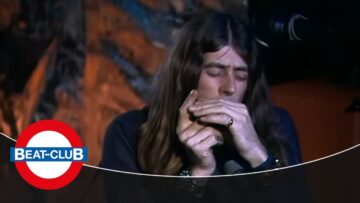
It was a quiet choice on a loud bill, and the television version is not the record. On USA Union the song has no drums and no violin, only guitar, bass and Mayall’s vocal close to the front. Onstage the band had already been playing it differently: a 1970 live recording of My Pretty Girl, issued years later on the archive set The Second Generation: Live Magic 1968–1992, credits Harris on violin and vocals. In Bremen the on-screen credits list five players: Mayall on vocals and harmonica, Mandel on guitar, Taylor on bass, Harris on violin and Paul Lagos on drums. Behind them, Leckebusch’s crew hung stars and stripes over a family tree of Mayall’s own bands, running from the Powerhouse Four in 1955 through the Blues Syndicate to the first Bluesbreakers lineup of 1963.
The lineup did not last much longer. Mayall returned to the drummerless format once more, for Memories, with Jerry McGee replacing Mandel on guitar, before he moved on again. In 1988 he went back to the Back to the Roots tapes and remixed them as Archives to Eighties. Larry Taylor died in August 2019, at 77. Mayall kept moving for five more decades. He was appointed an Officer of the Order of the British Empire in 2005, kept touring until health problems ended it, and was chosen for the Rock and Roll Hall of Fame in 2024, with the ceremony set for that October. He died at his home in California on July 22, 2024, at 90, three months before it. The Laurel Canyon house where the USA Union years were lived was long gone by then: a fire on September 16, 1979, destroyed it along with 23 other homes, and Mayall lost his instruments, books, records and tapes.
Mayall did not turn professional until he was 30, after army service in the Korean War, and he is usually remembered as a talent scout, the bandleader whose groups trained Clapton, Green, McVie and Fleetwood. My Pretty Girl shows him on his own terms. In 1971, with all of those players gone, he took his American band onto Beat-Club and sang one of his most personal songs. Nothing about the performance depends on the famous names. It depends on the band he built after them.
SONG INFORMATION
Enjoyed this one? New forgotten gems every day — tap Music Videos Club below to visit and follow us on Facebook: