The Bagpipe Gamble That Made Holland’s Charlie’s Angels
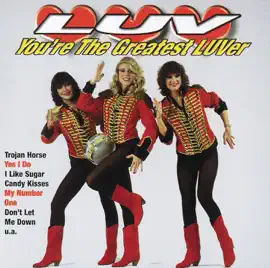
Released in November 1978 by Philips/Phonogram Records, “Trojan Horse” hit number one in both the Netherlands and Belgium, eventually selling over one million copies worldwide. The song reached the top five in Germany, Austria, Switzerland, and Denmark, the top ten in New Zealand and Argentina, and charted across South Africa, Zimbabwe, France, Australia, and Canada. For a Dutch girl group still proving they weren’t a one-hit wonder, this was the moment everything changed.
The single cemented Luv’ as Holland’s biggest export act, earning them the prestigious Conamus Export Prize in 1979. Their debut album With Luv’ had already gone platinum in the Netherlands, but “Trojan Horse” pushed them into genuine international stardom. The release party took place in Laren on November 13, 1978, where the trio received gold records for both their previous single “You’re the Greatest Lover” and the album. Dutch celebrities packed the event, watching three women from modest backgrounds become pop royalty overnight.
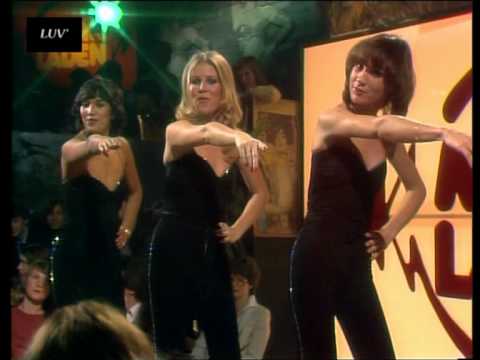
Producers Hans van Hemert and Piet Souer, writing under the pseudonym Janschen & Janschens, had created Luv’ in 1976 inspired by German disco trio Silver Convention. They recruited José Hoebee from a folk band called Young Tradition, Marga Scheide from beauty pageants, and Patty Brard, who had been working as Van Hemert’s secretary. After the Spanish-flavored “You’re the Greatest Lover” became a smash, Van Hemert and Souer needed something different. They gambled on bagpipes. The intro was directly inspired by Alfred Newman’s famous 20th Century Fox fanfare, that triumphant brass flourish audiences heard before every Fox film. The lyrics played with double meanings, particularly the line about a gate not yet being open so the horse cannot come in.
The track was recorded at Wisseloord Studios in Hilversum, the same facility where ABBA cut some of their biggest hits. Piet Souer conducted the Metropole Orkest for the string arrangements while Van Hemert supervised production. The bagpipe hook came from synthesizers rather than actual instruments, creating that distinctive European disco sound that dominated late 1970s charts. The three singers recorded their vocals together, their harmonies blending into that bright, infectious sound that made Luv’ instantly recognizable. Engineer Pieter Boer captured everything with the crisp, punchy quality that Dutch studios were becoming famous for.
The song appeared on the German edition of With Luv’ and later on compilations like Luv’ Gold and 25 Jaar Na Waldolala. Shortly after its success, manager Han Meijer sued the group over ownership of their name, but the women won the legal battle and kept recording under new manager Pim ter Linde. They founded a company called Interluv’ with their producers to control every aspect of their career, following the ABBA business model. Follow-up singles “Casanova” and “Ooh, Yes I Do” continued their chart dominance, and by 1979 Luv’ had become the Netherlands’ most successful musical export.
The song has been covered and remixed continuously since its release. De Bumpers parodied it in 1979 as “M’n Doedelzak” (My Bagpipes). Swedish singer Siw Inger recorded German and Swedish versions. Czech group Bezinky covered it as “Trojský Kůň” in 1980. In Estonia, a 2001 cover called “Üks päev” became a beloved birthday song still sung today. DJ Kav Verhouzer’s 2022 remix reached number ten on the Dutch iTunes chart and eventually surpassed one million Spotify streams. Matt Pop remixed the track for Peter Boonstra’s 2015 photo book The Story of Luv’ and again for the 2025 album Only Luv’ – The Matt Pop Remixes, using original master tapes from Van Hemert’s archives.
Hans van Hemert passed away in October 2024, but he lived long enough to see his creation continuously rediscovered by new generations. That bagpipe hook still sounds like pure joy, a burst of Euro-disco optimism that refuses to age. Three women who started as a secretary, a beauty queen, and a folk singer became the Spice Girls two decades early. And that cheeky song about a horse that can’t get through the gate? It keeps finding new doors to open.