




![Led Zeppelin – In My Time of Dying (Live at Earls Court 1975) (Official Video) [HD]](https://musicvideosclub.com/wp-content/uploads/2026/03/led-zeppelin-in-my-time-of-dying-360x203.jpg)




Céline Dion – Dansons
Jean-Jacques Goldman wrote “Dansons” in 2020 when the world had stopped moving. People were dancing indoors, confined to their homes, and he wrote a song about dancing anyway — above the abyss, in defiance of instability, for everyone who could not. Six years later, when Céline Dion’s team made contact and the recording sessions at Studio at The Palms in Las Vegas took shape, Goldman looked at the lyric and found nothing to revise. The virus had gone, but the world had not become any saner. The abyss was still there. The recommendation to dance above it was, if anything, more urgent than it had been in the year it was conceived. “Dansons” — which translates to “Let’s Dance” — was released on April 17, 2026, as Dion’s first original song in several years, her first French-language recording in over a decade, and the opening statement of a comeback that nine million people had already tried to buy tickets for.
The reunion between Dion and Goldman carries weight beyond its immediate commercial context. Their previous major collaboration was D’eux, the 1995 album for which Goldman wrote every track and which went on to become the best-selling French-language album of all time. They worked together again on “Encore un soir” in 2016, and then a decade passed — years that included the COVID postponement of the Courage World Tour, Dion’s public disclosure of her stiff-person syndrome diagnosis in December 2022, the cancellation of that tour, and a long silence that ended only in July 2024 when she appeared at the opening ceremony of the Paris Olympics, singing Édith Piaf’s Hymne à l’amour from the Eiffel Tower in front of a global audience of hundreds of millions. That performance carried its own freight. For Dion’s supporters, it was the first confirmation in years that the voice was still there, still capable of the kind of emotional delivery that had made her one of the best-selling artists in recording history. “Dansons” is the follow-through: the first piece of new studio work to land since that night on the Eiffel Tower.
The Song That Arrived From Somewhere Else
Stiff-person syndrome is a rare neurological disorder affecting approximately one or two people in every million, causing progressive muscle stiffness and severe painful spasms. Its effect on Dion’s ability to perform had been documented with unusual candor in the 2024 film I Am: Celine Dion, which included footage of a studio session that was interrupted by a muscle spasm severe enough to stop recording entirely. “Dansons” was recorded after that film, at Studio at The Palms in Las Vegas, where Dion has worked across various points in her career. The vocal that made it onto the released track drew immediate critical response: La Presse described it as “sensitive and delicate,” noting that listeners rediscover her from the first seconds. The production — Goldman, Luc Leroy, and Yann Macé — is built around waltzing strings and a tempo that allows the voice to breathe. At three minutes and twenty-six seconds, there is nothing wasted, nothing that outstays its welcome.
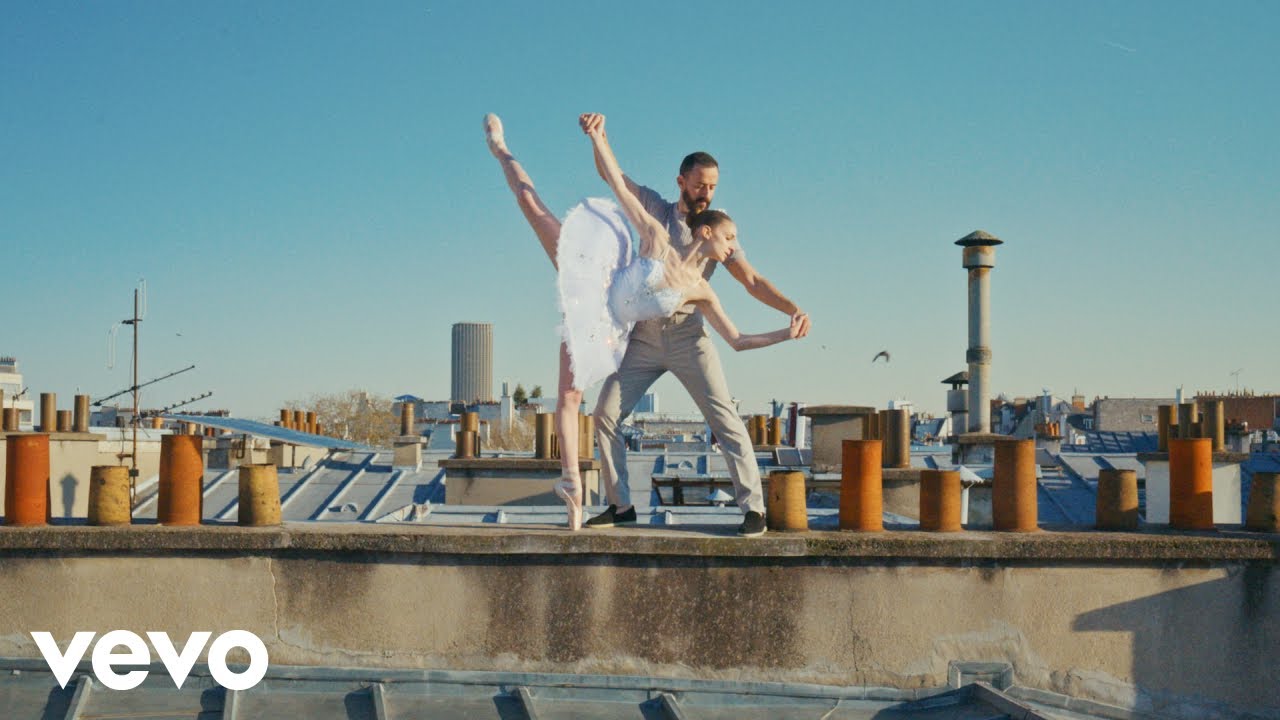
The lyric video, directed by the young French filmmaker Maxime Allouche and filmed in the streets of Paris, was released alongside the track. It does not feature Dion. Instead, it follows couples dancing and embracing across Parisian locations — ballerina Victoria Dauberville on a rooftop with the Eiffel Tower behind her, violinist Esther Abrami, comedian and performer Lola Dubini, dancer and movement artist Mathieu Forget, and rising artist Oria, their presence turning the city into a living tableau of the song’s central argument. The choice to place Paris rather than Dion at the center of the video is not a coincidence. The city is where her return to the stage will take place: sixteen shows at Paris La Défense Arena, beginning September 12, 2026, running through October 17. The 480,000 tickets were sold out within hours of going on sale, after approximately nine million fans around the world registered for the lottery that gave access to the early purchase window.
The First Line and What It Carries
The song opens with the line “Dansons, au-dessus des abîmes” — let’s dance, above the abyss. Goldman’s statement at the time of release noted that the abyss had not closed in the six years since he wrote the song, that the image remained as accurate in April 2026 as it had been in the confined spring of 2020. A later lyric, translated, reads: “Let’s dance so we can stand tall and stay true / Because we owe it to ourselves / For everyone who can’t move.” In the context of Dion’s illness — a syndrome that, at its most severe, has made movement painful and performance uncertain — the line lands with a specificity that no press release needed to point out. Dion has said she feels good, feels strong, feels ready. The song says the same thing without saying it directly, which is what good writing does.
The release of “Dansons” is the opening move of what is likely a larger French-language project, and it arrives at a moment when the stakes are high enough that nothing perfunctory would have survived the scrutiny. Nine million people registered for a lottery. A 2024 documentary showed the private cost of the illness in real time. An Olympics opening ceremony on the Eiffel Tower set a standard that every subsequent piece of music would be measured against. In that context, Goldman’s decision to reach back to a lyric written in lockdown — and to find it unchanged by everything that followed — feels like the right instinct. The world is still unbalanced. Dion is still standing. The abyss is still there, and the recommendation remains: dance above it, because we owe it to ourselves, and for everyone who cannot.