



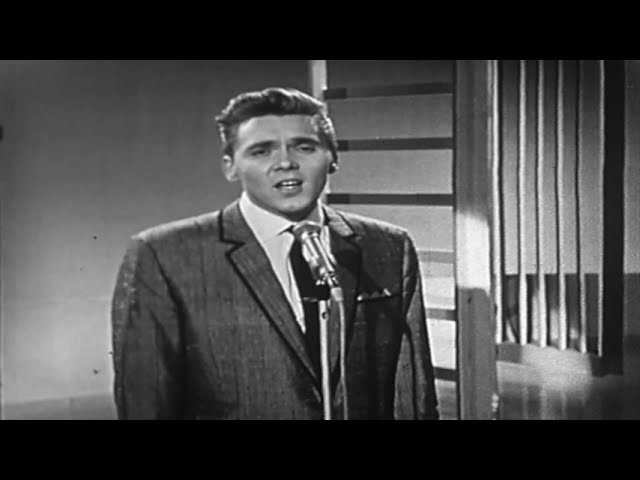







Billy Fury – I’d Never Find Another You
The Beatles Auditioned to Be His Backing Band — and He Never Got a Number One
The footage of Billy Fury performing “I’d Never Find Another You” on British television in early 1962 captures a specific and unrepeatable moment: the third consecutive top-five single in less than six months from a Liverpool singer who was, at that point, the dominant figure in British pop. “Halfway to Paradise” had reached number three in August 1961. “Jealousy” had hit number two in October — held off the top by Helen Shapiro’s “Walkin’ Back to Happiness.” Now, released in December as Fury’s Christmas single and peaking at number five in January, “I’d Never Find Another You” completed a run that no British male artist of the period could match. The Beatles were still eighteen months away from their first chart entry. Cliff Richard was the only serious rival. And the band Billy Fury had auditioned as a possible touring outfit — in a now-famous Parnes audition session in Liverpool that spring — had been turned down partly because their bass player wouldn’t be sacked. John Lennon had left with Fury’s autograph. The rest is history of a kind that overwhelmed Fury’s own.
“I’d Never Find Another You” was written by Gerry Goffin and Carole King and first recorded by Tony Orlando for his September 1961 album Bless You and 11 Other Great Hits. Orlando was sixteen years old, a New York teenager with a strong voice and an emerging career. The song had not charted for him in America. When Decca’s head of A&R Dick Rowe decided to try the song for Fury, he was continuing a strategy that had already produced two Goffin-King top-five hits in a matter of months: the Brill Building connection was running hot. Fury had not written the songs himself — he had been encouraged to move away from self-penned material after his rockabilly debut album The Sound of Fury in 1960, a decision that Record Collector would later describe as one of the more costly errors in British pop management — but what he did with other people’s songs was transformation, not imitation. The Disc reviewer called this one “a rather graceful ballad with a beat in it, sung simply and warmly.” The New Musical Express heard “a medium-pace rock-cum-Latin beat” behind “the most attractive melody.” Both descriptions locate something real about the record: it is unhurried, warm, and quietly insistent.
The arrangements were the work of Ivor Raymonde, the orchestrator who had shaped the Fury sound through this peak period. Raymonde directed the orchestra on both sides of the single — the B-side, “Sleepless Nights,” written by Buck Ram, had been a solo recording by former Platters lead singer Tony Williams earlier that year. The production partnership of Raymonde and Mike Smith gave the Decca recordings of this period a quality that contemporaries in the Vintage Rock assessment would later describe simply as knocking the American originals “out of the park.” The string arrangements breathed without overwhelming; the vocal sat forward. Fury’s approach to Goffin and King’s melody was what Vintage Rock called “a sensuous croon” with “an almost haunted undertone” — not quite the semi-operatic sweep of Roy Orbison, but nothing in Britain did it better. The single sold 250,000 copies and was awarded a silver disc.
The Boy from the Dingle
Ronald Wycherley had been born in the Dingle area of Liverpool on April 17, 1940 — the same district that produced Ringo Starr. Two bouts of rheumatic fever in childhood left him with a damaged heart that would define and ultimately end his life. He had a guitar by fourteen, was leading a local group at fifteen, and had begun writing songs before Larry Parnes found him in October 1958 at the Essoldo Theatre in Birkenhead. Wycherley had gone hoping to pitch his songs to Marty Wilde; Parnes, seeing something immediate in the shy teenager, pushed him onstage in the interval. The crowd’s response was enough. Parnes signed him, added him to the tour, and renamed him Billy Fury — part of the impresario’s habit of gifting his artists names that carried emotional charge: Marty Wilde, Vince Eager, Dickie Pride. Fury was given a Decca recording contract in early 1959. His first single, the self-penned “Maybe Tomorrow,” reached number eighteen. Decca then made a considered decision: shift him away from rock and roll and toward orchestrated ballads. By the summer of 1961, that decision was producing top-five records every few months.
The television appearance that forms this video is a document of that trajectory at its height — before the Beatles changed the market entirely, before Fury’s health began the series of deteriorations that would limit his touring and recording. He was twenty-one years old, backed by a band that could put the arrangements across live, performing a song he had made considerably more than its American original. He would continue to chart through 1964, and the arrival of Merseybeat did not immediately destroy his commercial presence — “Last Night Was Made for Love” reached number four in 1962, and he had seven top-five singles between 1961 and 1963. But the Goffin-King run of 1961 represented the concentrated centre of gravity of his pop career, and “I’d Never Find Another You”, the last of those three consecutive hits, is the moment the footage holds.
The Record That Stayed Without Him
Billy Fury died of a heart attack on January 28, 1983, returning from a recording session, aged forty-two. He had spent 332 weeks on the UK singles chart during his career without achieving a single number one — held off the top across his peak years by Helen Shapiro, Craig Douglas, and others who were fractionally better positioned in the charts at the key moments. In 2003, a bronze statue sculpted by Tom Murphy was unveiled at the National Museum of Liverpool Life. In 2010, Camden Council named a lane Billy Fury Way near Finchley Road, close to the Decca Studios where he had recorded. His daughter’s observation about his legacy — that the songs outlast the biography, that the voice carries something the chart positions don’t fully capture — is borne out by the continued circulation of the recordings. What the early television performance preserves is Fury before the biographical weight settled: a young Liverpudlian with a damaged heart, two Goffin-King hits already behind him, a third sitting at number five, and no particular reason yet to know that this was the peak.
SONG INFORMATION
Enjoyed this one? New forgotten gems every day — tap Music Videos Club below to visit and follow us on Facebook:
Related videos
 Watch LaterAdded
03:05
Watch LaterAdded
03:05  Watch LaterAdded
04:05
Watch LaterAdded
04:05  Watch LaterAdded
02:57
Watch LaterAdded
02:57