




Alabama – Tennessee River
Three Cousins from Fort Payne Had Spent Six Years Playing the Bowery Bar in Myrtle Beach for Tips Before RCA Records Signed Them in 1980. Tennessee River Was Their First Single on the Label. It Became Their First Number One — and the First of Twenty-One Consecutive Number-One Country Singles, a Record No Act in Any Genre Has Equalled Since.
Randy Owen wrote Tennessee River sitting on the edge of memory. He had grown up on a cotton farm on Lookout Mountain in northeast Alabama, in the small town of Fort Payne, with his cousin Teddy Gentry on a neighbouring farm down the road. His father, Hoyt, used to drive the boy to Scottsboro, Alabama, on the first Monday of every month — a thirty-mile trip to a sprawling open-air market called First Monday, where people from all over the region came to buy and trade dogs, cows, cats, goats, sheep, hunting knives, and anything else that could change hands in an afternoon. Local politicians worked the crowd. The Tennessee River ran past the route, visible from the descent off Sand Mountain. The boy, three or four years old, looked out the window of his father’s truck. He carried the image. Decades later, after a band had been formed and unformed and renamed twice, after a Myrtle Beach summer-bar residency had stretched into six years of tip jars at a club called the Bowery, after every Nashville label had passed and one independent label had given them a moderate-hit single that bought them another year, Randy Owen — by then the lead singer and rhythm guitarist of an act called Alabama, signed at last to RCA Records in March 1980 — turned the memory into a song.
Alabama was three cousins from Fort Payne and a drummer from Mississippi. Randy Owen, Teddy Gentry, Jeff Cook. Mark Herndon had joined them in 1979 as the band’s third permanent drummer in six years. They had been called Young Country in 1969, when Randy and Jeff had just graduated high school. They had been called Wildcountry by 1972. They had renamed themselves Alabama in 1977 after the chart success of two independent singles — I Wanna Be With You Tonight on Deuces Wild Records in 1977, and I Wanna Come Over on MDJ Records in 1979 — had built them enough regional reputation to get the attention of RCA Nashville. Nashville did not want them, exactly. Nashville did not, in 1980, want any country band. The industry consensus was that country music required a solo star at the front, a recognisable face for radio and television to attach itself to, and that bands were too complicated to brand and too prone to internal collapse to be reliable label investments. The signing of Alabama to RCA in March 1980 was, in industry terms, an experiment with a low expected ceiling. The label gave them a debut album budget. They cut My Home’s in Alabama, which was released April 21, 1980, with the band’s MDJ single re-recorded for the major-label version.
The Verse RCA Made Them Cut
Tennessee River had originally been recorded by Alabama on their 1979 independent album Alabama Band #3 — a version that ran past five minutes and included a second verse that took the song into deeper biographical territory than the radio cut would allow. When the band signed with RCA in March 1980, the label’s A&R team demanded the second verse be dropped from the single. The full-length version was too long for radio. The producers — Harold Shedd, a Muscle Shoals veteran who had also worked with K.T. Oslin and would later discover Shania Twain, Toby Keith, and many other Nashville stars, alongside Larry McBride — quickly cut a new shorter version with session musicians and released it a month after the album. The radio cut ran under three and a half minutes. The single was released on May 16, 1980. It debuted on the Billboard Hot Country Singles chart at the bottom of the Top 40 and climbed steadily through the summer. It reached number one in August 1980. The band celebrated with the kind of disbelief that follows six years of every Nashville rejection. They had a hit. Owen, when later asked which of his songs he was proudest of, told interviewers that Tennessee River was the one that mattered most — not for chart reasons but because it captured, in three and a half minutes, what he could see from the passenger seat of his father’s truck on a Monday morning on the way to Scottsboro.
The band’s live arrangement of the song, as performed across every tour from 1980 onward, restored the second verse the label had cut. They performed it with the extended guitar jam the original demo had carried. Jeff Cook, the band’s lead guitarist and the only member with technical multi-instrumental range — guitar, fiddle, keyboards — would play one section of the solo with his teeth. Mark Herndon’s drum patterns drove the rhythm section. Teddy Gentry’s bass anchored. Randy Owen’s voice carried the melody up into the harmonies of the chorus, where the three cousins’ interlocking vocal lines — the same vocal stack they had been practising in church before they were six years old — defined the band’s sound for the next four decades. The album My Home’s in Alabama sold a million copies and was certified Platinum. The follow-up singles Why Lady Why (late 1980) and Old Flame (early 1981) also reached number one. By the end of 1981, Alabama had three consecutive number-one country singles. The streak would continue without a break until 1987 — twenty-one consecutive number-one country singles in twenty-one consecutive releases, a record that no act in any commercial music genre has ever matched.
Farm Aid II, July 4, 1986
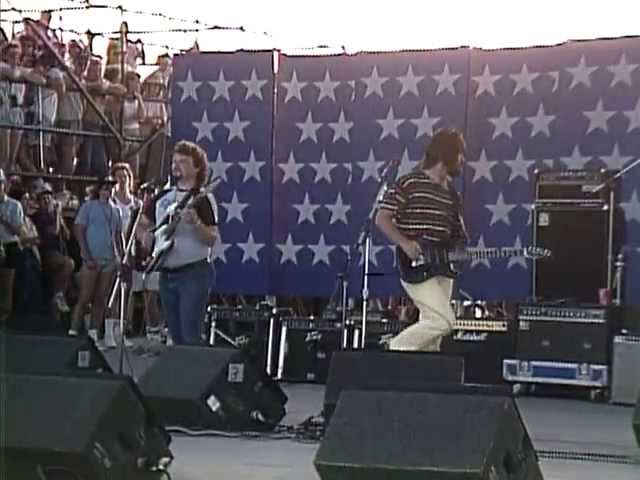
The video featured here was filmed at Farm Aid II — the second annual Farm Aid concert, held at Manor Downs in Austin, Texas, on July 4, 1986. The Farm Aid concert series had been founded the previous year by Willie Nelson, Neil Young, and John Mellencamp to raise money for American family farmers facing foreclosure during the agricultural crisis of the early-to-mid 1980s. The first concert, held in Champaign, Illinois, in September 1985, had raised $9 million. By July 1986, Alabama were at the absolute commercial peak of their run. My Home’s in Alabama was their certified-Platinum debut. Feels So Right had been #1 country in 1981. Mountain Music had spent fifty-five weeks on the country albums chart in 1982-1983 and went 5× Platinum. The Closer You Get was #1. Roll On was #1. The previous January, RCA had released the Alabama Greatest Hits compilation, which would itself go 5× Platinum, making Alabama the most commercially successful country act of the entire decade.
The Farm Aid II performance came two months before they would release The Touch, the album that produced You’ve Got the Touch and Touch Me When We’re Dancing — both #1 country singles. The band’s signing-bonus-by-comparison MDJ contract was six years in the past. The Texas farmers watching the band from the audience that July 4 had been part of the country music constituency that had carried If You’re Gonna Play in Texas (You Gotta Have a Fiddle in the Band) to #1 in 1984. The Farm Aid II setlist included the band’s biggest hits — but it was Tennessee River, the song that had started everything six years earlier, that the cameras caught most fully. The performance restores the second verse the radio cut had removed. The extended guitar solo is there. The audience-singing-along sequences are there. The footage is one of the most-watched documents of Alabama in their commercial prime — captured at a benefit concert raising money for farmers like the cotton farmers Randy Owen had grown up between, in a state where Alabama had become country music’s most reliable touring draw, six years after their first number-one and at the absolute centre of a chart streak that no act in any genre has since matched. Jeff Cook would die of Parkinson’s disease in 2022 at age seventy-three. Randy Owen and Teddy Gentry have continued to tour as Alabama in the years since. The song that had been written about a river view through a windshield in Fort Payne, Alabama, has remained, by every reasonable measure, the foundation on which the entire body of their work was built.
![Van Halen – Dreams (Official Music Video) [HD]](https://musicvideosclub.com/wp-content/uploads/2026/01/van-halen-dreams-official-music-360x203.jpg)