



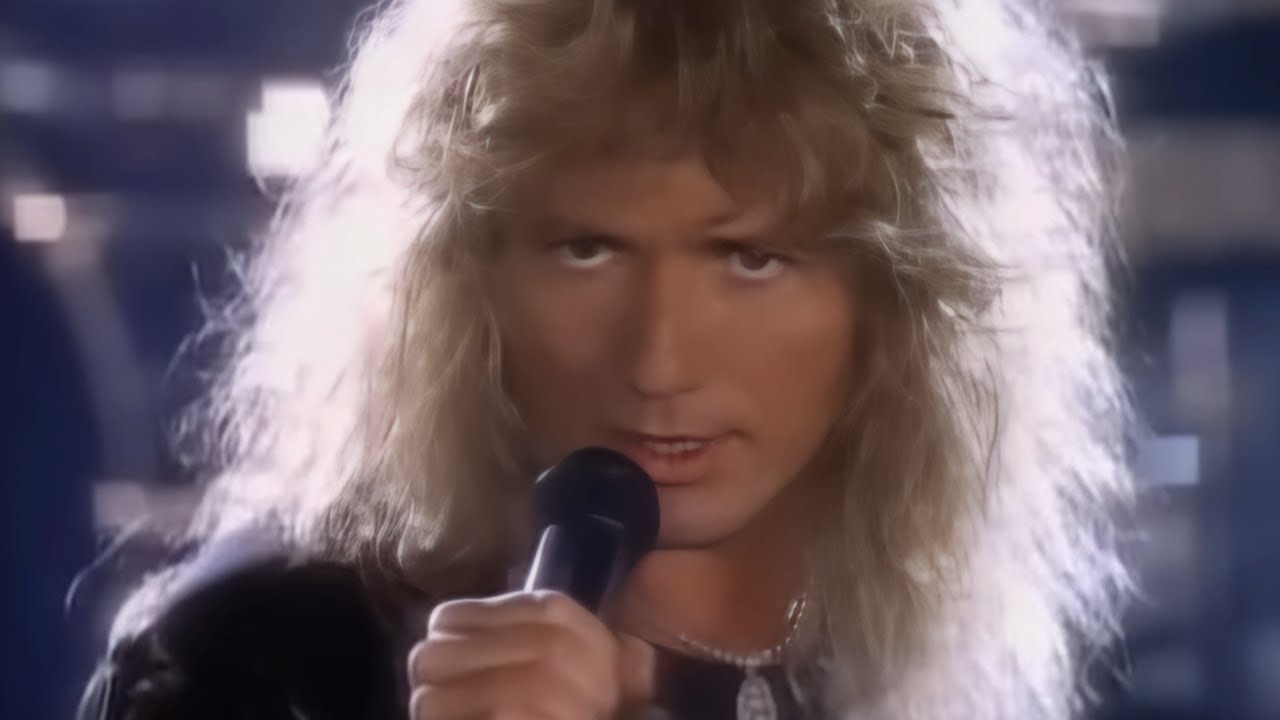



Whitesnake – Here I Go Again
The song that gave Whitesnake their only American No. 1 exists because David Coverdale agreed to re-record it as part of a deal to get something else he wanted.
In October 1987, “Here I Go Again” reached No. 1 on the Billboard Hot 100 — the only time Whitesnake ever topped the American chart. What almost nobody singing along to it on MTV knew was that the song was already five years old, that it had flopped nearly everywhere the first time, and that this second version existed largely because David Coverdale had struck a bargain with his record label. He wanted to re-record an old ballad called “Crying in the Rain.” Geffen said yes — on the condition that he also redo “Here I Go Again.” The biggest hit of his career was, in his own telling, the price of a favor.
Keep watching: Whitesnake – Is This Love · Deep Purple – Child in Time (Jon Lord)
The original “Here I Go Again” came out in 1982 on Saints & Sinners, written by Coverdale with guitarist Bernie Marsden and produced by Martin Birch. That version is a different animal: slower, bluesier, built on a gospel-tinged organ played by Jon Lord, Coverdale’s former bandmate in Deep Purple. It ran over five minutes, took its time, and went almost nowhere commercially — No. 34 in the UK, minor placings in Australia and Germany, and no real impact in the United States at all. Coverdale never hid his frustration with the album that housed it, later calling Saints & Sinners a contractual-obligation record he’d made under difficult circumstances.
A deal, a new band, and a glossier take
By 1987 Whitesnake was effectively a new band. Coverdale was the only survivor of the earlier lineup, and he had spent years reshaping the group’s sound for American radio — leaner, harder, built for arenas rather than blues clubs. The re-recording of “Here I Go Again” for the self-titled 1987 album, produced by Mike Stone and Keith Olsen, replaced Lord’s organ with a keyboard intro and handed the guitar solo to a guest, the Dutch musician Adrian Vandenberg, who would soon join the band full-time. When Geffen wanted an even more compact version for the American single, Olsen produced a separate radio remix cut with an entirely different set of studio players, including guitarist Dann Huff — which means the crisp single most Americans first heard on the radio and the album version anchoring the record are not, strictly speaking, the same performance.
The gamble Coverdale resisted paid off enormously. The 1987 recording became Whitesnake’s signature song and their commercial peak, hitting No. 1 in both the United States and Canada that October and reaching No. 9 in Britain — a dramatic upgrade on the 1982 original’s modest showing. The parent album sold in the millions and turned a veteran British blues-rock outfit into an American arena headliner.
One word, quietly rewritten
The most-discussed change between the two versions is a single word in the chorus. The 1982 original runs, “like a hobo I was born to walk alone.” By 1987 that line had become “like a drifter.” Coverdale’s account has a twist most listeners never suspect: the lyric had started life as “drifter,” but he’d changed it to “hobo” for the first recording because “drifter” felt overused in other songs. For the remake he reverted, and the reason he later gave was blunt — he worried “hobo” was being misheard as “homo,” and wanted the line to land cleanly on radio. It is a small edit that fans still argue about, convinced their memory of the “wrong” word is playing tricks on them. It isn’t; both words are real, on two different official recordings.
The 1987 video sealed the song’s place in the decade. Directed by Marty Callner, it featured the actress and model Tawny Kitaen cartwheeling and posing across the hoods of two Jaguars, intercut with the band, and it ran in heavy rotation on MTV until the single had reached far past Whitesnake’s hard-rock base. The song has never really left circulation since, turning up across films, television, karaoke scenes, and national ad campaigns for decades. For a track that its own writer had to be talked into revisiting, “Here I Go Again” has proven remarkably unwilling to walk alone.
SONG INFORMATION
Related videos
![David Lee Roth – California Girls (Official Video) [HD]](https://musicvideosclub.com/wp-content/uploads/2026/10/david-lee-roth-california-girls-360x203.jpg) Watch LaterAdded
04:37
Watch LaterAdded
04:37  Watch LaterAdded
05:29
Watch LaterAdded
05:29  Watch LaterAdded
04:05
Watch LaterAdded
04:05