





![George Benson – Give Me The Night (Official Music Video) [HD Remaster]](https://musicvideosclub.com/wp-content/uploads/2026/02/george-benson-give-me-the-night-360x203.jpg)

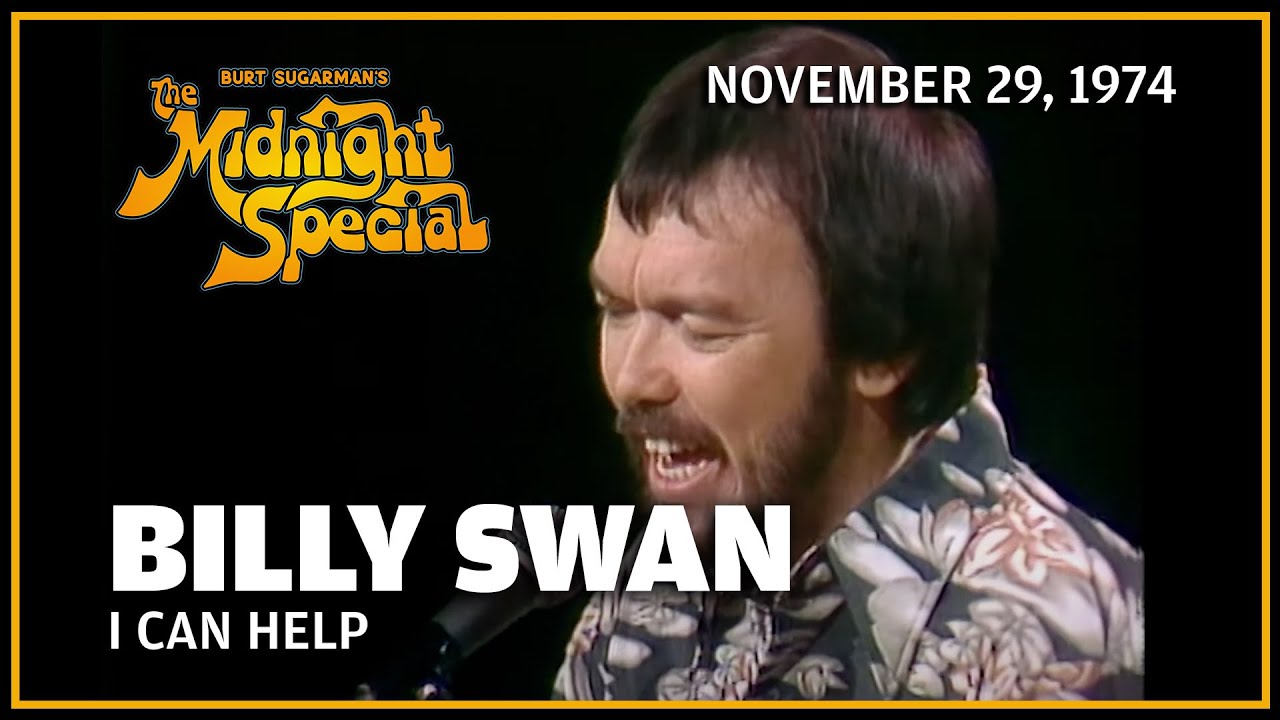
Billy Swan – I Can Help
He Wrote It in Twenty Minutes at Home in March 1974. He Recorded It in Two Takes at a Small Tennessee Studio With a Borrowed Farfisa Organ. A German Shepherd Puppy Tugged at His Pants Leg Through the Session. Five Months Later It Was Number One on Both the Pop and Country Charts. Four Months After That, Elvis Presley Recorded a Version of His Own.
Billy Swan was thirty-one years old in March 1974 and had been making his living in music for twelve years without ever having a hit of his own. He had been born in Cape Girardeau, Missouri, in 1942, had moved to Nashville at twenty, and had spent the 1960s and early 1970s as one of those Nashville journeymen who appear on the credits of other people’s records — a songwriter whose song Lover Please had been a #7 hit for Clyde McPhatter in 1962, a session bassist, a touring musician with Kris Kristofferson, a janitor at Columbia Recording Studios whose job he had given to Kristofferson on his way out the door. He had recorded singles for various labels through the late 1960s. None of them had charted. By the early 1970s he was signed to Monument Records, the Nashville-based label founded by Fred Foster that had built its catalogue around Roy Orbison’s early hits. Swan had recorded an album for Monument in 1973 that had not been released. In March 1974, sitting at home in Nashville, he wrote a song in approximately twenty minutes. He titled it I Can Help. The verses came as fast as the hook. The whole thing, he later told Sound on Sound, “just came out of the air, including the words.” The shuffle rhythm in his head was based on an early drum machine preset he had been listening to. He took the song into the studio that same month.
The studio was Young’un Sound, a small facility in Murfreesboro, Tennessee, run by producer and engineer Chip Young — the Memphis-trained session guitarist who had been on Elvis Presley’s studio band continuously between 1965 and 1977 and who had also been recording Swan’s stalled Monument material for several years. Young was a regular collaborator with Felton Jarvis, Elvis’s longtime producer. The two had become friends. Young’un Sound was a small operation; the live room was modest, the staff was minimal, the puppy was a regular presence. Chip Young’s German Shepherd puppy, named Bowser, had the run of the studio. He was learning the rhythms of recording sessions the way studio dogs do. The vocals for I Can Help were recorded with a Neumann U47 microphone. The Farfisa organ that gave the recording its distinctive sound did not belong to Billy Swan — it had been borrowed from the Memphis session musician Bobby Emmons, who was friends with Young and had left the portable instrument at the studio for whoever needed it. Swan played it himself. The Farfisa, Mike Leech’s bass, and Reggie Young’s guitar were all recorded direct, without amplification. The drums and shuffle rhythm — modelled on the drum machine preset Swan had been listening to — were played live by a session drummer. The recording took two takes. The puppy tugged at Swan’s pants leg throughout the second one. The band applauded when the take was finished. The recording was done.
The Single Monument Records Almost Didn’t Release
Monument Records was initially uncertain. Fred Foster — the founder of the label, the producer who had signed Roy Orbison and Dolly Parton and Kris Kristofferson — consulted an industry friend about which track from Swan’s completed album should be the lead single. The friend recommended Ways of a Woman in Love — the Johnny Cash song that Swan had covered and that the label preferred for its country radio profile. The friend dismissed I Can Help as a non-starter. Foster went with the friend’s recommendation initially. The single, when Monument did decide to release I Can Help as the A-side in late July 1974, climbed slowly. Country stations played it first. By September it was crossing onto pop radio. The Farfisa organ, the shuffle rhythm, Swan’s relaxed lower-register vocal — the combination read as warm and conversational to listeners across both formats, a song about offering help to a romantic partner that managed to sound neither pleading nor presumptuous. The single climbed across October. It reached number one on the Billboard Hot 100 the week of November 23, 1974, and held the position for two weeks. It simultaneously reached number one on the Hot Country Singles chart. It hit number six in the United Kingdom and number one in Canada. The Recording Industry Association of America certified it Gold. Monument, having nearly buried the single before release, watched the song they had hesitated over become the biggest single in the label’s history.
The album I Can Help followed in late 1974, topping the country albums chart in 1975 and producing two further charting singles. None matched the title track’s commercial reach. Billy Swan recorded several subsequent albums through the late 1970s. None produced another Top 40 single. The song that had been written in twenty minutes and recorded in two takes — the only major pop hit of his career — became the recording on which the rest of his commercial profile would rest.
Elvis, the Socks, and a Cover That Sealed Its Status
The most significant validation of I Can Help, beyond its chart success, arrived four months after its peak. Felton Jarvis — the Elvis Presley producer who had written the liner notes for Billy Swan’s debut album and who had been the friend who first played the song to Elvis — recommended I Can Help as a cover for Elvis’s upcoming album. Elvis liked the song. The session was scheduled at Stax Studios in Memphis in March 1975 for what would become the Today album. Chip Young, the producer of Swan’s original recording, was on the Elvis session as a member of the studio band — he had been a continuous member of Elvis’s recording lineup since 1965 — and Young recreated the original guitar solo as an overdub on Elvis’s version. Elvis nailed the entire track on the first complete take. Afterwards, as a thank-you and a memento for the songwriter, Felton Jarvis handed Billy Swan the socks Elvis had been wearing during the session. Swan, by his own account, has kept them.
Elvis’s version was released on the Today album in May 1975, six months after Swan’s original had hit number one. The cover sealed the song’s status as a part of the American pop standard catalogue. Billy Swan continued recording sporadically through the 1980s and 1990s. He joined the country supergroup Black Tie in the early 1990s with Randy Meisner, Jimmy Griffin, and Charlie Rich Jr. He played on Kris Kristofferson’s tours throughout much of his career. He appeared as a featured songwriter at various Americana festivals across the decades. I Can Help remained the recording most listeners knew him for — the song written in twenty minutes, recorded in two takes, with a puppy tugging at his pants leg, that became a #1 record on two American charts simultaneously and that Elvis Presley covered four months later. The math of how songs become standards has always been mysterious. Sometimes the math is twenty minutes plus two takes plus a borrowed Farfisa plus a puppy. Sometimes the math, by some miracle, is exactly that.