



![Madonna – Open Your Heart (Official Video) [HD]](https://musicvideosclub.com/wp-content/uploads/2026/01/madonna-open-your-heart-official-360x203.jpg)


![Starship – We Built This City (Official Music Video) [HD]](https://musicvideosclub.com/wp-content/uploads/2024/10/starship-we-built-this-city-offi-360x203.jpg)
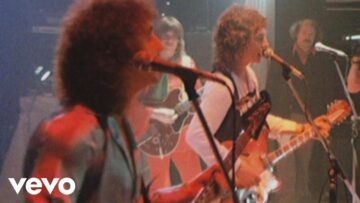
Fleetwood Mac – Little Lies
Christine McVie wrote “Little Lies” with the man she had just married — and it is not a love song. It is a song about asking to be lied to, and it became the last US Top 10 hit Fleetwood Mac would ever have.
“Little Lies” was written by two newlyweds, and it is one of the least romantic hit songs of the 1980s. Christine McVie, Fleetwood Mac’s keyboardist and one of its three singer-songwriters, had married the Portuguese musician Eddy Quintela in 1986, roughly seven months before the band’s album Tango in the Night was released. The two of them wrote “Little Lies” together. But anyone expecting a song about new love from a pair of newlyweds would be reading it wrong. “Little Lies” is a song about preferring a comfortable deception to a painful truth — about a person who knows they are being lied to and asks for the lying to continue anyway. McVie explained the lyric plainly in an interview collected in Timothy White’s Rock Lives: “The idea of the lyric is: If I had the chance, I’d do it differently next time. But since I can’t, just carry on lying to me and I’ll believe, even though I know you’re lying.” It is a study of willful self-deception, written, with a certain irony, by a woman at the start of a new marriage.
The song came together as a genuine collaboration in more ways than the writing credit shows. McVie has recalled that the song’s distinctive counter-vocals — the call-and-response that runs through the chorus — were built on a melodic idea from Lindsey Buckingham, which she then expanded into the finished arrangement. That chorus is the song’s signature: McVie sings lead through the verses in her warm, even alto, and then the chorus opens out into close three-part harmony, with brief vocal solos surfacing from Buckingham and Stevie Nicks. It is one of the cleanest demonstrations on record of what made the classic Fleetwood Mac lineup work — three distinct singers, each a songwriter in their own right, folded into a single shimmering vocal sound.
The last great record of a lineup falling apart
“Little Lies” was recorded for Tango in the Night, Fleetwood Mac’s fourteenth studio album, between November 1985 and March 1987 at Rumbo Recorders and at the Slope, Lindsey Buckingham’s home studio, in Los Angeles. Buckingham co-produced the album with Richard Dashut, and the production is a large part of why the record sounds the way it does — “Little Lies” is layered with digital textures, sampled and sequenced sounds, and the kind of meticulous studio detail Buckingham specialized in. The album was, by every account, an ordeal to make, assembled through a haze of band tensions and Buckingham’s increasingly solitary working methods. It was also the last studio album the classic five-member lineup — Buckingham, McVie, Nicks, Mick Fleetwood, and John McVie — would complete together. Buckingham announced his departure from the band shortly after the album was finished, before the supporting tour; Fleetwood Mac had to honor their touring commitments with Billy Burnette and Rick Vito replacing him. Tango in the Night was the end of an era, and it was also, after Rumours, the biggest album the band ever made, eventually selling more than 15 million copies worldwide.
Released as the album’s third single on August 14, 1987, “Little Lies” became one of Fleetwood Mac’s biggest late-period successes. It reached No. 4 on the Billboard Hot 100 in November 1987 and spent four weeks at No. 1 on Billboard’s Adult Contemporary chart. In the United Kingdom it reached No. 5, with a long fourteen-week chart run — a particular milestone for Christine McVie, as it was her first UK Top 10 hit as a vocalist and composer, and her first UK Top 20 appearance as a singer since Chicken Shack’s 1969 cover of “I’d Rather Go Blind.” It cracked the Top 10 in Canada, New Zealand, Switzerland, Finland, and Ireland, and was the first Fleetwood Mac single ever to reach the Top 5 in both the United States and the United Kingdom. In the US, it also marked an ending: “Little Lies” was the last Top 10 hit Fleetwood Mac would ever have on the Billboard Hot 100. The follow-up single, “Everywhere,” reached No. 14.
A farm, golden fields, and Dominic Sena
The music video, directed by Dominic Sena — who would later move into feature films — set the song against an unexpected backdrop. Rather than the glossy, high-concept staging that defined so much of late-1980s MTV and VH1, Sena placed Fleetwood Mac in a rural setting: the band performing on and around a farm, framed by barns and golden fields, the visual tone soft-focus and understated. It was a deliberate move away from cliché, and it suited the song — a record about quiet, private self-deception did not need spectacle around it. Fleetwood Mac’s core audience had always sat somewhat outside the MTV demographic, but the launch of VH1 in 1985 had given the band a natural video outlet in America, and Warner Bros. commissioned substantial videos for the Tango in the Night singles to take advantage of it.
“Little Lies” has endured as one of the most-loved songs of Fleetwood Mac’s later catalog, a fixture of classic-hits radio and a regular presence in films and television. Its writer and lead singer, Christine McVie, left Fleetwood Mac in 1998 before returning in 2014; she died on November 30, 2022, at the age of 79. After her death, Billboard compiled her biggest Hot 100 hits, and “Little Lies” placed second among them — behind only “Hold Me” — a measure of how central the song was to her legacy within the band. It remains exactly what it was in 1987: a precisely built piece of pop-rock about the comfort of a lie, made by a band that was, even as it recorded it, quietly coming apart.