







Shakira, Burna Boy – Dai Dai
Sixteen years after “Waka Waka” became the most-watched music video on YouTube and the most-streamed FIFA World Cup song in history, Shakira is back at the World Cup — this time with a Nigerian Grammy winner, a five-language lyric, and a song that quietly carries the largest charity ask in tournament music history.
Shakira does not really need to write another World Cup song. Waka Waka (This Time for Africa), the 2010 single she made for the tournament in South Africa with the band Freshlyground, has accumulated more than four-and-a-quarter billion YouTube views, became the most-streamed FIFA World Cup song in history (over a billion plays on Spotify, a Guinness World Record), sold around fifteen million units globally, and is still — sixteen years later — the song people instinctively reach for when they want a single piece of music to summarise what an international football tournament feels like. Her sequel Dare (La La La) for the 2014 World Cup in Brazil also charted in every Spanish-speaking market on earth. She has, in short, already done the job. Twice.
And yet on May 14, 2026, here she is again, with a new World Cup record called Dai Dai, made with the Nigerian Afrobeats superstar Burna Boy and released through Ace Entertainment and Sony Music Latin as the official song for the 2026 FIFA World Cup. The tournament begins on June 11 at the Estadio Azteca in Mexico City and runs through July 19 across forty-eight teams, three host countries, and sixteen cities in Canada, Mexico, and the United States. Dai Dai, named for the Italian phrase that translates loosely as “come on, come on” or “let’s go,” runs three minutes long and rotates through five languages — English, Spanish, Italian, French, and Japanese — in what is plainly an attempt to give the song a foothold inside every confederation FIFA has on its books.
The credits are revealing. Shakira self-produced the track alongside the Mexican-American producer Alexander Castillo; the songwriting credits include Burna Boy, the Canadian songwriter Benny Adam, the American Jon Bellion, and — perhaps most surprisingly — Ed Sheeran, who has been writing in the shadows of major Latin pop releases for a few years now. The lyric lists historical football icons (Maradona, Pelé, David Beckham) and current global stars Shakira evidently expects to be on the pitch in June (Messi, Cristiano Ronaldo, Kylian Mbappé), then runs through the countries playing, with a deliberate emphasis on the global south. Burna Boy’s verse handles most of the song’s central groove, his Lagos-trained Afrobeats phrasing locking into Shakira’s hip-shaking pop in the kind of natural collaboration that only really works between two artists who have already proved they can sell records in every country at the same time.
The first World Cup Final halftime show, and the first time a Nigerian artist has co-led a tournament’s defining song
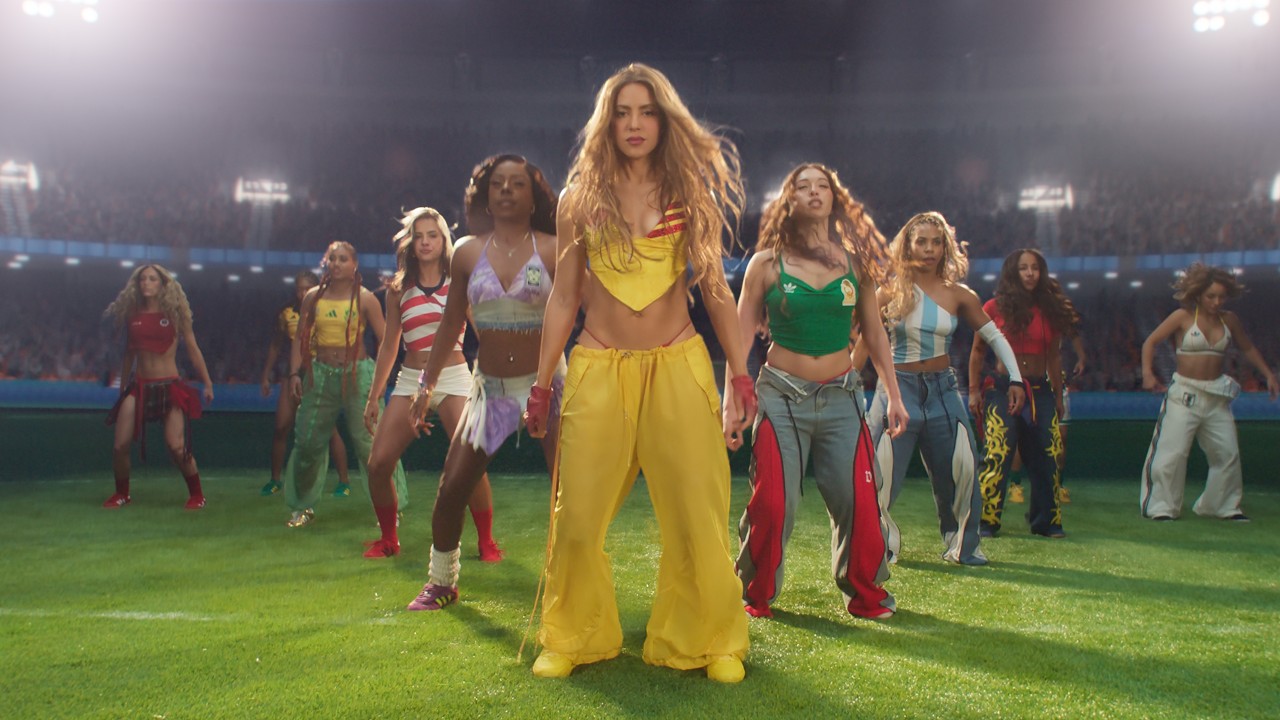
The music video, directed by Hannah Lux Davis and released on May 23, 2026, opens with Lionel Messi, Kylian Mbappé, and Erling Haaland walking onto a pitch to declare, simply, “we are ready.” Shakira appears on top of Mexico City’s Angel of Independence column, then in a desert landscape, then atop a glowing globe in a starry sky, surrounded by female dancers wearing outfits coded to the flags of the forty-eight participating nations. Burna Boy turns up midway through the four-minute clip for his verse. The whole thing was shot in Miami and is, by some distance, the largest-scale music video Shakira has been the centre of since her own 2020 Super Bowl halftime show with Jennifer Lopez.
What gives Dai Dai a larger context than just another tournament song is what FIFA has organised around it. All of the royalties from the recording flow to the FIFA Global Citizen Education Fund, which aims to raise one hundred million dollars by the end of the World Cup to provide education to children across the globe. It is, by some distance, the most ambitious charitable structure ever wrapped around a FIFA musical release. And then there is the matter of the closing ceremony. FIFA has announced that the World Cup Final, on July 19, 2026, at MetLife Stadium in New Jersey (renamed New York New Jersey Stadium for the tournament), will feature the first-ever halftime show in World Cup Final history — and Shakira will co-headline it alongside Madonna and the South Korean group BTS. The collaboration with Burna Boy is also the first time a Nigerian artist has co-led the principal song of a FIFA tournament — Davido featured on the 2022 Qatar song Hayya Hayya (Better Together), but as one of four credited artists rather than as a co-lead. Burna Boy gets equal billing here.
Sixteen years on from Waka Waka, the question is not whether Dai Dai will reach the same numbers. The 2010 single is one of the most-watched videos in YouTube’s history; nothing made in 2026 is likely to chase down four billion views inside a month. The interesting question is whether the strategy this time — the deliberate Pan-African collaboration, the explicit five-language reach, the historic charitable commitment, the halftime-show capstone — will turn out to be a more globally consequential intervention than a single chart hit could ever have been on its own. Shakira plainly does not need another Waka Waka. What she is trying to do with Dai Dai looks like something different. Watch the video.