








Ringo Starr – Long Long Road
T Bone Burnett Was at a Poetry Reading When Ringo Asked Him to Write a Song. He Went Home and Wrote a Gene Autry Number — Because He Has Always Heard Ringo as a Texas Artist.
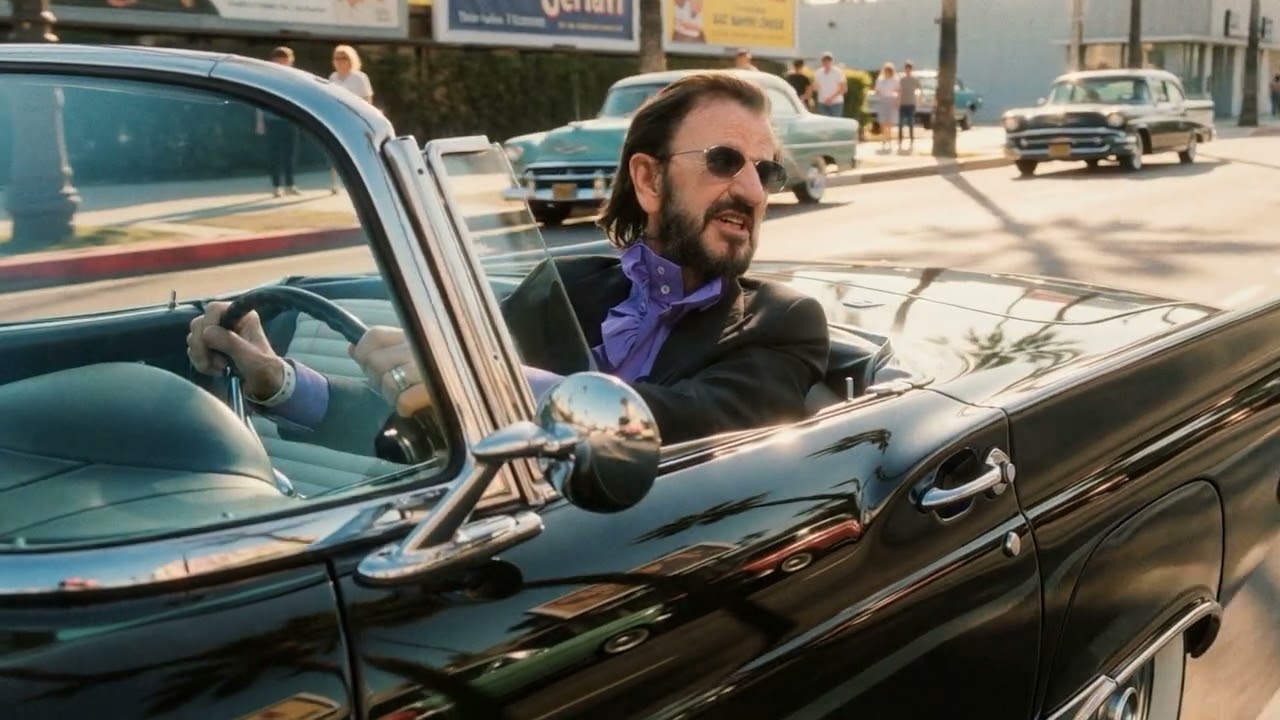
The title track of Ringo Starr’s twenty-second studio album was born at a poetry reading. The two men — Starr and T Bone Burnett, producer, songwriter, and the creative architect of the most significant run of late-career recordings Ringo has made — were there together when Starr turned to Burnett and said: write me a song. Burnett went home and wrote a Gene Autry number, a slow, spacious piece of Americana built around the sound he has always associated with Ringo’s drumming — Texas music, he calls it, the rolling feel of the Southwest that he heard in Starr’s playing long before either of them thought to make a country record together. He named it “Long Long Road,” and Ringo gave the same name to the album. The reason, he has said, is simple: he has been on a long long road. From Dingle in Liverpool, through the Hurricanes, through the Beatles, through five decades of solo recording, through everything. The road is long. This morning, April 24, 2026, the album arrived.
Long Long Road is Ringo Starr’s third country and Americana record — the first being Beaucoups of Blues in 1970, recorded in Nashville in two days with Music City’s finest session musicians, and the second being Look Up, released in January 2025, which became his first Top 10 on the Billboard all-genre Top Album Sales chart and his first solo number one on the UK Official Country Chart. Look Up was Ringo’s first country record in fifty-five years and his first collaboration with Burnett. Long Long Road is the second. When Burnett speaks about the project, he describes Ringo with a reverence that is not promotional language: “Ringo Starr is a recording artist of the highest caliber,” he said at the announcement. “I wanted to surround him with these young masters, bringing in some of this extraordinary young energy that’s happening around Nashville.” The young masters in question include Billy Strings, who has redefined bluegrass for the streaming generation; Sheryl Crow, whose own relationship with roots Americana runs deep; St. Vincent, whose presence on a country record signals that Burnett’s curatorial instincts remain as unexpected as they are precise; and Molly Tuttle and Sarah Jarosz, who appeared on the first single “It’s Been Too Long” and whose harmonies gave it the weight of genuine country tradition rather than the pastiche that often results when rock figures venture south of the Mason-Dixon line.
The Texans and the Carl Perkins Connection
The core band that Burnett assembled for Long Long Road bears the same name as for Look Up: The Texans. The name is Burnett’s affectionate joke — a reference to the Liverpool band called The Texans that Ringo played with in 1959, before the Beatles, when a working-class kid from Dingle was learning his craft in the clubs and dance halls of Merseyside and American country music was the sound he was reaching for. The band in Nashville in 2025 and 2026 includes Paul Franklin on steel guitar, David Mansfield, Dennis Crouch, Daniel Tashian — who co-produced alongside Burnett and Bruce Sugar — Rory Hoffman, Patrick Warren, and Colin Linden. The recording sessions moved between Nashville and Los Angeles, ten songs shaped across the two cities, six of them written or co-written by Burnett, three co-written by Ringo himself. The album closes with the title track — Burnett’s Gene Autry number, the poem that became a song at a poetry reading — which is the right place to put it: the last word, the road stretching back across everything.
The Carl Perkins connection is one of the most carefully considered choices on the record. Ringo has always been the Beatle who loved Perkins most openly — he sang lead on “Matchbox” and “Honey Don’t” during the band’s early years, two of the most unself-conscious expressions of pure rockabilly joy in the entire Beatles catalogue. On Long Long Road, he covers “I Don’t See Me in Your Eyes Anymore” — a song Perkins recorded in 1959, written by Bennie Benjamin and George David Weiss, that Ringo had never heard before Burnett found it. “I recorded two Carl Perkins songs with The Beatles,” Ringo has said, “and both T Bone and I wanted one on this record, and he found this beautiful track I’d never heard before.” The gesture completes a circle that began in Liverpool in the late 1950s: a young drummer in a band called The Texans, in love with American country and rockabilly, now making country records in Nashville with a band also called The Texans, covering Carl Perkins at eighty-five years old.
The Grand Ole Opry and What Came Before
The groundwork for Long Long Road was laid in February 2025 when Emmylou Harris invited Ringo to make his Grand Ole Opry debut at the Ryman Auditorium in Nashville — two nights at one of the most storied rooms in American music, recorded for a two-hour special that streamed on CBS and Paramount Plus. The invitation from Harris was not a novelty booking. It was a recognition that something genuine was happening: that a man who had spent most of his solo career making rock and pop records had, in his eighties, found a musical home in the tradition that had always been closest to the way he heard music. Look Up had already demonstrated that the country audience was receptive. The Opry nights confirmed it in person. Long Long Road arrived this morning as the follow-through — ten songs, thirty-three minutes, available on vinyl, colored vinyl, CD, and all streaming services. The “Ultraviolet Dream” colored vinyl is particularly suited to a project built around purple-themed teasers that Ringo released on social media starting in February 2026, which the internet duly noticed and attempted to decode for several weeks before the announcement came. The title track official video was released yesterday on his YouTube channel, and the album is out today. The road is, as the song says, long. It shows no sign of ending.
SONG INFORMATION
Enjoyed this one? New forgotten gems every day — tap Music Videos Club below to visit and follow us on Facebook:
Related videos
 Watch LaterAdded
04:17
Watch LaterAdded
04:17  Watch LaterAdded
02:56
Watch LaterAdded
02:56  Watch LaterAdded
05:03
Watch LaterAdded
05:03