



![David Lee Roth – California Girls (Official Video) [HD]](https://musicvideosclub.com/wp-content/uploads/2026/10/david-lee-roth-california-girls-360x203.jpg)

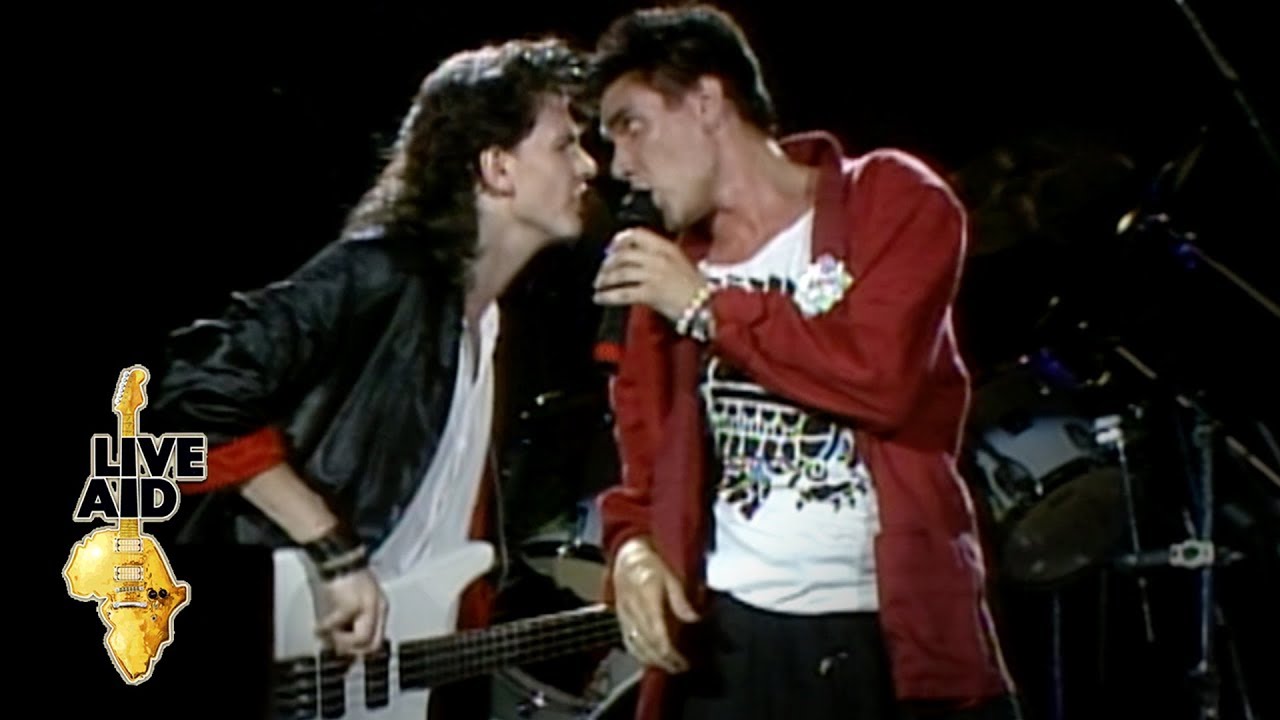
Duran Duran – The Reflex (Live Aid 1985)
The Label Told Nile Rodgers He Had Made Them Sound “Too Black” and Tried to Block the Release. Wiser Heads Prevailed. The Live Aid Performance That Closed the Night Was Also the Last Time the Original Five-Piece Ever Stood on a Stage Together.
The song existed in two versions and only one of them was a hit. The original recording of “The Reflex” — produced by Alex Sadkin and Ian Little alongside the band across sessions at a chalet near Cannes on the Côte d’Azur and at George Martin’s Air Studios on the Caribbean island of Montserrat in 1983 — ran five minutes and twenty-nine seconds and opened Seven and the Ragged Tiger as an album track. It was, by consensus within the band, not a single. The first two singles from the album were “Union of the Snake” and “New Moon on Monday,” and by the time Duran Duran were midway through the Sing Blue Silver world tour in early 1984, the label needed a third. John Taylor heard the answer in Australia. He had been listening to a prerelease copy of “Original Sin” by INXS — produced by Nile Rodgers of Chic, engineered by Jason Corsaro — and heard something in the production that made him certain Rodgers was the man to remix “The Reflex.” The commission went out. Rodgers went to work. What he sent back was so transformed that, according to band lore, when Duran Duran first heard the cassette they weren’t entirely sure what they were listening to — sampling was new enough in 1984 that the looped, stuttering “re-re-re-re-flex” vocal effect that Rodgers had constructed from Simon Le Bon’s original vocal was genuinely unfamiliar as a production technique.
The response from the record company was not warm. Rodgers later recalled the call he received from Nick Rhodes, phoning from the tour bus: “I still remember the sorrow in Nick Rhodes’ voice,” he said. “He told me: ‘Nile, we’ve submitted it to the record company, and they hate it — they say you’ve made us sound too Black.'” The objection came from the US label Capitol, and it was not subtle. Rodgers had added looping vocals, increased the tempo, enhanced the percussion, and incorporated sampled effects that moved the track decisively toward the dancefloor — all of which were, in 1984, associated in the minds of certain radio executives and label personnel with Black music, which they believed would alienate Duran Duran’s established fanbase. Wiser heads prevailed. The single was released on April 16, 1984. It entered the UK chart at number five and climbed to number one within two weeks, where it held for four consecutive weeks — keeping Phil Collins’ “Against All Odds” at number two for the first two, and the Pointer Sisters’ “Automatic” at number two for the remaining two. Neither of those records made it to the top. In the United States, “The Reflex” topped the Billboard Hot 100 for two weeks, becoming Duran Duran’s first American number one — and, in the process, one of two consecutive singles to block Bruce Springsteen’s “Dancing in the Dark” from reaching the top, the other being Prince’s “When Doves Cry.” It was also the first Duran Duran single to break the top twenty of the US dance chart, which may be taken as the most precise form of vindication available for Nile Rodgers in that particular argument.
What Russell Mulcahy Filmed in Toronto
The music video was John Taylor’s idea, and it was a deliberate statement. He wanted to put aside conceptual filmmaking — the yachts, the models, the exotic locations that had defined Duran Duran’s visual identity through the Rio era — and show what kind of live band they had become after two years of arena touring. Director Russell Mulcahy flew to Toronto and filmed across two days at Maple Leaf Gardens on March 5, 1984: afternoon closeups in an empty arena in the afternoon, then live footage during that evening’s concert in front of a full house. The technical centrepiece of the video is Nick Rhodes operating a Fairlight CMI — the first commercially available digital sampling synthesiser — with a light pen, an image that placed Duran Duran at the visible frontier of the technology that Rodgers’ remix had just deployed in the recording. The steel drum sound that runs through the arrangement had itself been created by Rhodes on a Roland Jupiter-8, slightly out of tune, which producer Ian Little later recalled with affection as sounding exactly right despite — or because of — its imprecision. The video was nominated for the MTV Video Music Award for Best Stage Performance, losing to Van Halen’s “Jump.” It remains in steady rotation wherever 1980s pop is curated seriously.
The single’s success secured Rodgers’ ongoing relationship with the band: he went on to produce “The Wild Boys” later in 1984 and the album Notorious in 1986, a partnership that outlasted the original lineup. Seven and the Ragged Tiger, boosted five months after its November 1983 release by the single’s momentum, became the band’s first and only UK number one album. In the United States it went double platinum. The band spent the remainder of 1984 in various states of exhaustion and fragmentation, the Sing Blue Silver tour having pushed everyone to their limits. Andy Taylor and John Taylor formed the Power Station with Robert Palmer and Tony Thompson. Simon Le Bon, Nick Rhodes, and Roger Taylor recorded the Arcadia album So Red the Rose. Duran Duran briefly reconvened to record the James Bond theme “A View to a Kill” — which became their second US number one — and then gathered one more time for the occasion that would, without anyone quite realising it at the moment, close their first chapter.
The Last Show of the Original Five
Live Aid took place on July 13, 1985, simultaneously at Wembley Stadium in London and John F. Kennedy Stadium in Philadelphia — a sixteen-hour global broadcast watched by an estimated 1.9 billion people across 150 nations. Jack Nicholson hosted the US television coverage. Joan Baez opened the Philadelphia show by telling the crowd: “This is your Woodstock, and it’s long overdue.” Phil Collins performed at Wembley, caught a Concorde flight, and appeared at JFK the same evening. The scale of the event was, in every measurable sense, unprecedented. Duran Duran performed at JFK Stadium in Philadelphia, before a crowd of approximately 100,000 people, playing four songs: “A View to a Kill,” “Union of the Snake,” “Save a Prayer,” and “The Reflex.” The lineup was the original five — Simon Le Bon on vocals, John Taylor on bass, Andy Taylor on guitar, Nick Rhodes on keyboards, Roger Taylor on drums — joined by percussionist Raphael Dejesus and backing vocalist Curtis King Jr. Within months of that afternoon, Andy Taylor and Roger Taylor had both departed the band. The five men who had formed in Birmingham in 1978, become one of the defining acts of the early MTV era, and stood together on the stage of the largest concert in history, never performed together again as Duran Duran until the Astronaut reunion in 2001.
“The Reflex” closed the set. A song that had been an album track before Nile Rodgers heard it, that the label had tried to suppress because it sounded too Black, that had gone to number one in America and Britain and Belgium and Ireland and the Netherlands, was the last thing the original Duran Duran played to the world on a July afternoon in Philadelphia. The crowd at JFK Stadium numbered a hundred thousand. The television audience numbered nearly two billion. The record company had been wrong about the remix. And the moment, it turned out, was one that could not be repeated — not because the music had run its course, but because the five people making it had finally run out of road to travel together.
SONG INFORMATION
Related videos
 Watch LaterAdded
03:30
Watch LaterAdded
03:30  Watch LaterAdded
06:49
Watch LaterAdded
06:49  Watch LaterAdded
04:05
Watch LaterAdded
04:05