






Elvis Presley – Are You Lonesome Tonight?
Elvis Wanted It Thrown Away
Released on November 1, 1960, “Are You Lonesome Tonight?” debuted at number 35 on the Billboard Hot 100 on November 14, jumped to number two the following week, and hit number one by November 28. It became Elvis Presley’s fifteenth chart-topping single and spent six weeks at the top, eventually selling 1.8 million copies in the United States alone. The song also reached number three on the R&B chart, number 22 on the country chart, and spent four weeks at number one in the UK. Elvis recorded it at 4 a.m. with the lights turned off, told his producer to throw the tape away, and walked out convinced he’d failed.
The single displaced Maurice Williams and the Zodiacs with the shortest number one hit in chart history, and held off Floyd Cramer playing piano on his own chart hit while simultaneously playing piano on Elvis’s track. It became Elvis’s third number one of 1960, capping the last calendar year he would ever have three chart-toppers. RCA executives initially delayed the release for months because they worried a 1920s parlor ballad didn’t fit Elvis’s newly publicized post-Army style. They were spectacularly wrong. When orders started coming in, they went from 900,000 copies the first week to 1.2 million the second week, eventually earning double platinum certification in 1992.
The only reason Elvis ever recorded the song was because Colonel Tom Parker’s wife Marie loved it. Parker famously had zero interest in music and never interfered with Elvis’s repertoire choices, making this the single exception in their entire professional relationship. Marie had heard the song performed by Gene Austin, whom Parker had promoted in the 1940s, and it became her favorite. Parker suggested it to Elvis in 1959 when there was a possibility of recording in Germany during his Army service. When Elvis finally tackled it in April 1960, he already seemed familiar with the material, possibly from Jaye P. Morgan’s 1959 version that reached number 65 or from Al Jolson’s 1950 recording with the spoken bridge.
The track was recorded at RCA Studio B in Nashville during an all-night session that began April 3, 1960, concluding in the early morning hours of April 4. Elvis had already recorded eight songs before attempting this one. He cleared the studio of everyone except Scotty Moore and Hank Garland on guitar, Bob Moore on bass, drummers D.J. Fontana and Buddy Harman, pianist Floyd Cramer, and the Jordanaires for backing vocals. He demanded the studio lights be turned completely off. Engineer Bill Porter had accidentally left echo on Elvis’s vocal from a previous take but didn’t mention it, figuring there would be more attempts. There was a glitch at the end of the fifth take, and Elvis wanted to abandon it entirely. Producer Steve Sholes talked him into recording just the ending so they could splice it together. Porter made the edit between syllables of the word tonight, creating a seamless master that became the final single.
The song appeared on the album Elvis Is Back!, widely considered one of his most consistent studio albums and a landmark post-Army statement. The April sessions also produced his versions of Fever and It’s Now or Never, creating a trifecta of classics that showcased Elvis moving beyond narrow definitions of rock and roll. His television appearance with Sinatra in March 1960 had already signaled this shift, and these recordings cemented his transformation into a versatile pop artist who could dominate multiple genres simultaneously. The stripped-down arrangement on this track, featuring just acoustic guitar, bass, drums, and vocals, represented a stark departure from his fuller productions.
The success spawned at least five answer records by female singers, all titled Yes I’m Lonesome Tonight, with versions by Dodie Stevens, Thelma Carpenter, Linda Lee, and Ricky Page all competing for chart positions. Stevens reached number 60 while Carpenter hit number 55. Connie Francis was literally driving to the studio to record her own version when Elvis’s single came on the radio, having convinced her father it would be a number one song. She never got the chance. The song became a staple of Elvis’s live performances, first performed at a USS Arizona Memorial benefit in Honolulu in March 1961. During his Las Vegas engagement on August 26, 1969, he changed the spoken section to reference a bald audience member, cracked himself up, and laughed through the rest of the performance while Cissy Houston gamely continued singing her part.
Frank Sinatra recorded it without the spoken bridge in 1962, Merle Haggard’s 1977 version reached number 12 on the country chart, and Donny Osmond covered it in 1973. The laughing Las Vegas version was officially released in 1980 and became legendary among fans. Billboard ranked it number 81 on the Hot 100 All-Time Top Songs list in 2008. For a song Elvis wanted discarded after a middle-of-the-night recording session with the lights turned off, it turned out to be one of the most enduring and versatile recordings of his entire career, proving that sometimes the artist is the last person who knows what they’ve just created.
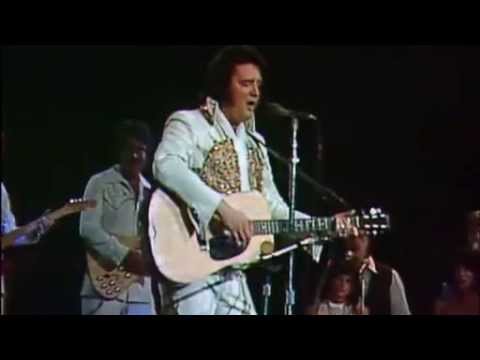
*Video recorded live on June 21, 1977 at Rushmore Plaza Civic Center, Rapid City, South Dakota – (filmed for CBS’s Elvis in Concert)
Related videos
 Watch LaterAdded
03:05
Watch LaterAdded
03:05  Watch LaterAdded
04:05
Watch LaterAdded
04:05  Watch LaterAdded
02:57
Watch LaterAdded
02:57