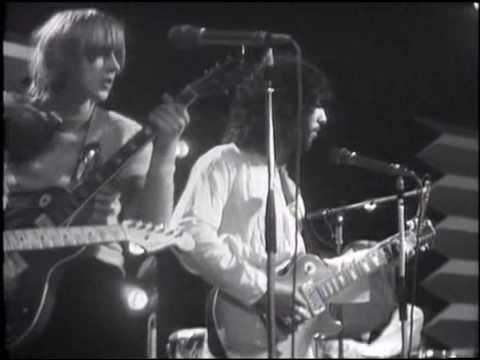
When Fleetwood Mac released “Oh Well” on September 26, 1969, Peter Green was convinced it would fail. He’d even made bets with bandmates Mick Fleetwood and John McVie that the song was too sad to chart. They all lost money when it climbed to number two in the UK, held from the top only by The Archies’ bubblegum hit “Sugar, Sugar”. The single spent sixteen weeks on the UK chart, hit number one in the Netherlands for eleven weeks, and became Fleetwood Mac’s first entry on the American Billboard Hot 100, peaking at number fifty-five. In an October 1969 interview with NME, Green admitted he wouldn’t be surprised if the single flopped and said he’d be disheartened if that happened. Instead, it became one of the most influential blues-rock recordings of the era.
The song came together in an unusual way. Green had bought a Ramirez Spanish guitar after hearing one on the radio and wrote an ambitious classical-influenced instrumental he was excited about. Then he added what he called a throwaway riff at the beginning, inspired by Muddy Waters’ blues classic about being a catfish. Green wanted the classical section as the A-side and planned to bury the blues-rock riff on the B-side, but the record label flipped his plan. Years later, Green remained frustrated that the first part became the famous section, telling Guitar magazine in 2007 that he never really intended the song to have that first section at all.
Recording took place on August 3, 1969, at De Lane Lea Studios in London with the full band present. They cut the first part in just four takes, with Jeremy Spencer adding maracas. The hypnotic blues riff builds around Green’s dobro-style resonator guitar before breaking into unaccompanied verses and then exploding into a rock shuffle. That iconic cowbell part that punctuates the track? Completely accidental. Fleetwood grabbed the cowbell spontaneously during the session, and Green loved it so much he insisted on keeping it. The second part showcased Green’s versatility with Spanish-style acoustic guitar, cello that he played himself, piano from Spencer, and recorder parts mostly played by Green. His girlfriend Sandra Elsdon played the final few recorder notes, though she insisted she had no musical skills and admitted to making mistakes.
“Oh Well” was initially released only as a single, never appearing on the UK version of Then Play On. Manager Clifford Davis had expected Danny Kirwan’s “When You Say” to be the next single instead. After another track, “Rattlesnake Shake”, failed to chart in America, the label finally released “Oh Well” there in January 1970. The success prompted a revised US edition of Then Play On that combined both parts of the song into one eight-minute-plus track, replacing Kirwan’s “When You Say” and “My Dream”. During live performances, only the blues-rock first part was played, becoming a concert staple that outlasted Green’s tenure with the band.
The song’s influence reached far beyond the charts. Jimmy Page later admitted that the call-and-response vocal structure of “Oh Well” directly inspired Led Zeppelin’s “Black Dog” in 1971. Music critics have noted both songs as early examples of blues-rock crossing into heavier territory. The track has been covered by everyone from Deep Purple and Aerosmith to Tom Petty and the Heartbreakers, whose guitarist Mike Campbell made it his showcase piece when he joined Fleetwood Mac in 2018. Jimmy Page recorded a live version with The Black Crowes for their 2000 album Live at the Greek. Even David Gilmour of Pink Floyd performed the rarely-heard second part at a 2020 Peter Green tribute concert in London, marking what Fleetwood called the first proper stage performance of that section. Rolling Stone ranked the song at number nine on their list of the fifty greatest Fleetwood Mac tracks.
“Oh Well” captures Peter Green at the peak of his creative powers, right before his mental health struggles forced him to leave the band in 1970. The song’s two contrasting sections mirror Green’s own duality—the driving blues power that made him famous alongside the ambitious classical experiments he valued more. For anyone discovering the early blues-rock era of Fleetwood Mac, this track remains essential listening. It’s proof that sometimes an artist’s throwaway riff becomes their most enduring legacy, and that the songs we’re most uncertain about can become the ones that define us.