



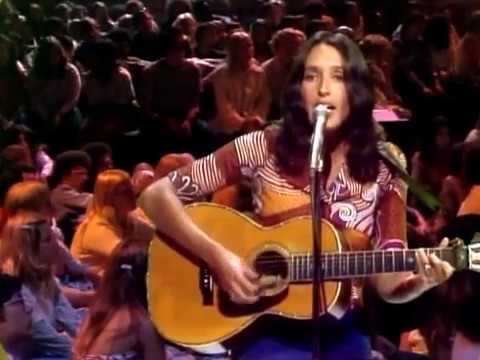
Joan Baez – The Night They Drove Old Dixie Down
She Never Saw The Lyrics And Levon Helm Never Forgave Her
Released in August 1971, Joan Baez’s cover of “The Night They Drove Old Dixie Down” became her biggest commercial hit despite being learned entirely by ear without ever seeing the printed words. The single peaked at number three on the Billboard Hot 100 in October 1971, matching the Cash Box Top 100, while spending five weeks at number one on the Adult Contemporary chart and reaching number six in the UK. Billboard ranked it as the twentieth song of 1971, and it earned RIAA Gold certification on 22 October, selling over one million copies. Baez later admitted to Rolling Stone’s Kurt Loder she’d learned the song by listening to The Band’s 1969 album and recorded it with the misheard words, creating permanent lyric changes that reportedly so angered drummer Levon Helm that he refused to perform the song after The Last Waltz in 1976. Garth Hudson revealed Helm’s refusal wasn’t about songwriting credit disputes with Robbie Robertson but specifically about his dislike of Baez’s version.
The chart success marked an unexpected crossover for both Baez and the song. The Band’s original version from their 1969 self-titled album had never charted as a single, though the album reached number nine on the Billboard 200. Baez’s rendition introduced the Civil War narrative to mainstream pop audiences who’d never encountered The Band’s rootsy original. The song appeared on Blessed Are, her final double album for Vanguard Records after eleven years with the label, making it both a farewell triumph and a contractual obligation fulfilled. The album reached number eleven in the US and featured twenty-two tracks including covers of The Beatles’ “Let It Be,” The Rolling Stones’ “Salt of the Earth,” and Kris Kristofferson’s “Help Me Make It Through the Night.” Her next album Come from the Shadows in 1972 would be for A&M Records, marking a new chapter in her career.
Robbie Robertson wrote the original song over eight months, spending time at the library with Helm researching Civil War history to make General Robert E. Lee emerge with due respect. In his 2016 memoir Testimony, Robertson recalled flashing back to visiting Helm’s parents in Marvell, Arkansas, where Helm’s father told him not to worry because the South would rise again. That sparked the concept of writing from a Southern family’s perspective during the war’s final days. The song tells the story through Virgil Caine, a poor white Southerner who worked on the Danville train until Union General George Stoneman’s cavalry tore up the tracks during his 1865 raid through southwest Virginia. Critics have debated whether the song glorifies the Confederacy or simply portrays war’s devastating human cost on civilians regardless of their cause, with Ralph Gleason writing in Rolling Stone that nothing he’d read brought home the overwhelming human sense of history like this song did.
Recording took place in Nashville during 1971 with producer Norbert Putnam, who’d worked at Fame Studios in Muscle Shoals before relocating to Nashville with session players Kenneth Buttrey on drums and David Briggs on keyboards. The backing musicians included Norman Blake on guitar and dobro, Pete Wade on guitar, and Charlie McCoy on harmonica, creating a polished country-folk hybrid sound that facilitated Baez’s crossover appeal. Engineer Gene Eichelberger captured Baez’s vocals at their most emotive, though the misheard words created permanent alterations. Where Helm sang about Stoneman’s cavalry, Baez heard and sang about so much cavalry. Where the original stated Richmond had fell, Baez transformed it into took the train to Richmond that fell, accidentally eliminating the historical reference to Richmond’s capture on May 10, 1865. The line about working the land became a working man, subtly shifting the agricultural specificity to generic labor.
“The Night They Drove Old Dixie Down” appeared on Blessed Are, released in July 1971 as a double LP with a bonus seven-inch single pressed on styrene featuring Woody Guthrie’s “Deportee.” The album marked the end of Baez’s Vanguard era, which began with her 1960 debut recorded in just four days at New York’s Manhattan Towers Hotel ballroom. The title track opened with spiritual references to the Beatitudes from Matthew’s Gospel, adapting them to celebrate modern wanderers and skeptics as tribute to Janis Joplin following her October 1970 overdose. Critics praised the Nashville production for its lush arrangements but faulted the album’s excessive length as a contractual obligation that diluted its impact. Retrospective evaluations highlight it as an underrated gem that bridged folk traditions with mainstream accessibility, though some wished for a tighter, more focused presentation.
The controversy around Baez’s lyric changes intensified over decades. Some critics viewed her alterations as disrespectful misappropriation of fellow musicians’ work, particularly given how clear Helm’s original vocals were on The Band’s recording. Others noted that her version succeeded commercially precisely because it softened the specific historical details, making the song more universally accessible as a meditation on war’s human cost rather than a particular moment in Confederate decline. Baez acknowledged the mistakes in later concerts, performing the song as Robertson originally wrote it from the 1990s onward. The fact that she was a female singing a first-person narrative from a male Confederate soldier’s perspective added another layer of distance from the source material, though this seemed to bother audiences far less than the unintentional lyric changes.
The song’s legacy became complicated by Helm’s refusal to perform it after The Last Waltz. For years, rumors suggested his dispute with Robertson over songwriting credits explained the boycott, given Helm’s claim in his 1993 autobiography This Wheel’s on Fire that he’d helped research the history and geography. Hudson’s revelation that Helm specifically disliked Baez’s version added a tragic dimension to the story. The only Southerner in The Band, Helm had poured his Arkansas upbringing and understanding of Southern pain into his vocal performance on the original. Watching Baez’s pop-friendly version with its altered words outsell and overshadow his definitive interpretation must have felt like a final defeat, the song’s authentic Southern voice drowned out by commercial success. Helm took his exact reasons to his grave when he died in 2012, leaving only speculation about whether he minded the changed words, the popularity eclipsing his original, or simply the transformation of something deeply personal into mainstream pop candy.
Other artists tackled the song with varying approaches. Johnny Cash recorded it on his 1975 album John R. Cash, bringing his own interpretation of Southern struggle to Robertson’s narrative. The Jerry Garcia Band performed it regularly during the 1980s and 1990s. In 2020, contemporary singer-songwriter Early James recorded a version with deliberately altered words opposing the Confederate cause, transforming the line about remembering the time so well into a time to bid farewell. A 2020 editorial in The Roanoke Times argued the song doesn’t glorify slavery or the Confederacy but tells the story of a poor, non-slaveholding Southerner trying to make sense of losing his brother and livelihood. Jack Hamilton of the University of Virginia called it an anti-war song first and foremost, pointing to the bells ringing and people singing in the chorus as universal symbols of hope amid devastation.
Looking back, Baez’s “The Night They Drove Old Dixie Down” represents the complicated intersection of commercial success, artistic interpretation, and historical authenticity. Her version introduced millions to a song they’d never have encountered through The Band’s rootsier original, yet it did so through accidental lyric changes that removed specific historical references in favor of more generic imagery. The irony runs deep: a Canadian wrote one of the greatest American Civil War songs, an Arkansas native gave it authentic Southern soul, and a half-Mexican folk singer from New York turned it into her biggest pop hit by mishearing the words. Baez’s progressive activism and her interpretation of a Confederate soldier’s lament created ideological tensions that continue sparking debate about art, context, and intention. As she told Loder years later, she’d simply heard a beautiful song and wanted to sing it, never imagining the complications that would follow. The song endures in both versions, each telling its own story about how music transforms across performers, generations, and misheard lyrics that become their own kind of truth.
SONG INFORMATION
Related videos
 Watch LaterAdded
04:13
Watch LaterAdded
04:13  Watch LaterAdded
03:46
Watch LaterAdded
03:46  Watch LaterAdded
03:13
Watch LaterAdded
03:13