





![Commodores – Three Times A Lady [Live]](https://musicvideosclub.com/wp-content/uploads/2025/06/commodores-three-times-a-lady-li-360x203.jpg)
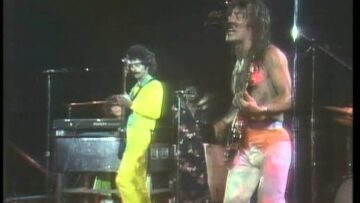

Average White Band – Pick Up The Pieces
Malcolm Duncan Argued Against Releasing It as a Single — a “Funk Instrumental Played by Scotsmen,” He Said. By the Time It Hit Number One, Their Drummer Was Dead, and the Song Had Become Something None of Them Had Written It to Be.
The song started with a guitar lick. Hamish Stuart played a single-line figure one afternoon in a house in the Hollywood Hills — the band had been camped there for weeks, woodshedding new material for an album that their existing label MCA had flown them to America to record and then declined to release. That lick was the seed. Roger Ball went off and wrote the horn line, played in unison by Ball on alto and Duncan on tenor. The following day the rest of the band fleshed it out: Owen McIntyre’s rhythm guitar, panned hard left against Stuart’s chromatically inflected hook on the right, Robbie McIntosh’s hi-hat-heavy drum part sitting over Alan Gorrie’s locked-down bass line. In Gorrie’s words, it was their tribute to James Brown and the JBs — six working-class Scotsmen in a Hollywood Hills living room, trying to make the tightest funk record they knew how to make. The result was “Pick Up the Pieces.” Malcolm Duncan’s response, when the question of a single was raised, was direct: it was a funk instrumental played by Scotsmen, he said. Nobody was going to buy it.
The band had left Scotland in 1972 with a specific ambition: to play soul and R&B at the highest possible level, in a music industry that consistently struggled to believe that ambition was possible. Their debut album Show Your Hand had gone nowhere. MCA had given them a second chance, booked them into sessions with Bobby Womack and Sly Stone, and then passed on the finished album. The turning point came when Jerry Wexler — the Atlantic Records soul legend who had produced Aretha Franklin, Ray Charles, and Wilson Pickett — heard them play in London and signed them on the spot. Atlantic brought in Arif Mardin to produce. Mardin, who had already worked with Aretha, the Bee Gees, and Bette Midler, and who would later go on to produce Norah Jones and Chaka Khan, understood immediately what the band was. He booked Atlantic Studios in New York. Roger Ball arranged overdubs: Randy Brecker on trumpet, Glenn Ferris on trombone, Michael Brecker on tenor saxophone, Ralph MacDonald on congas. What had started as a riff in a Hollywood living room arrived at 841 Broadway sounding like the real thing, because under Mardin’s direction it was.
The Party on September 23
The album AWB — known informally as the white album for its plain sleeve — was released on Atlantic in August 1974. The single “Pick Up the Pieces” came out in July. Both entered the charts slowly. By September the band was playing the Troubadour in Los Angeles, and on the night of September 23 some of them were guests at a Hollywood party thrown by a millionaire named Kenneth Moss. Robbie McIntosh and Alan Gorrie were offered what they believed was cocaine. It was heroin. McIntosh felt sick afterward and returned with his wife to the Howard Johnson’s motel in North Hollywood to recover. His bandmates found him dead in his room later that night. He was twenty-four years old. Alan Gorrie survived because Cher, who was also at the party, kept him conscious until medical help arrived. Moss was charged with murder, eventually pleaded guilty to involuntary manslaughter, and served approximately three months. The NME reported in January 1975 that the band played a benefit concert for McIntosh’s widow at the Marquee Club in London. The following month, “Pick Up the Pieces” reached number one on the Billboard Hot 100, knocking Linda Ronstadt’s “You’re No Good” from the top spot. It had taken seven months. McIntosh never knew.
By the time the record hit the top of the chart, what it meant to the band had changed completely. They had decided, in the aftermath of McIntosh’s death, to continue — a decision that required both courage and a new drummer. Steve Ferrone, who had played with Bloodstone and crossed paths with McIntosh before in Brian Auger’s Oblivion Express, was recruited. Ahmet Ertegun, Atlantic’s founder and chairman, personally persuaded Ferrone to join permanently. The band went to work on a third album, Cut the Cake, which was dedicated to McIntosh’s memory. Ferrone would remain with the band for the next decade, later joining Tom Petty and the Heartbreakers in 1994. The RIAA certified “Pick Up the Pieces” gold in March 1975. The AWB album simultaneously topped the Billboard Pop Albums chart and the Black Albums chart — the latter a measure of how completely the band had been accepted by the American soul and R&B audience that Duncan had assumed would reject them.
The Response From 120th Street
James Brown’s backing band, the JBs — to whom the song had been conceived as a tribute — responded in kind. They recorded “Pick Up the Pieces, One by One” and released it under the name AABB: Above Average Black Band. The title was a joke with warmth in it, a piece of musical signifying that acknowledged the tribute without ceding the territory. The exchange between the two records — AWB’s instrumental and the JBs’ rejoinder — sits within a long tradition of call-and-response in Black American music, and the fact that six white Scotsmen had prompted it was, depending on your perspective, either the finest compliment or the sharpest irony the funk tradition had to offer. The band took it as the former. The song has since been sampled by a significant number of hip-hop and rap artists, and has appeared on sporting event soundtracks, film scores, and compilation albums across five decades. AWB went on to record five more studio albums for Atlantic, plus a collaboration with Ben E. King, generating fourteen charting R&B singles and nine Hot 100 entries. Hamish Stuart joined Paul McCartney’s touring band. Malcolm Duncan, the saxophonist who had been most sceptical about the single’s prospects, played on every one of those records. He died in 2019, and the sales figures he had doubted back in 1974 had long since proven him wrong in the best possible way.
“Pick Up the Pieces” is two minutes and fifty-one seconds of interlocking parts that fit together with the precision of a clock mechanism — except that it breathes and swings in a way that clock mechanisms do not. Gorrie’s bass locks to McIntosh’s kick drum in a relationship that the rest of the arrangement orbits. The horn line and the guitar lick chase each other through the groove without ever quite meeting. The title is shouted at intervals — not sung, not melodically developed, just announced — and then the groove resumes. There is nothing decorative about the record. Every element serves the rhythm, and the rhythm serves the dance, which was the whole point. James Brown understood that. Arif Mardin understood it. Roger Ball understood it when he wrote the horn line. The Billboard Hot 100 understood it in February 1975, when it moved the record to the top. Malcolm Duncan had been wrong about who was going to buy it — which, given everything else that happened in September 1974, turned out to be the smallest of the surprises that song had in store.