



Tracy Chapman – Fast Car
Stevie Wonder’s Missing Hard Disk — and the Twenty-Four-Year-Old Who Filled the Silence at Wembley
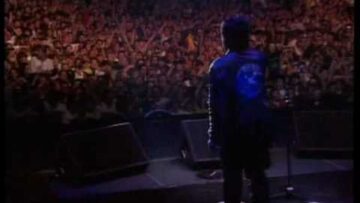
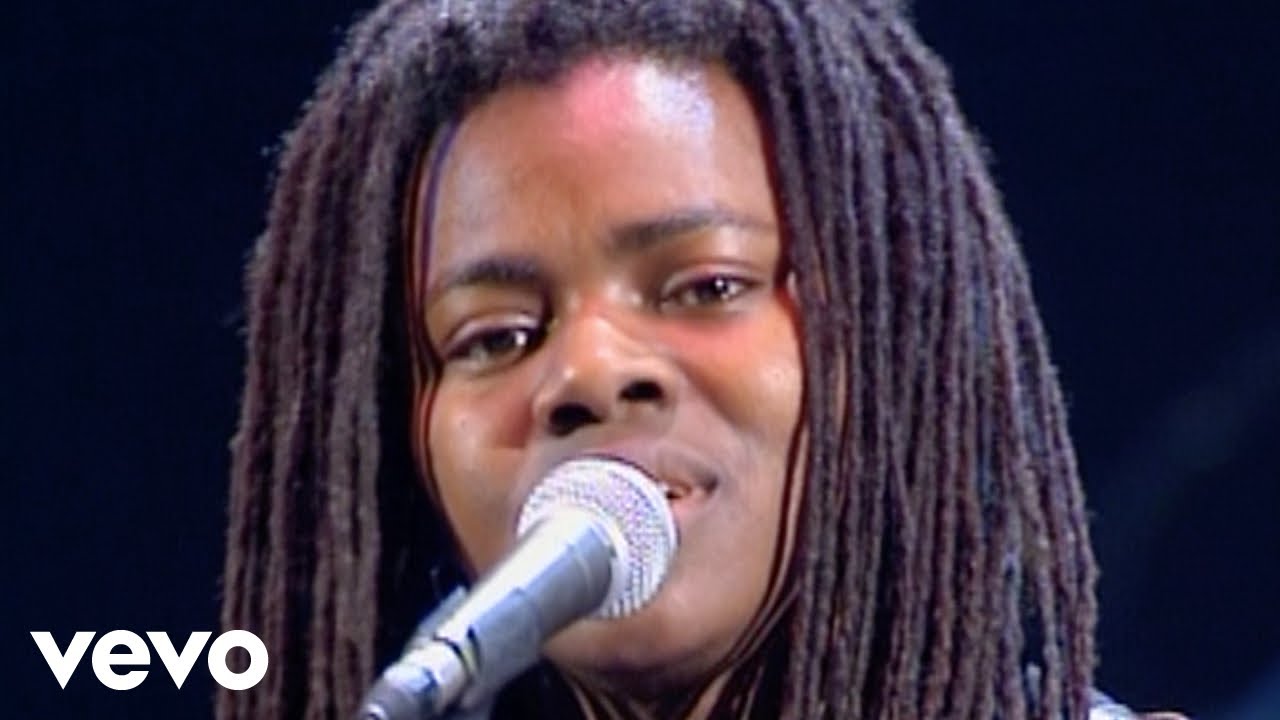
Tracy Chapman had already played her afternoon set at Wembley Stadium on June 11, 1988, and was watching from the wings when Stevie Wonder discovered that the hard disk containing the synthesized backing for his entire act had not made it from the airport. He was already heading toward the stage when someone pulled him back. With 72,000 people in the stadium and an estimated 600 million watching on television worldwide, the organizers needed someone who could walk out with nothing and hold a crowd. They found Chapman. She had her acoustic guitar. She had three songs. She had never played to an audience anywhere near this size. She walked out into a beam of light, sat down, and played “Fast Car” to the largest audience of her life — an audience that, two hours earlier, had barely known her name.
What the cameras caught that evening is the most consequential unplanned performance in the history of modern popular music. Chapman had released her debut single just two months earlier, on April 6, 1988. Before Wembley, the self-titled album had sold roughly 250,000 copies worldwide. In the two weeks following her two sets that afternoon and evening — the planned one to polite applause, the unplanned one to something approaching awe — she sold over two million. “Fast Car” climbed to number six on the Billboard Hot 100 the week of August 27, 1988, the same week the album hit number one on the Billboard 200. In the UK it reached number five. It was certified platinum by the RIAA and won the Grammy for Best Female Pop Vocal Performance at the 31st Annual Grammy Awards in 1989, with further nominations for Record of the Year and Song of the Year. The performance at Wembley was not incidental to that story. It was the story.
The song itself had been written during Chapman’s years at Tufts University in Medford, Massachusetts, where she studied anthropology and played solo acoustic sets in the coffee houses around Boston. The lyric is drawn from the world she observed growing up in Cleveland, Ohio — a childhood shaped by her mother working double shifts, a father absent from the household, and a social landscape where the gap between wanting a better life and reaching it was the defining fact of existence. The car in the song is not a car. It is velocity itself — the fantasy of movement, escape, and the possibility of becoming someone other than who circumstance has decided you are. Chapman has said the song addresses themes shared by everyone: “we’ve all been in situations we wanted to escape from; we’ve all had dreams of a better life.” At Wembley, that universality reached 600 million people in a single evening.
The studio recording, produced by David Kershenbaum at Fantasy Studios in Berkeley, California, was built around nothing more than Chapman’s vocals, her acoustic guitar, and a rhythm section of bass and drums. Kershenbaum and Chapman made a deliberate decision to keep the production sparse — no synthesizers, no layered guitars, no production tricks to fill the space. The Wembley performance strips even that back: just Chapman, her guitar, and a single spotlight in a blacked-out stadium. It is the rarest kind of live performance — one where the reduction of means increases, rather than diminishes, the emotional impact. The crowd at Wembley went quiet in a way that 72,000 people almost never go quiet. You can hear it on the recording. You can see it on the faces in the audience footage.
The song’s second life has been as remarkable as its first. In 2015, British producer Jonas Blue released a tropical house remix built around a new vocal by Dakota — it reached number two in the UK and number one in Australia, introducing the song to an entirely new generation. Luke Combs recorded a country version for his 2023 album Gettin’ Old that became a crossover phenomenon: it reached number two on the Billboard Hot 100 and made Chapman the first Black woman songwriter to score a number one on the US country charts as a solo composer, and to win the CMA Award for Song of the Year. In February 2024, Chapman appeared at the 66th Grammy Awards — her first major public performance in fifteen years — to play the song alongside Combs on the Grammy stage. The standing ovation began before she’d finished the first verse.
In 2025, Tracy Chapman’s debut album was preserved in the National Recording Registry by the Library of Congress. Earlier that year, the UK certified “Fast Car” quintuple platinum on the strength of nearly four decades of downloads and streaming — a number that reflects not just initial enthusiasm but the sustained, rolling presence of a song that has never been absent from the culture since the evening a missing hard disk sent a twenty-four-year-old back out onto a Wembley stage to fill a silence that nobody had planned for. She filled it better than anyone could have imagined. She has been filling it ever since.