


![Fleetwood Mac – Landslide (Live) (Official Video) [HD]](https://musicvideosclub.com/wp-content/uploads/2025/05/fleetwood-mac-landslide-live-off-360x203.jpg)
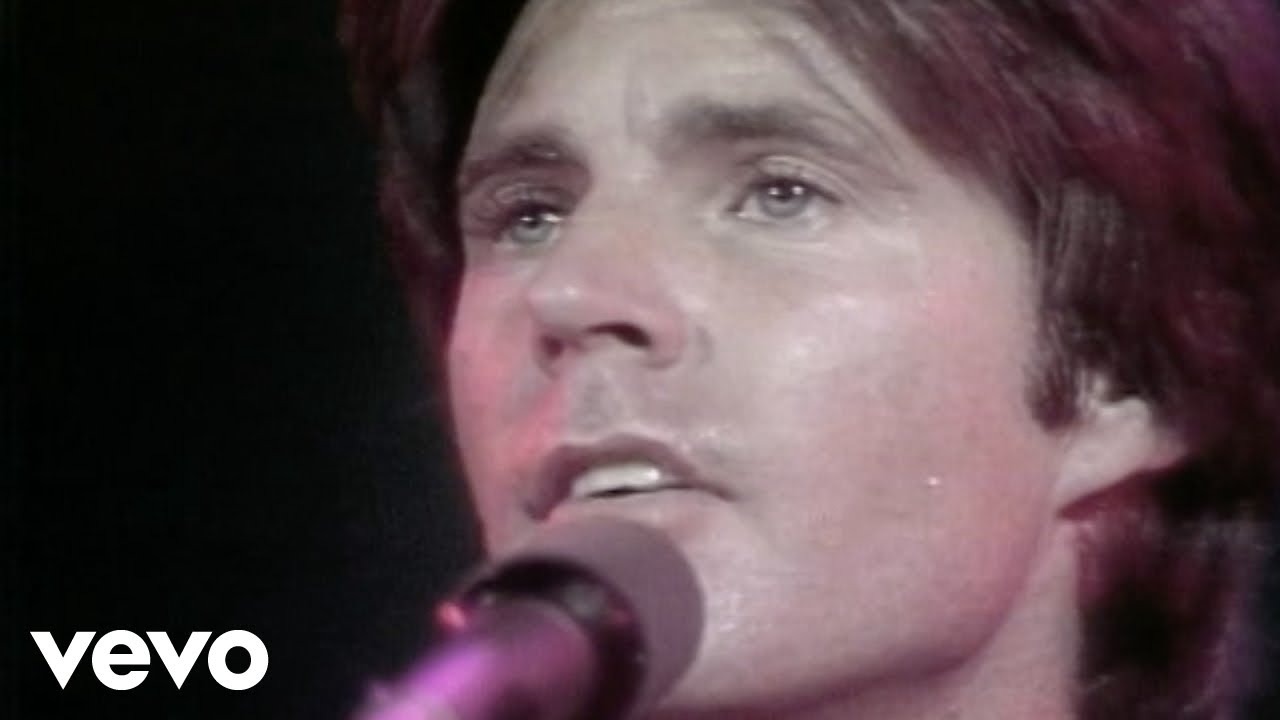
Rick Nelson – Garden Party
He Walked Onstage at Madison Square Garden in October 1971 in Bell-Bottoms, a Velvet Shirt, and Shoulder-Length Hair. The Audience Booed When He Played a New Song. He Walked Off and Never Returned for the Finale. Eight Months Later He Released a Song About the Night That Became His First Top 10 Single in Eight Years.
Rick Nelson was thirty-one years old on October 15, 1971, when he walked onto the stage of Madison Square Garden’s Felt Forum for Richard Nader’s Rock ‘n Roll Spectacular Volume VII. He had been one of the most successful teen idols of the late 1950s and early 1960s — fifty-four chart hits, thirty-two of them in the Top 40 between 1957 and 1963, the runner-up to Elvis in nearly every measure of teen-rock-era commerce. He had not had a Top 10 single since 1964, when the Beatles arrived and the entire commercial logic of his career was reorganised around a sound he was not, at the moment, making. He had been chasing a way back for eight years. He had formed the Stone Canyon Band in 1969 — including bassist Randy Meisner, who would soon co-found the Eagles — and had spent the early 1970s recording country-rock material with them, releasing two albums that did not break commercially. The October 15 concert, billed as a Rock ‘n Roll Spectacular, would put him on the same bill as Chuck Berry, Bo Diddley, Bobby Rydell, the Shirelles, the Coasters, and Gary U.S. Bonds. Nelson had agreed to the booking because Nader had renamed the franchise from “Rock ‘n Roll Revival” to “Rock ‘n Roll Spectacular,” at Nelson’s request, to avoid the impression of an oldies-circuit gig. Nelson did not see himself as a nostalgia act. He saw himself as a working country-rock songwriter who had also recorded thirty-two pop hits a decade earlier.
He walked onstage that night dressed in the contemporary fashion: bell-bottom jeans, a purple velvet shirt, cowboy boots, hair grown to his shoulders. His longtime audience — many of whom had bought his records as teenagers in the 1950s and were now in their thirties looking for the version of him they remembered — were aghast at his appearance before he had played a note. He started the set with the older material the audience had come to hear. Hello Mary Lou. Be-Bop Baby. She Belongs to Me — the Dylan cover that had been one of his more recent hits. The reception was warm. Then he switched. He moved to the piano. He played a country-rock cover of the Rolling Stones’ Honky Tonk Women — the version they had recorded as Country Honk on the previous year’s Let It Bleed, which Nelson had been performing as part of his country-rock evolution. The audience began to boo. The booing was loud enough that members of the band heard it clearly. Nelson finished the song, walked back to his guitar, played one more number to fulfil his contractual obligation, and left the stage. He did not return for the finale. He was, by his own subsequent account, deeply hurt.
What Was Actually Happening at the Back of the Hall
The Stone Canyon Band’s guitarist later told reporters that the booing, when the band investigated afterwards, had not necessarily been directed at Nelson. There had been a confrontation at the back of the room — one or two drunk audience members being escorted out by police — and the booing had been at the police, not at the stage. The full truth has never been definitively established. Some who were present that night have continued to insist Nelson was being booed for his appearance and his country-rock material. Others have insisted the booing was for the police. Concert promoter Richard Nader said in subsequent interviews: “The people that were in Madison Square Garden were not there to hear contemporary music; they were there to escape it.” Nelson, regardless of what was actually being booed, took it as personal. He never appeared at another oldies revival show. He went home to Los Angeles and, over the following months, wrote a song about the experience.
He recorded Garden Party with the Stone Canyon Band in early May 1972 at his home studio. The arrangement was the Stone Canyon Band’s signature gentle country-rock — pedal steel, acoustic guitar, harmonies, brushed drums — the sound that Glen Campbell and James Taylor had taken to mainstream commercial success the previous year and that the Eagles, with Randy Meisner soon among them, would push to its largest commercial reach in 1972 and beyond. The lyric Nelson wrote was the song’s most distinctive feature. He filled it with oblique references to other artists who had been at, or near, the Madison Square Garden bill that night. Chuck Berry: “Out stepped Johnny B. Goode.” Bo Diddley: “People came from miles around.” Yoko Ono and John Lennon: “Yoko brought her walrus.” George Harrison: “Mr. Hughes hid in Dylan’s shoes” — Harrison’s traveling alias having been “Mr. Hughes” at the time, the Dylan reference pointing to Harrison’s planned and abandoned Dylan-covers project. Nelson’s own catalogue: “I said hello to Mary Lou, she belongs to me.” The song that had caused the booing: “I sang a song about a honky-tonk.” His departure: “It was time to leave.”
The First Top 10 Hit in Eight Years
The song’s central refrain delivered the entire moral architecture of the experience in twelve words: “You can’t please everyone, so you’ve got to please yourself.” Nelson had not yet released a song that made the case for artistic independence with that much directness. The sentiment had been, in 1972, the prevailing argument that singer-songwriters had been making to their audiences across the back end of the previous decade — Bob Dylan’s electric turn, John Lennon’s primal-scream therapy, James Taylor’s confessional ballads — but Nelson’s particular contribution was that he made it without anger, without indignation, without trying to recover what he had been. He simply explained, in a country-rock arrangement with shimmering pedal steel underneath, that he was no longer going to perform a version of himself that had stopped existing.
Garden Party was released as a single in July 1972 by Decca Records, which was at that moment being absorbed into MCA. It entered the Billboard Hot 100 the week of July 23, 1972, at number ninety-nine. It climbed steadily through the summer and into the autumn. It peaked at number six on October 29, 1972, where it stayed for two weeks. It topped the Billboard Easy Listening chart for two consecutive weeks. It reached number one in Canada. It reached number six in Australia and South Africa. It became Rick Nelson’s nineteenth Top 10 single — his first since 1964, an eight-year gap that the recording industry had largely written off as the end of his commercial career. The song would be Nelson’s last Top 40 hit on the United States pop chart. He continued to record and tour through the rest of the 1970s and into the 1980s. On December 31, 1985, his leased 1944 Douglas DC-3 caught fire in mid-air over east Texas. The plane crash-landed near DeKalb. Seven passengers, including Nelson and his fiancée Helen Blair, died. The two pilots survived. He was forty-five years old. He was inducted into the Rock and Roll Hall of Fame two years later, in 1987. The song he had written about being booed at Madison Square Garden — about the moment a teen-idol career had ended and a different kind of recording career had begun — has been covered by John Fogerty with Don Henley and Timothy B. Schmit, by Dwight Yoakam in concert, and adapted by Johnny Lee as Country Party. It remains, as of 2026, one of the more cogent statements any working musician has ever made on stage about the difficulty of remaining the artist one used to be — and the relief, eventually, of no longer trying.