



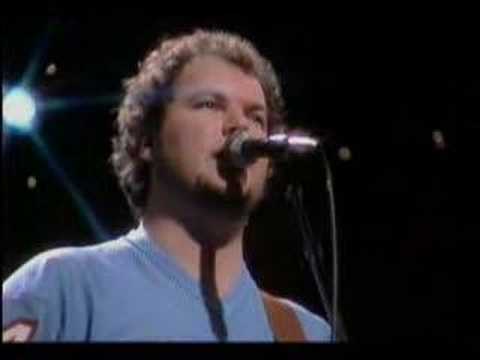










Christopher Cross – Sailing
The Song He Wrote About Escaping His Alcoholic Father’s House Won Him Four Grammys in One Night — a Sweep Nobody Repeated for Thirty-Nine Years.
The most peaceful-sounding number-one record of 1980 was, in its origins, an escape song. Sailing reads on the surface as nothing more than a meditation on a clear day, a soft wind, and a small boat — the lyric a series of perfectly arranged details that have become so synonymous with calm that the song now functions, decades after the fact, as a kind of cultural shorthand for relaxation itself. What it actually describes is the only refuge a teenage Christopher Cross had from a household run by an alcoholic father — and the older musician friend who would take him out on Canyon Lake in a small Sunfish sailboat, several hours’ drive northeast of San Antonio, to spend the day on the water and away from everything else. The serenity in the song is not a setting. It is a remembered escape.
His birth name was Christopher Charles Geppert. His father, Leo J. Geppert, was a US Army colonel and pediatrician who had served in three wars — the Second World War, Korea, and Vietnam — and went on to chair the pediatrics department at the Children’s Hospital of San Antonio. He was respected in his profession and difficult at home. The young Geppert found his refuge in two places: in the music his father played at home in his quieter hours (jazz records he played bass along to, having played professionally in college), and in his friendship with Al Glasscock, a slightly older musician who became something close to a surrogate older brother and who owned the Sunfish. Cross has spoken about both relationships across the years, including in interviews with Howard Stern and the Texas Monthly. The sailing trips were not really about sailing. They were about being elsewhere.
Two Years of Writing, Six Months of Recording, One Cleaner’s Vote
The song took Cross roughly two years to write. By the time he submitted it as part of a demo tape to Warner Bros. Records in mid-1978, he had been pursuing a record deal for the better part of the decade, fronting an Austin-based four-piece called Christopher Cross with bassist Andy Salmon, drummer Tommy Taylor, and keyboardist Rob Meurer — a band of childhood friends from San Antonio. Warner’s A&R department had repeatedly passed on Cross’s demos. The exception was Michael Omartian, a junior staff producer who had previously played session keyboards for Steely Dan and Loggins & Messina, and who heard something in the same tape his colleagues had shrugged off. Omartian convinced the room to let him sign and produce Cross. He was given his own funeral to direct, in essence, and told to make of it what he could.
What he made of it was one of the cleanest-sounding records ever cut to that point. The album was recorded over roughly six months at Amigo Studios in Burbank (which Warner Bros. would later rename Warner Bros. Studios) using the 3M Digital Recording System — making the album one of the very first commercial pop records to be cut digitally. The musicianship around Cross was elite: Don Henley, JD Souther, and Nicolette Larson on backing vocals, Michael McDonald lending his unmistakable upper register to Ride Like the Wind, and Omartian himself playing acoustic piano on most of the album. The legendary piano solo on Sailing itself was something Cross took roughly four hours to warm up to: he had not envisioned a solo at that point in the song, Omartian recorded one in a single take, and Cross hesitated. According to Omartian, Cross only finally accepted the take after asking the studio’s overnight cleaner — a man who had wandered into the control room while they were listening — what he thought of it. The cleaner liked it. The solo stayed.
The Sweep That Took Thirty-Nine Years to Equal
Released as a single in May 1980, four months after Christopher Cross had reached the public, Sailing climbed unhurriedly through the summer and reached number one on the Billboard Hot 100 the week of August 30, 1980, where it stayed for one week. It was the album’s second single, following the much more aggressive Ride Like the Wind, which had peaked at number two earlier in the spring. By the end of 1980, Cross’s debut album was multi-platinum and the basis of a Grammy nomination unlike anything the ceremony had ever seen. At the 23rd Annual Grammy Awards in February 1981, Cross became the first artist in Grammy history to sweep all four general field awards in a single ceremony — Record of the Year and Song of the Year, both for Sailing; Album of the Year, for Christopher Cross; and Best New Artist. Sailing also took Best Arrangement Accompanying Vocalist, giving the song three Grammys of its own. No artist would replicate the four-category sweep until Billie Eilish accomplished it thirty-nine years later, at the 62nd Annual Grammy Awards in 2020.
The album sold over five million copies in the United States. Cross followed it the next year with Arthur’s Theme (Best That You Can Do), written with Burt Bacharach, Carole Bayer Sager, and Peter Allen for the 1981 Dudley Moore film Arthur; that song reached number one and won the Academy Award for Best Original Song. In 2007, VH1 named Sailing the most “softsational soft rock” song of all time — a backhanded honour Cross has since had complicated feelings about, given how the entire “yacht rock” framing erased the personal weight of the song he had written. Decades on, the record remains exactly what it was: a song about needing to be somewhere else, written by a man who once needed it badly. The cultural shorthand for tranquility came out of a real shortage of it. That is the part of the song the surface never quite reveals — and the part that, once you hear it, you cannot unhear.