






![ZZ Top – Sharp Dressed Man (Official Music Video) [HD Remaster]](https://musicvideosclub.com/wp-content/uploads/2025/12/zz-top-sharp-dressed-man-officia-360x203.jpg)
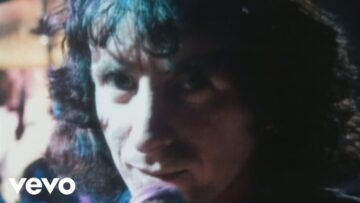
Stealers Wheel – Stuck In The Middle With You
He Wrote It as a Bob Dylan Joke at a Record Label Dinner — Then It Sold a Million Copies and He Couldn’t Believe It
Gerry Rafferty told the story of “Stuck in the Middle with You” plainly enough: in 1972, A&M Records threw a launch party in a chic restaurant in Chelsea for the newly signed Stealers Wheel. There was a large table, around fifty people — executives, their wives, musicians, hangers-on, wine flowing freely. Rafferty found himself wedged between two label executives he had nothing to say to. Two days later, he and Joe Egan sat down and wrote the song in half an hour. The clowns to the left, the jokers to the right: those were the music industry people at the table. The whole thing was structured as a parody of Bob Dylan’s lyrical paranoia and vocal delivery — the nasal pinch, the surrealist non sequiturs, the first-person bewilderment at a scene nobody else seemed to find strange. The parody was so precise that listeners assumed it was Dylan himself. Rafferty found the subsequent success of the song genuinely difficult to process. He had meant it as a joke. It sold over a million copies and defined the rest of his life.
The recording took place during sessions for Stealers Wheel’s self-titled debut album at A&M in 1972, produced by Jerry Leiber and Mike Stoller — the writing and production team behind some of the most celebrated American rock and roll recordings of the 1950s and 1960s, from “Hound Dog” to “Stand by Me.” Rafferty later told Rolling Stone that the cultural and generational distance between the Paisley-raised Scottish duo and the veteran American producers made for tense sessions: dead on two o’clock, coffee break at exactly five, finished at eight regardless of where the recording was. No room for the kind of creative drift Rafferty preferred. “There was a generation gap and a culture gap,” he said. “We didn’t share a sense of humor or much of anything.” The results on tape, he acknowledged, were good. Leiber and Stoller got the sound right. The tension simply made the sessions uncomfortable.
The debut album was released in October 1972. By the time it came out, Rafferty had already left the band — exhausted by the business, retreating to his family in Scotland, wanting out of the industry entirely. Luther Grosvenor filled in on tour. “Stuck in the Middle with You” was released as a single in April 1973 and appeared on Top of the Pops in May, with Joe Egan miming at a garishly set banquet table — clown, bowler-hatted guest eating spaghetti, lavishly dressed woman eating cream cakes — while Rafferty’s lead vocal played on the track. The slide guitar solo, played on a guitar laid flat with an empty beer bottle for a slide, appeared briefly in the performance footage. The song reached number six on the US Billboard Hot 100 and number eight on the UK Singles Chart. The single was certified gold. With the record selling well, Rafferty was persuaded to return to the band. “Baker Street,” his most celebrated solo recording, would later be written partly about the legal standoff that followed.
The Dinner That Became a Standard
The song had a specific detail lodged in its origins that Rafferty appreciated for its comic irony: the Chelsea restaurant dinner was exactly the kind of industry event the song mocked. The executives who sat on either side of him at that table were the clowns and jokers the chorus named. Stealers Wheel — a band that had already been through multiple lineup changes before releasing a note, that would go through more before breaking up in 1975, that existed in a state of near-constant internal tension — had written their most enduring song as a satire of the world they were trying to enter. The fact that radio programmers and the buying public received it without apparent awareness of the satire is the most Dylanesque element of the whole episode. Dylan’s own most cryptic songs were absorbed and loved by audiences who interpreted them as personal; Rafferty’s Dylan parody was absorbed and loved by audiences who assumed it was sincere. The irony compounded itself so thoroughly that the band eventually just let it go.
For nearly twenty years, the song lived in the softer regions of oldies radio, pleasant and familiar. Then Quentin Tarantino placed it in the torture scene of Reservoir Dogs in 1992, and everything changed again. Mr. Blonde’s ear-cutting dance to the song’s breezy, handclap-driven groove is one of the most precisely calibrated deployments of popular music in film history — the song’s amiable surface amplifying rather than deflecting the horror of what is happening on screen. Tarantino told Rolling Stone that he’d known during auditions that the song would work perfectly in that scene. Rafferty’s daughter Martha later observed that the sync requests for “Stuck in the Middle with You” now exceed those for “Baker Street” — that the song her father wrote as a half-hour throwaway joke at a Chelsea dinner has become one of the most-placed tracks in the catalogue, generating more interest than the song he laboured over as his deliberate artistic statement. Rafferty, who died of liver failure in January 2011, never quite made peace with the song’s scale. Joe Egan died in July 2024 at the age of seventy-seven.
The Performance That Preserved the Joke
The promotional video from 1973 is a document of the joke at its most literal: the banquet table, the clown with the plastic chicken, the supper guests dressed for some surrealist party that nobody sent the right invitations to. Egan mouths the words Rafferty had already sung on the record and departed to avoid singing in public again. The band plays in a corner of a large empty building, caught between two locations — the party table and the performance space — exactly as the lyric describes being caught between the clowns and the jokers. It is not quite a music video, not quite a TV performance; it is a promotional film from the moment when those things were not yet clearly defined, made for a song that was not quite a hit, not quite a parody, not quite what anyone intended. Which is precisely the condition the song had always described.